
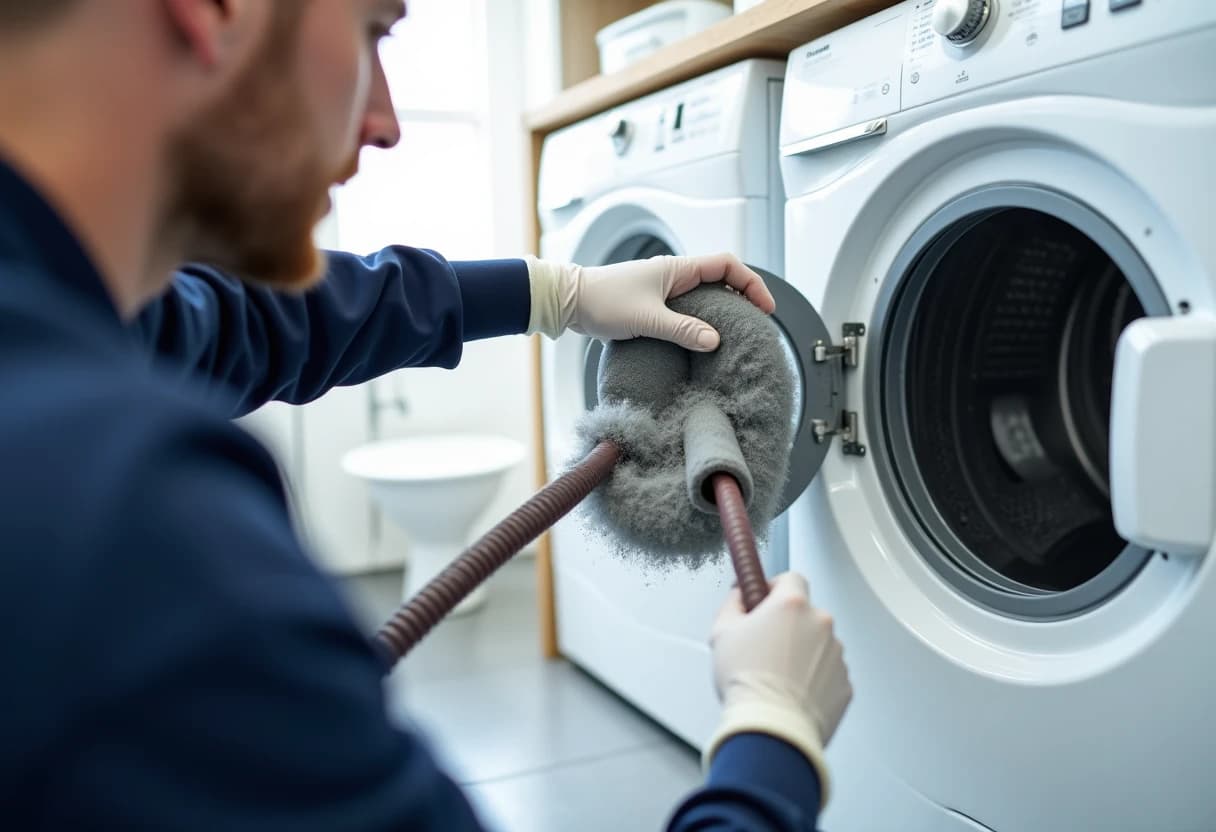
Every load of laundry sheds lint, and your dryer's lint screen catches only a fraction of it. The rest travels into the exhaust duct, where it snags on joints, elbows and screw tips and slowly packs the line shut. FEMA estimates around 2,900 home clothes dryer fires occur in the US every year, and failure to clean the vent is the leading contributing factor. Our Charlestown dryer vent cleaning service removes that hazard completely: a rotary brush scrubs the full length of the duct while a HEPA vacuum captures the lint, and we clean from both the dryer side and the exterior termination so nothing is left behind.
Why Dryer Vent Cleaning Matters for Charlestown Homes
The fire statistics on clothes dryers deserve to be taken literally. FEMA's national estimates attribute roughly 2,900 residential fires per year to clothes dryers, causing an estimated five deaths, one hundred injuries and $35 million in property loss — and the leading factor, cited in about a third of these fires, is failure to clean. The mechanism is simple: lint escapes past the screen on every cycle, accumulates in the duct, restricts airflow, and drives exhaust temperatures upward until the lint itself — which ignites easily and burns fast — meets a hot enough surface or a stray spark from the dryer's heating element. A professional cleaning breaks every link in that chain at once. It removes the fuel, restores the airflow that keeps operating temperatures in the safe range, and gives a trained technician a look at the transition duct, joints and termination where problems concentrate. For $149 to $299, it is the cheapest fire prevention a homeowner can buy, and it pays part of itself back in energy savings immediately.
Charlestown homeowners tend to discover their dryer vent problem in winter, when a marginal vent finally fails: cold-stiffened exterior dampers stick, moist exhaust meets freezing duct sections and condenses into lint cement, and holiday laundry loads push the system past its limit. Charlestown pairs some of Boston's oldest brick and clapboard rowhouses - many predating the Civil War on the slopes around Monument Square - with converted Navy Yard warehouse lofts and newer waterfront condo buildings. The rowhouses have seen generations of heating retrofits, from coal to steam to gas forced air, leaving abandoned chases and improvised duct paths behind old walls. Navy Yard conversions feature exposed industrial ductwork with huge interior surface area that shows dust plainly. Charlestown sits on a peninsula between the Mystic and Charles rivers, and that maritime humidity works its way into basements and duct systems, encouraging musty odors in the neighborhood's antique housing. In the Navy Yard lofts, the exposed spiral ductwork that gives units their character also makes accumulated dust visible to everyone at a dinner party - a surprisingly common reason we get called across the bridge. We keep winter availability across Suffolk County precisely because blocked-vent calls spike from December through February. Booking a fall cleaning is the smarter move — but whenever you call, our Charlestown route coverage means fast scheduling and a flat price that includes the full run, elbows, and the exterior termination.
Our Dryer Vent Cleaning Process in Charlestown
1Inspect the Dryer, Transition Duct & Vent Path
First we establish what we are cleaning: duct material, run length, number of bends, and termination type. We also measure baseline airflow at the exterior hood with the dryer running. That number matters — it is how we prove, at the end of the visit, that the cleaning actually restored the exhaust capacity your dryer needs.
2Protect the Laundry Area & Disconnect the Dryer
We treat laundry rooms — often tight, finished spaces — with the same care as any living area: drop cloths down, dryer walked out on protective sliders, and the work zone contained. Disconnecting at the appliance gives us a clean entry point into the duct and a chance to inspect the connection hardware that so often leaks lint into the wall cavity.
3Rotary Brush the Full Length of the Duct
Mechanical agitation is what separates professional cleaning from blow-through methods. The rotary brush physically breaks up compacted lint that air pressure alone would only compress further. We select brush heads sized to your duct — standard 4-inch for code-compliant lines, alternates for older oversized or reduced runs — so the bristles actually contact the duct wall the whole way.
4Capture Everything With HEPA Vacuum Extraction
Extraction runs continuously during brushing so debris moves in one controlled direction. On long or heavily blocked runs we alternate: brush a section, extract, advance. This staged approach clears even fully plugged ducts — the ones where the exterior damper has not opened in years — without compacting the blockage deeper.
5Clean From the Exterior Termination Inward
Cleaning from both ends is non-negotiable on longer runs. The last few feet before the termination, and the hood itself, accumulate the densest lint — it is where moist exhaust meets cold outdoor air and fibers mat together. We open the hood, clear the damper, remove nesting if present, and brush the final duct section back toward the vacuum.
6Service the Transition Duct & Reconnect
Reassembly is done to code and to the appliance manual: UL-listed transition duct, proper clamps, no more than the listed connector length, and the dryer set far enough from the wall that the duct keeps its shape. We level the machine, verify the gas connection is undisturbed on gas units, and run a test cycle before calling the mechanical work done.
7Verify Airflow & Walk You Through the Results
Final checks: test cycle run, exhaust verified at the hood, laundry area vacuumed and everything returned to place. If we found issues cleaning cannot fix — overlong runs, crushed sections, illegal materials — you get straight documentation and a separate quote, never pressure. Most vents simply need this cleaning, once a year, and nothing more.
Benefits of Professional Dryer Vent Cleaning in Charlestown
Less Moisture, Mildew & Musty Odor
Each load exhausts about a gallon of water as vapor. When the vent is blocked, that moisture backs into the laundry room and the duct itself — condensing on walls, peeling paint, and feeding mildew. A clear vent sends the humidity outside, drying out the laundry area and eliminating the damp, musty smell that clings to blocked systems.
Dramatically Reduced Fire Risk
Roughly 2,900 home dryer fires occur each year in the US, and the leading factor is simply failure to clean. An annual professional cleaning takes that statistic off your list of worries for about the cost of a dinner out. Few home services offer a clearer safety return on such a modest price.
Documentation for Insurance, Condos & Peace of Mind
For landlords and multi-family owners, documented dryer vent service is due-diligence gold: it demonstrates fire-safety maintenance across units in a single record. We service whole buildings in one visit with per-unit documentation, which is why property managers across Greater Boston keep us on an annual rotation.
Faster Drying Times
If laundry has become an all-day affair, the fix is rarely a new dryer. We regularly clean vents for customers who were quoted $1,000+ appliance replacements, and the old machine performs like new once it can breathe. Try the $149 to $299 solution before the four-figure one.
Lower Energy Bills
Every minute of unnecessary drying time is metered energy. A restricted vent that doubles cycle times roughly doubles the dryer's share of your utility bill — often $10 to $20 a month for an average household. Annual cleaning typically pays for a large fraction of itself in the first year of restored efficiency.
Safer Operation for Gas Dryers
Massachusetts homes rely heavily on natural gas, and gas dryers are common across Greater Boston's housing stock. If yours vents through a long or aging duct, annual cleaning plus an airflow check is the standard of care fire and gas utilities recommend. It takes an hour and removes an entire category of risk.
Signs Your Charlestown Home Needs Dryer Vent Cleaning
The Exterior Vent Flap Barely Opens
Lint visible around the exterior hood, on the siding or in the shrubs below means the duct is shedding overflow. Paradoxically, a completely lint-free hood on an older system can be worse news: it may mean nothing is reaching the exit at all. Either extreme warrants a cleaning and airflow check.
Clothes Take More Than One Cycle to Dry
Homeowners adapt to slow drying so gradually they stop noticing, until they use a laundromat or a friend's machine and remember what one-cycle drying feels like. If your definition of a drying cycle has quietly stretched past an hour, the vent is overdue for inspection and almost certainly for cleaning.
Burning Smell During a Cycle
A hot, singed odor while the dryer runs is lint beginning to scorch — on the heating element, in the internal ducting or in the exhaust line. It is the most serious warning sign on this list. Stop the dryer, let it cool, and do not run full loads again until the vent and machine interior have been cleaned.
Laundry Room Gets Hot and Humid
In winter, backed-up dryer moisture migrates to the coldest nearby surfaces — window frames, exterior-wall corners, basement sills — and condenses there, feeding mold New England homes already fight. If winter condensation spikes on laundry days, your vent is contributing and a cleaning will subtract it.
It Has Been More Than a Year
Households that run a load daily, dry pet bedding, or share laundry across a multi-family building accumulate lint at two to three times the average rate and should clean every six to twelve months. A quiet couple doing weekly laundry can stretch toward the annual mark, but rarely safely beyond it.
Lint Building Up Behind or Inside the Dryer
Visible lint at any joint, seam or connection is a flag worth acting on. It usually indicates positive pressure in the duct from a downstream blockage forcing air out through gaps — or a partially disconnected duct dumping exhaust into the wall cavity, which our inspection will catch.
Dryer Vent Cleaning Cost in Charlestown, MA
Dryer vent cleaning in Greater Boston typically costs $149 to $299, and the honest drivers of price are the run itself: length, number of elbows, and where it terminates. A first-floor laundry with a short straight shot to a side wall sits at the low end near $149. A basement laundry venting up and across to a second-story wall, or any roof termination, sits toward $249 to $299 because of the added access work and ladder or roof time. Severely blocked ducts that need staged extraction, nest removal from the termination, or cleaning from both ends of a very long run can add modestly, and we tell you before proceeding. What never changes: our quote covers the complete line — dryer connection to exterior hood, elbows included — plus transition duct inspection, exterior damper service and airflow verification. Beware pricing that covers 'the first six feet' with per-foot charges after; a dryer vent is only clean if all of it is clean.
Want the full pricing picture? See our complete Boston-area cost guide or call (617) 390-7145 for an exact flat quote for your Charlestown home.
Local Knowledge: Charlestown, Suffolk County
What makes Charlestown different? Charlestown pairs some of Boston's oldest brick and clapboard rowhouses - many predating the Civil War on the slopes around Monument Square - with converted Navy Yard warehouse lofts and newer waterfront condo buildings. The rowhouses have seen generations of heating retrofits, from coal to steam to gas forced air, leaving abandoned chases and improvised duct paths behind old walls. Navy Yard conversions feature exposed industrial ductwork with huge interior surface area that shows dust plainly. Charlestown sits on a peninsula between the Mystic and Charles rivers, and that maritime humidity works its way into basements and duct systems, encouraging musty odors in the neighborhood's antique housing. In the Navy Yard lofts, the exposed spiral ductwork that gives units their character also makes accumulated dust visible to everyone at a dinner party - a surprisingly common reason we get called across the bridge. For duct and dryer vent systems, those local factors translate into specific, predictable problems — and predictable problems are the ones we solve fastest. Call (617) 390-7145, tell us your street and home style, and we will quote the job accurately the first time, usually in under five minutes.
The Best Time of Year in Charlestown
New England's humid summers work on dryer vents from the other direction. High dew points mean exhaust moisture lingers in the duct instead of flashing away, and damp lint packs harder and grips duct walls tighter than dry lint ever does. Basement laundry areas — the Massachusetts default — add their own ambient humidity to the mix. By September, a vent that entered summer marginal is often matted solid. Summer is also nesting season at the other end of the line: birds and squirrels find an unscreened, warm, sheltered dryer termination irresistible, and a spring nest becomes a fall blockage. Our cleanings clear both problems and note whether your termination needs a code-compliant guard.
Why Choose Boston Air Duct Cleaners
What separates us from the coupon crowd is simple: we do the whole job, we prove it, and we charge what we quoted. Our technicians clean supplies, returns, trunks and blower compartments on every visit — never a cosmetic vent wipe. Photo documentation comes standard, pricing is flat and confirmed up front, and our trucks carry true commercial vacuum equipment, not rented shop-vacs. Based in West Newton and serving Charlestown year-round, we answer our own phone at (617) 390-7145 and stand behind every cleaning with a satisfaction guarantee.
Serving Charlestown and Surrounding Communities
We serve every community around Charlestown as well: Boston, Somerville, Everett, East Boston, Cambridge, Chelsea all fall inside our regular service routes. If you have a second property, a rental, or family nearby, ask about multi-home scheduling — grouped appointments on the same route are our most requested discount.