
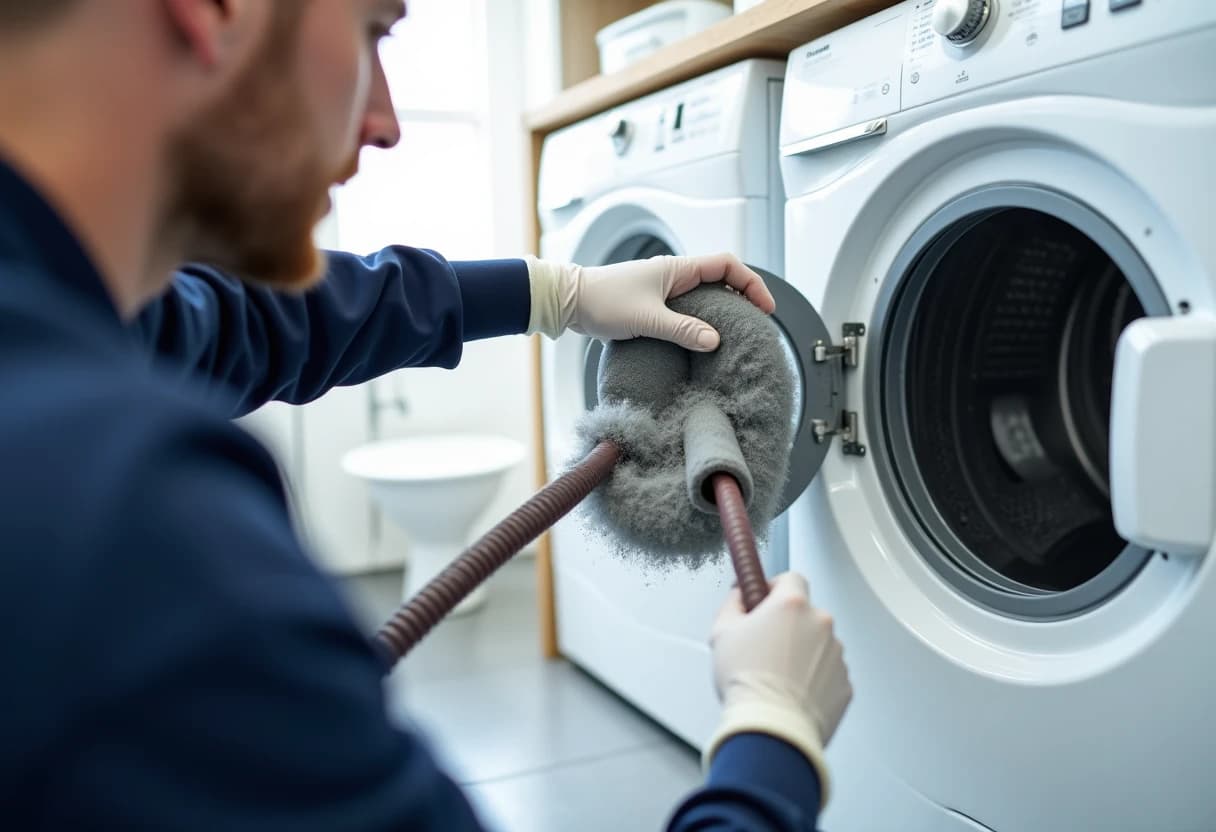
Most homeowners clean the lint screen every load and assume the job is done. But dryer manufacturers, the NFPA and the US Fire Administration all say the same thing: the vent duct itself needs professional cleaning at least once a year. Lint bypasses the screen constantly, and in Greater Boston homes — where vents commonly run twenty feet or more through basements, up wall cavities and across roofs — the accumulation happens out of sight. Our Danvers technicians use full-length rotary brushes driven through the entire run while a HEPA vacuum collects everything, then verify airflow at the termination before we leave.
Why Dryer Vent Cleaning Matters for Danvers Homes
The fire statistics on clothes dryers deserve to be taken literally. FEMA's national estimates attribute roughly 2,900 residential fires per year to clothes dryers, causing an estimated five deaths, one hundred injuries and $35 million in property loss — and the leading factor, cited in about a third of these fires, is failure to clean. The mechanism is simple: lint escapes past the screen on every cycle, accumulates in the duct, restricts airflow, and drives exhaust temperatures upward until the lint itself — which ignites easily and burns fast — meets a hot enough surface or a stray spark from the dryer's heating element. A professional cleaning breaks every link in that chain at once. It removes the fuel, restores the airflow that keeps operating temperatures in the safe range, and gives a trained technician a look at the transition duct, joints and termination where problems concentrate. For $149 to $299, it is the cheapest fire prevention a homeowner can buy, and it pays part of itself back in energy savings immediately.
From the multi-family blocks near Glen Magna Farms to the single-families out toward Rebecca Nurse Homestead, Danvers laundry setups share a common risk profile: dryers pushed far from exterior walls, vents extended during renovations, and terminations no one has looked at in years. Danvers blends genuine colonial-era survivors like the Rebecca Nurse Homestead's neighborhood with early-1900s village homes around Danvers Square and broad postwar plats of capes and ranches toward Route 1. Danversport adds waterfront homes on the Porter and Crane Rivers, and much of the mid-century stock still runs its original steel trunk-and-branch ductwork. That combination is how lint blockages build unnoticed. Tidal-river humidity in Danversport and busy traffic along the Route 1 and Route 114 retail corridors both leave their signature in local duct systems - damp-smelling returns near the water, fine road dust everywhere else. We also service many of the restaurants and shops around the Liberty Tree Mall area. Because our shop is in West Newton, about 23 miles away, we can usually offer Danvers same-week appointments — and because we clean from both the appliance side and the exterior hood, blockages at either end of the run are fully removed, not pushed deeper.
Our Dryer Vent Cleaning Process in Danvers
1Inspect the Dryer, Transition Duct & Vent Path
First we establish what we are cleaning: duct material, run length, number of bends, and termination type. We also measure baseline airflow at the exterior hood with the dryer running. That number matters — it is how we prove, at the end of the visit, that the cleaning actually restored the exhaust capacity your dryer needs.
2Protect the Laundry Area & Disconnect the Dryer
We treat laundry rooms — often tight, finished spaces — with the same care as any living area: drop cloths down, dryer walked out on protective sliders, and the work zone contained. Disconnecting at the appliance gives us a clean entry point into the duct and a chance to inspect the connection hardware that so often leaks lint into the wall cavity.
3Rotary Brush the Full Length of the Duct
Our core cleaning tool is a motor-driven rotary brush on flexible rods, fed through the entire duct run. The spinning brush head scrubs lint off the duct walls through every elbow and vertical section, in runs up to 35 feet and beyond. Unlike hand brushes, it maintains full scrubbing force at the far end of the line — where the worst accumulation usually hides.
4Capture Everything With HEPA Vacuum Extraction
As the brush works, a HEPA-filtered vacuum runs simultaneously on the duct, pulling loosened lint into a sealed collection system instead of letting it blow into your laundry room or yard. The combination — agitate and extract at once — is what leaves the duct genuinely empty rather than redistributing the clog.
5Clean From the Exterior Termination Inward
Cleaning from both ends is non-negotiable on longer runs. The last few feet before the termination, and the hood itself, accumulate the densest lint — it is where moist exhaust meets cold outdoor air and fibers mat together. We open the hood, clear the damper, remove nesting if present, and brush the final duct section back toward the vacuum.
6Service the Transition Duct & Reconnect
Reassembly is done to code and to the appliance manual: UL-listed transition duct, proper clamps, no more than the listed connector length, and the dryer set far enough from the wall that the duct keeps its shape. We level the machine, verify the gas connection is undisturbed on gas units, and run a test cycle before calling the mechanical work done.
7Verify Airflow & Walk You Through the Results
Final checks: test cycle run, exhaust verified at the hood, laundry area vacuumed and everything returned to place. If we found issues cleaning cannot fix — overlong runs, crushed sections, illegal materials — you get straight documentation and a separate quote, never pressure. Most vents simply need this cleaning, once a year, and nothing more.
Benefits of Professional Dryer Vent Cleaning in Danvers
Longer Dryer Lifespan & Fewer Repairs
Blocked vents kill dryers slowly: thermal fuses blow, heating elements burn out, belts and bearings log double hours, and moisture backing into the machine corrodes components. Appliance technicians confirm that vent restriction underlies a large share of dryer service calls. A clear vent lets the machine run within its design limits — and last accordingly.
Lower Energy Bills
Every minute of unnecessary drying time is metered energy. A restricted vent that doubles cycle times roughly doubles the dryer's share of your utility bill — often $10 to $20 a month for an average household. Annual cleaning typically pays for a large fraction of itself in the first year of restored efficiency.
Safer Operation for Gas Dryers
For gas dryers, vent cleaning is combustion safety, not just lint management. Backdrafting exhaust is odorless and invisible; the protection is a clear duct and a working CO detector. We verify complete, strong exhaust at the exterior termination on every gas dryer job — the confirmation that byproducts are leaving the house.
Less Moisture, Mildew & Musty Odor
Basement laundry areas in New England fight humidity even on good days; a restricted dryer vent turns them into swamp rooms. Post-cleaning, customers consistently report the laundry area feels drier, smells cleaner, and stops fogging windows and sweating pipes during dryer cycles.
Documentation for Insurance, Condos & Peace of Mind
The quiet benefit is simply knowing. A dryer vent is invisible infrastructure that most homeowners have never once seen inside — and after our visit, you have photos, airflow numbers and a professional's assessment on file. That certainty, renewed once a year, is worth the modest price by itself.
Dramatically Reduced Fire Risk
This is the benefit that matters most. Lint is extraordinarily flammable, and a clogged vent both supplies the fuel and creates the overheating that ignites it. Removing the accumulation removes the hazard — which is why fire departments, the NFPA and FEMA all urge annual dryer vent cleaning as basic home fire prevention.
Signs Your Danvers Home Needs Dryer Vent Cleaning
Laundry Room Gets Hot and Humid
In winter, backed-up dryer moisture migrates to the coldest nearby surfaces — window frames, exterior-wall corners, basement sills — and condenses there, feeding mold New England homes already fight. If winter condensation spikes on laundry days, your vent is contributing and a cleaning will subtract it.
Lint Building Up Behind or Inside the Dryer
Visible lint at any joint, seam or connection is a flag worth acting on. It usually indicates positive pressure in the duct from a downstream blockage forcing air out through gaps — or a partially disconnected duct dumping exhaust into the wall cavity, which our inspection will catch.
The Exterior Vent Flap Barely Opens
Lint visible around the exterior hood, on the siding or in the shrubs below means the duct is shedding overflow. Paradoxically, a completely lint-free hood on an older system can be worse news: it may mean nothing is reaching the exit at all. Either extreme warrants a cleaning and airflow check.
Burning Smell During a Cycle
Never normalize a burning odor from a dryer. Investigators repeatedly find that households smelled scorching lint for weeks before an ignition. A cleaning visit resolves the source in about an hour and includes vacuuming the dryer's internal lint paths near the element — where the smell most often starts.
It Has Been More Than a Year
The NFPA, FEMA and every major dryer manufacturer converge on the same guidance: professional vent cleaning at least annually, more often for heavy use. If you cannot remember your last cleaning — or know there has never been one — the schedule alone says you are due, whatever the symptoms.
Clothes Take More Than One Cycle to Dry
The single most reliable symptom. A healthy dryer dries a standard load in 35 to 50 minutes; when towels need a second cycle or jeans come out damp at the waistband, exhaust airflow has dropped. The dryer has not gotten weaker — the vent has gotten narrower. Cleaning restores the original performance in one visit.
Dryer Vent Cleaning Cost in Danvers, MA
For budgeting across property types: single-family homes run $149 to $299 as described; condos are usually $149 to $199 unless the unit vents to the roof; and multi-family buildings get per-unit rates that drop meaningfully when we clean all units in one visit — the arrangement most triple-decker owners and condo associations choose, both for cost and for the single insurance-ready service record covering the building. Commercial laundry and shared-venting systems are quoted after a walkthrough. Frequency matters to lifetime cost too: an annual cleaning is quick and inexpensive because accumulation is light, while a vent neglected for five years often needs blockage-level work at the top of the range, and sometimes reveals damage requiring repair. The cheapest way to own a dryer vent, year over year, is to clean it on schedule — which is why we log your service date and send a reminder when the next one is due.
Want the full pricing picture? See our complete Boston-area cost guide or call (617) 390-7145 for an exact flat quote for your Danvers home.
Local Knowledge: Danvers, Essex County
What makes Danvers different? Danvers blends genuine colonial-era survivors like the Rebecca Nurse Homestead's neighborhood with early-1900s village homes around Danvers Square and broad postwar plats of capes and ranches toward Route 1. Danversport adds waterfront homes on the Porter and Crane Rivers, and much of the mid-century stock still runs its original steel trunk-and-branch ductwork. Tidal-river humidity in Danversport and busy traffic along the Route 1 and Route 114 retail corridors both leave their signature in local duct systems - damp-smelling returns near the water, fine road dust everywhere else. We also service many of the restaurants and shops around the Liberty Tree Mall area. For duct and dryer vent systems, those local factors translate into specific, predictable problems — and predictable problems are the ones we solve fastest. Call (617) 390-7145, tell us your street and home style, and we will quote the job accurately the first time, usually in under five minutes.
The Best Time of Year in Danvers
Fall is the strategic season for dryer vent cleaning in Massachusetts, and not only because winter laundry is coming. Fall is when heating systems seal the house — windows shut, mechanical ventilation doing all the work — which raises the stakes on any appliance that exhausts into, rather than out of, the building envelope. A restricted or leaking dryer vent in a closed-up house pushes moisture and, for gas dryers, combustion byproducts into air that will not be refreshed until April. An October cleaning means the vent enters the closed-window months verified clear, the damper moves freely before the first freeze, and holiday-season laundry marathons run on full airflow.
Why Choose Boston Air Duct Cleaners
As a West Newton-based company, we treat Danvers like the neighborhood it is — because for us, it is. Our reputation lives or dies on local referrals, so every job gets the full process: complete system cleaning under negative pressure, mechanical agitation of every run, blower compartment service, and a documented walkthrough before we leave. We are licensed and insured, our estimates are free and flat, and our schedule holds same-day slots for urgent calls. One visit and you will understand why neighbors keep our magnet on the fridge.
Serving Danvers and Surrounding Communities
Danvers sits in the heart of our service area, and neighboring Peabody, Beverly, Middleton, Topsfield, Salem, Wenham appointments share the same routes. That density is why our response times in this part of Essex County are among our fastest — and why you will see our trucks in the area week after week.