
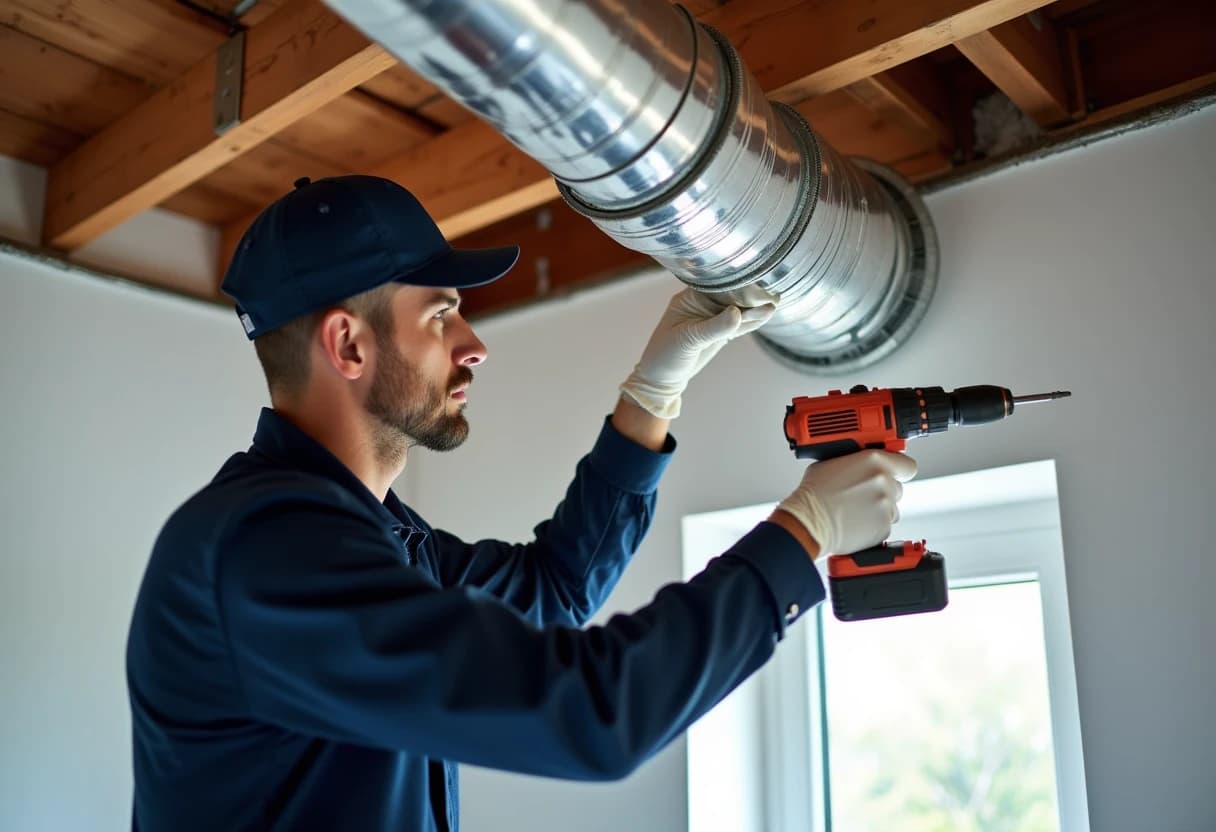
The building code is specific about dryer venting for a reason written in fire statistics: the IRC's dryer exhaust rules (Section M1502) call for smooth-interior rigid metal duct, a 4-inch diameter, a maximum equivalent length of 35 feet with deductions for every elbow, no fasteners protruding into the airstream, and a termination with a backdraft damper and no screen. Most Greater Boston homes fail several of those tests, because their vents were improvised generations ago. Our installation service brings your Danvers laundry up to that standard — a new route where the old one is hopeless, rigid metal end to end, and documentation that satisfies inspectors, insurers and condo boards.
Why Dryer Vent Installation & Rerouting Matters for Danvers Homes
There is also a straightforward performance and cost case. A dryer on a proper vent dries a standard load in one cycle; on a bad vent, in two — doubling energy per load, roughly $10 to $20 a month for a busy household, while heat-cycling the machine toward early component failure. A rigid, correctly sloped, correctly sized system also changes the maintenance economics: annual cleanings on smooth duct are quick and thorough, blockage-level service calls largely disappear, and appliance repairs caused by backpressure — thermal fuses, elements, high-limit switches — stop recurring. Add the avoided moisture damage (each load carries about a gallon of water that either exits the termination or enters your building assemblies) and the installation typically pays a real fraction of its cost back within a couple of years, then keeps paying. For homes about to sell, documented code-compliant venting removes a standard inspection flag before it costs a negotiation. For homes about to install a new dryer, it protects the warranty, which manufacturers condition on adequate exhaust. Either way, it is infrastructure bought once and used every laundry day for decades.
Condo and multi-family installation around Rebecca Nurse Homestead is its own discipline, and Danvers associations know the stakes: one bad vent in a shared structure is everyone's fire risk. Danvers blends genuine colonial-era survivors like the Rebecca Nurse Homestead's neighborhood with early-1900s village homes around Danvers Square and broad postwar plats of capes and ranches toward Route 1. Danversport adds waterfront homes on the Porter and Crane Rivers, and much of the mid-century stock still runs its original steel trunk-and-branch ductwork. We manage the full process — written scopes for board approval, certificates of insurance, penetrations planned with the building envelope and neighboring units in mind, and per-unit documentation on completion. Tidal-river humidity in Danversport and busy traffic along the Route 1 and Route 114 retail corridors both leave their signature in local duct systems - damp-smelling returns near the water, fine road dust everywhere else. We also service many of the restaurants and shops around the Liberty Tree Mall area. For triple-deckers and small associations we can rough in venting for multiple units in one mobilization, which cuts per-unit cost substantially and gives the building one consistent, compliant system.
Our Dryer Vent Installation & Rerouting Process in Danvers
1Site Assessment & Route Planning
The technician maps what exists and what is possible: where the dryer sits (or will sit), which walls are exterior, what the framing and foundation allow, and where obstacles — plumbing, wiring, ductwork, finished ceilings — constrain the path. Shortest is best: fewer feet and fewer elbows mean faster drying and slower lint accumulation for the life of the system.
2Demolition of Non-Compliant Venting
Replacement jobs start with removing what failed: vinyl and foil flex pulled from cavities and joist bays, abandoned duct capped or extracted, screened hoods and window inserts taken out, and improvised terminations into attics or crawlspaces closed off. We vacuum the lint these systems have shed along their routes — hidden accumulation that should not stay in the structure.
3Cut & Flash the Exterior Penetration
Penetrations are where amateur installs leak — water into sheathing, air into cavities. Ours are built like window details: sized to the hood, flashed to shed water over the cladding, sealed with quality exterior sealant, and finished so the termination looks intentional on the facade. On masonry we drill and anchor; we never improvise attachment.
4Install Rigid Metal Duct on the Planned Route
Support and slope are built in as we go: hangers and strapping at proper intervals so no section can sag into a condensation belly, and a continuous pitch toward the termination so any moisture that does condense drains outdoors instead of pooling. These details are invisible when the job is done and decisive for how the system ages.
5Mount the Termination Hood & Damper
Where pests are a known pressure — and in Greater Boston they are — we fit guard designs engineered for dryer exhaust: excluding birds and rodents without restricting airflow or trapping lint. We also note the hood in your service record so future cleanings include damper checks, keeping the one wear-prone component watched for the system's life.
6Connect the Appliance & Seal the System
System sealing is completed end to end: every joint taped with UL-listed foil tape, the wall penetration sealed inside and out, and the transition clamped tight. A dryer vent is a pressure system; leaks anywhere cost airflow at the termination and push lint and moisture into places they do not belong. Sealed means sealed everywhere.
7Test, Verify & Document the Installation
Before we leave: work areas vacuumed with HEPA equipment, penetration debris removed, the dryer set and leveled, and a walkthrough of the finished system — where it runs, how the damper should look during a cycle, and when the first annual cleaning is due. A correctly built vent needs almost nothing from you; we make sure you know the little it does.
Benefits of Professional Dryer Vent Installation & Rerouting in Danvers
Moisture Managed, Structure Protected
For basement laundries — the Massachusetts default — proper installation is the difference between a dry basement and a damp one. Vents that dump into crawlspaces, leak at joints or condense in cold runs feed exactly the humidity and mold problems New England basements already fight; a correct rim-joist installation removes the dryer from that fight entirely.
Code Compliance That Closes Every Question
Compliance has practical teeth in transactions: dryer venting is among the most commonly flagged items in Massachusetts home inspections, and an improvised system becomes a negotiation item or a closing repair. A documented compliant installation converts that liability into a selling point — visible evidence of a well-maintained house.
Dramatically Faster Drying
Every elbow removed and every foot shortened is resistance the dryer no longer fights on every load, forever. The performance gain is not subtle on bad systems — 30 to 50 percent cycle-time reductions are common when we replace overlong flex runs — and unlike an appliance upgrade, it benefits every dryer the laundry will ever have.
Decades of Service From a One-Day Job
Because we also clean and repair dryer vents across Greater Boston, we install with the next twenty years of maintenance in mind — routes our own brushes can traverse, access preserved where it matters, baselines recorded for future verification. We build systems we expect to service ourselves, and it shows in the choices.
Fire-Safe by Design, Not by Vigilance
A code-compliant installation attacks fire risk structurally: smooth rigid metal that lint slides across instead of catching on, a run short enough that exhaust velocity carries fibers all the way out, joints without screw tips to snag them, and a termination that cannot mat over. The system accumulates fuel slowly by design — safety that does not depend on anyone remembering anything.
A Laundry Located Where You Actually Want It
Relocation also fixes inherited mistakes: many Danvers-area laundries sit where a previous owner could most easily improvise a vent, not where the household actually wants to do laundry. Once the exhaust is treated as a designed system, the laundry can finally move to where life happens.
Signs Your Danvers Home Needs Dryer Vent Installation & Rerouting
Inspection, Insurance or Association Requirements
Appliance warranties add quiet pressure: manufacturers condition coverage on adequate exhaust, and a warranty claim on a dryer connected to a non-compliant vent can be denied on that basis. If you are buying a premium machine, the few hundred dollars of proper venting is also warranty insurance.
The Dryer Vents Indoors — Anywhere
Window inserts and condensation boxes marketed as 'indoor dryer vents' are not a solution for a standard vented dryer in a Massachusetts home; they are humidity machines. If one is in service in your laundry, a proper exterior route almost certainly exists — our assessment will find the shortest one and price it flat.
Blockages and Repairs Keep Recurring
The tell is the fade: a fresh cleaning helps for a few weeks, then performance sags again as lint resettles in the same flex ridges and dead-air corners. Well-designed systems hold their cleaning for a full year. If yours cannot, stop paying to maintain the flaw and price the fix.
The Run Is Overlong or Elbow-Heavy
Count the route: if your duct wanders more than roughly 25 linear feet, or turns more than three corners, it is likely past the code's 35-foot equivalent-length budget once elbows are deducted — typically five feet per 90-degree bend. Beyond the budget, the dryer physically cannot keep lint moving to the outlet, and chronic clogging is built in.
Your Vent Is Flexible Plastic or Foil Duct
A quick self-check: press gently on the visible duct. Rigid metal does not give; flex crumples. If any concealed portion of your run is flex, assume the hidden sections are in worse shape than the visible ones — they always are — and price the replacement before the blockage schedule prices it for you.
A New Laundry Location Needs Its First Vent
Moving laundry upstairs, finishing a basement, building an in-law suite or converting a condo all create the same requirement: a new exhaust route, designed before the walls close if at all possible. Vent routing decided at the framing stage is shorter, cheaper and cleaner than the same route retrofitted through finished surfaces months later.
Dryer Vent Installation & Rerouting Cost in Danvers, MA
Rerouting deserves its own cost frame, because its value is measured against the run it replaces. Shortening a 40-foot flex wander to a 12-foot rigid route typically costs $500 to $900 — and permanently removes the conditions that were costing you money continuously: second drying cycles (roughly $10 to $20 a month in energy for a busy household), twice-yearly cleanings instead of annual, recurring blockage calls, and the appliance repairs that backpressure schedules (thermal fuses and elements at $150 to $400 a visit). Most households with genuinely bad routes recover the rerouting cost within two to three years through those avoided expenses, then keep the savings for decades. There is also the risk column, harder to price but real: overlong flex runs are heavily represented in the roughly 2,900 annual US dryer fires, and their moisture leakage feeds mold remediation bills that start around $1,500. When we quote a reroute, we show you this math against your actual route — some marginal systems are worth keeping and maintaining, and we say so when they are.
Want the full pricing picture? See our complete Boston-area cost guide or call (617) 390-7145 for an exact flat quote for your Danvers home.
Local Knowledge: Danvers, Essex County
Every town's ductwork tells the story of its housing. Danvers blends genuine colonial-era survivors like the Rebecca Nurse Homestead's neighborhood with early-1900s village homes around Danvers Square and broad postwar plats of capes and ranches toward Route 1. Danversport adds waterfront homes on the Porter and Crane Rivers, and much of the mid-century stock still runs its original steel trunk-and-branch ductwork. Tidal-river humidity in Danversport and busy traffic along the Route 1 and Route 114 retail corridors both leave their signature in local duct systems - damp-smelling returns near the water, fine road dust everywhere else. We also service many of the restaurants and shops around the Liberty Tree Mall area. We plan Danvers jobs around those realities, from equipment selection to time on site, and it shows in the results. If you live near Endicott Park or anywhere across Danvers's 01923 area, we have almost certainly cleaned a system like yours before — and we can tell you exactly what to expect before we arrive.
The Best Time of Year in Danvers
Renovation season drives our installation rhythm as much as weather does. Greater Boston remodels from spring through fall — basements finished, laundries moved upstairs, triple-deckers converted to condos — and every one of those projects needs dryer exhaust designed rather than improvised. The economics of timing are stark: venting planned at framing stage routes shorter, conceals cleaner and costs $200 to $400 less than the same run retrofitted after drywall. We take planning calls from homeowners and contractors all season, often walking a route in fifteen minutes that saves the project real money and the homeowner a decade of compromise. If your project touches the laundry — or could move it somewhere better — the cheapest vent you will ever build is the one designed before the walls close.
Why Choose Boston Air Duct Cleaners
Homeowners across Essex County choose Boston Air Duct Cleaners for three reasons. First, honesty: our inspection camera tells you whether your system actually needs cleaning — and sometimes the answer is no. Second, capability: truck-grade negative-air machines, rotary brush systems and HEPA filtration handle everything from antique gravity-furnace conversions to brand-new high-velocity systems. Third, accountability: flat quoted pricing, before-and-after photos, insured technicians, and a real local office you can call at (617) 390-7145. That combination is rarer in this industry than it should be.
Serving Danvers and Surrounding Communities
We serve every community around Danvers as well: Peabody, Beverly, Middleton, Topsfield, Salem, Wenham all fall inside our regular service routes. If you have a second property, a rental, or family nearby, ask about multi-home scheduling — grouped appointments on the same route are our most requested discount.