
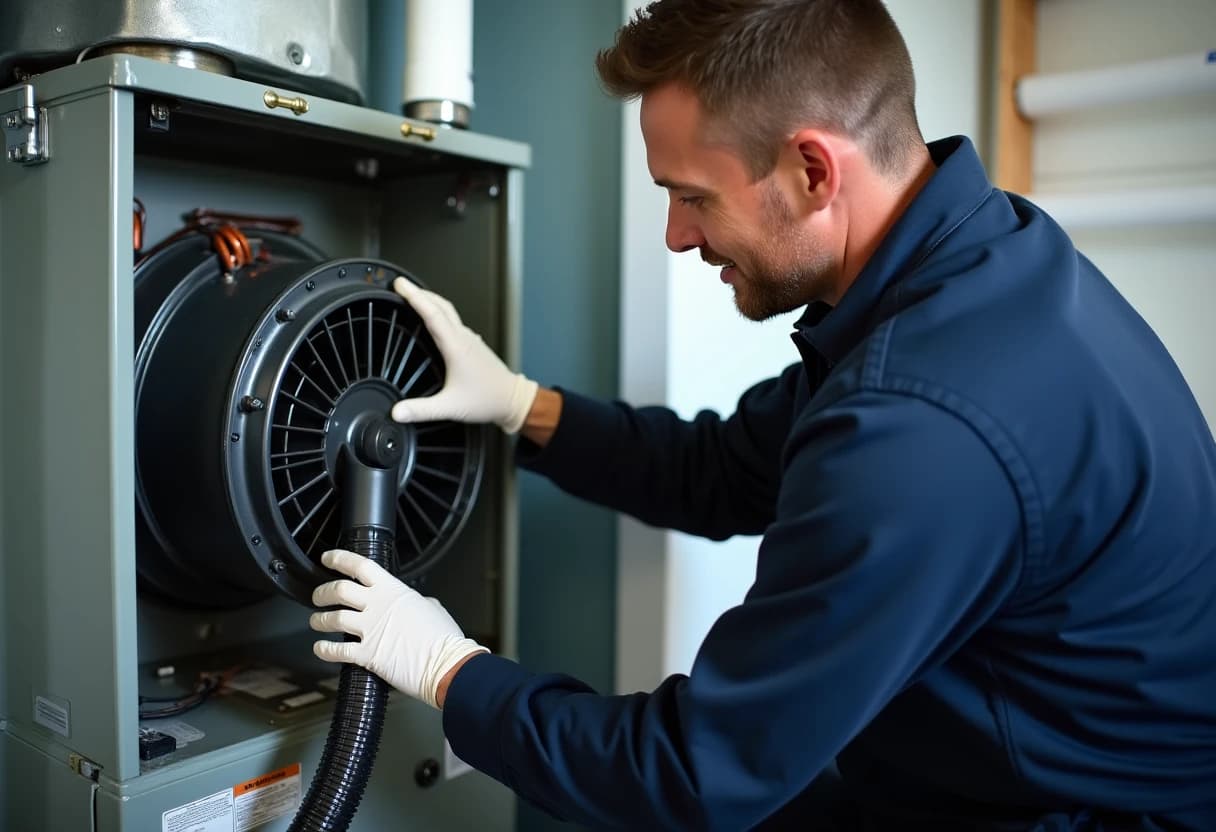
There is a reason 'we just had the ducts cleaned, why is the air still weak?' is a call we receive from homes other companies serviced: the ducts are only half the air path. The blower wheel alone, when matted with dust, can lose a startling share of its moving capacity, and the Department of Energy notes that a dirty coil measurably degrades cooling efficiency. Our HVAC system cleaning in East Boston covers the whole path — ductwork, plenums, blower, coil, cabinet — because cleaning any one piece while skipping the rest guarantees rapid recontamination and leaves the efficiency losses in place. It is the version of this service that actually shows up on your utility bill, and the one we believe every home should be quoted first.
Why HVAC System Cleaning Matters for East Boston Homes
The air side of an HVAC system fouls as a circuit, and it must be cleaned as one. Return ducts inhale household dust and deliver it to the blower; the blower drives it through the coil, where the wet fin surfaces trap a share of everything passing; the rest coats the supply plenum and duct runs on its way to the rooms, which shed it back toward the returns. Clean any single stage and the others reseed it — a fresh blower behind dirty returns is matted again within a season, and pristine ducts fed by a fouled blower gray out just as fast. That is the engineering case for whole-system cleaning, and it is also the economics: mobilization, system sealing and negative-pressure setup are the expensive parts of the visit, so cleaning the equipment while the system is already open costs far less than a second appointment ever would. NADCA's cleaning standard reflects the same logic — it defines HVAC cleaning as the full air-conveyance system, components included, precisely because partial cleanings produce temporary results.
Ask anyone maintaining an older home near LoPresti Park: East Boston basements are hard on mechanical equipment. East Boston's streets are lined with tightly packed triple-deckers and brick rowhouses from the immigrant boom of the early 1900s, now joined by a fast-growing waterfront of new condo buildings along the harbor at Jeffries Point and Clippership Wharf. The old stock carries the usual retrofit story - radiator-era buildings with forced air added unit by unit - while the new waterfront buildings use heat pumps and ERV systems whose compact ductwork still needs regular cleaning. Basements sit low and damp this close to the harbor. Eastie homes deal with a distinctive air mix: salt-laden harbor humidity, jet exhaust and particulates from Logan's runways, and dust from a decade of waterfront construction. Many residents keep windows closed under the flight paths, which makes the condition of the ductwork matter even more since the HVAC system handles nearly all air turnover. Corroded exterior vent hoods from the salt air are something we replace here routinely. Dust and humidity from below-grade spaces load the return side continuously, and the blower and coil absorb what the filter misses — year after unopened year. Our HVAC system cleaning addresses the whole circuit at once, and in East Boston housing stock the difference between duct-only and whole-system work is not subtle: the equipment is where the worst accumulation lives.
Our HVAC System Cleaning Process in East Boston
1Full System Inspection & Airflow Baseline
The baseline matters because this service promises measurable results. We record starting conditions — equipment buildup, duct interiors, airflow strength at the weakest registers — so the after-photos and the final walkthrough demonstrate recovery rather than assert it. Systems with issues cleaning cannot fix, like failed dampers or crushed runs, get flagged now, in writing, before work begins.
2Protection, Sealing & Negative Pressure
The system becomes a closed circuit before anything gets agitated: sealed openings, depressurized trunks, HEPA-filtered collection. This setup is what separates source removal from dust redistribution, and it protects the equipment work too — debris loosened in the ducts flows to the vacuum rather than settling into the freshly opened blower compartment downstream.
3Complete Duct Network Cleaning
Under negative pressure, every run gets individually agitated: rotary brushes sized to each duct scrub the walls while compressed-air whips chase debris from the register end back toward the vacuum. Supplies, returns, vertical risers and both main trunks are cleaned in sequence — no run skipped, with repeat passes wherever camera checks show buildup remaining.
4Blower Wheel & Motor Compartment Detailing
The blower assembly gets restoration-grade attention: wheel removed where design allows or detailed in place, blades cleared of the compacted felt that steals airflow, motor housing vacuumed and wiped, and the compartment HEPA-cleaned to bare metal. A clean wheel moves dramatically more air — this single component is where most of the felt recovery lives.
5Evaporator Coil Cleaning
The coil is the system's radiator and its biggest hidden airflow chokepoint — fins spaced tighter than a millimeter apart trap fine dust that filters miss, and the wet cooling-season surface glues it in place. We clean the coil face and fins with methods matched to buildup severity, restoring the heat transfer and airflow the Department of Energy identifies as central to system efficiency.
6Cabinet, Plenums & Condensate Service
Plenums collect the heaviest drifts in many systems — every airstream in the house passes through them — and they are routinely skipped by duct-only services because access takes cabinet work. We clean both, plus the cabinet interior, the filter rack and its sealing surfaces, and the condensate path, so the equipment core matches the freshly cleaned network around it.
7Fresh Filter, Reassembly & Verified Results
Reassembly is checklist-driven: panels sealed properly so the blower compartment holds no bypass leaks, filter seated with no gaps, registers remounted, thermostat restored, work areas HEPA-vacuumed. Then verification — strong, clean-smelling airflow at every register, quieter operation, and photo documentation matched shot-for-shot to the pre-cleaning set.
Benefits of Professional HVAC System Cleaning in East Boston
One Visit, Complete Documentation
Bundling ducts and equipment into one appointment beats the piecemeal alternative on every axis: one mobilization cost instead of two, one afternoon of access instead of several, and no gap period where the uncleaned half recontaminates the cleaned one. The flat system price runs well below the summed cost of duct cleaning, coil service and blower work booked separately.
Lower Energy Bills, Month After Month
A clean air side moves more air per watt and exchanges more heat per cycle — the Department of Energy points to dirty coils and blowers as core efficiency drains, and Massachusetts energy prices make the recovery unusually valuable here. Customers with visibly fouled systems routinely see the difference in the next bill, and the savings recur every month the system runs.
Cleaner Air From a Cleaner Machine
The equipment matters to air quality more than the ducts do, per square inch: the coil and pan stay damp all cooling season, hosting the biology behind musty odors, while the blower sheds its buildup into the airstream continuously. Cleaning ducts around contaminated equipment leaves the worst sources running; cleaning the whole system actually finishes the job.
Years Added to Equipment Life
Heat is the enemy of mechanical equipment, and dirt manufactures heat: insulated coils, blanketed motors, restricted exchangers all run hotter than design. Every degree accelerates wear on windings, bearings, igniters and boards. A clean air side is thermal relief for the whole machine — the difference, over a decade, between a system that retires on schedule and one that fails in a January cold snap.
Airflow Restored to Design Capacity
Airflow is the product your HVAC system exists to deliver, and dust taxes it at every stage — matted blower blades, blanketed coil fins, narrowed duct runs. Whole-system cleaning refunds the tax in full. The most common customer report after our visits: rooms that had not heated or cooled properly in years suddenly behave, with no equipment replaced and nothing adjusted but cleanliness.
Cooling That Keeps Up in July
The 'AC just can't keep up anymore' complaint usually is not an undersized or dying system — it is a fouled one. Buildup on the coil and blower can rob a meaningful share of delivered cooling, precisely the margin between comfortable and miserable on a 92-degree day. Whole-system cleaning recovers the margin, typically for a tenth the cost of the replacement being contemplated.
Signs Your East Boston Home Needs HVAC System Cleaning
Visible Buildup on the Blower or Around the Air Handler
Check the filter's service history as a proxy: filters that load with dust unusually fast indicate a heavy circulating burden, and filters that were skipped for long stretches guarantee the equipment downstream absorbed the difference. Either pattern — fast-loading or long-neglected — predicts exactly what we find when the cabinet opens.
Weak Airflow at Some or All Registers
Weak flow paired with a system that sounds like it is working hard — motor droning, air whistling at returns — is restriction announcing itself twice. The fan is fighting elevated static pressure and losing. Filters get checked first, and should be; when a fresh filter does not restore the registers, the buildup is deeper in the circuit and needs mechanical removal.
Energy Bills Creeping Up Year Over Year
If usage climbs while rates and habits hold steady, your system is paying an efficiency tax somewhere — and the air side is the usual collector. Fouled blowers and coils force longer runtimes for the same comfort, and the loss compounds annually as buildup grows. A bill trending wrong across two or three seasons is a cleaning inspection's strongest referral.
AC Struggling, Icing, or Running Nonstop
Ice on the refrigerant lines or coil is a stop-what-you-are-doing symptom: a restricted, dirty airflow path is letting the coil run below freezing, and continued operation risks the compressor — the most expensive component in the system. Shut the system down and get the air side inspected; in a large share of icing cases, cleaning is the entire cure.
Uneven Rooms, Noisy Cycles, Dust Everywhere
Fast-returning household dust means the system is redistributing a stored reservoir — and in a fouled system, the ducts, blower and cabinet all contribute. Cleaning only the ducts leaves the equipment share circulating. If a previous duct cleaning disappointed on the dust front, the blower wheel and plenums are usually the reason, and the whole-system version is the fix.
Burnt-Dust Smell at Furnace Startup
The acrid smell when the heat first fires each fall is accumulation cooking off the heat exchanger, plenums and duct surfaces — a direct sensory report of what the system carries. A faint note that clears in an hour is common; a strong smell recurring for days, or returning at every cold-snap restart, indicates a load worth removing before the season.
HVAC System Cleaning Cost in East Boston, MA
Three questions determine your number. First, how many runs and zones? System size is the base driver, same as any duct cleaning. Second, what equipment, and where? A standard basement furnace with an accessible A-coil is the baseline; attic air handlers, closet units in condos, and coils buried behind refrigerant plumbing add access time that honest quotes price in advance. Third, when was anything last cleaned? First-time cleanings of decade-plus systems carry the heaviest buildup and sit higher in the range; maintenance cleanings of previously serviced systems run quicker and cheaper — one reason the three-to-five-year cycle costs less over time than the wait-until-symptoms approach. Across Suffolk County, typical outcomes: $450–$600 for compact systems, $600–$750 for average homes, $750–$900 for large ones. Two honest caveats: coils fouled beyond in-place cleaning methods occasionally need an HVAC tech's pull-and-clean, which we flag rather than fake; and duct repairs are always a separate, approved line — cleaning quotes that quietly absorb repair work are hiding the cost somewhere.
Want the full pricing picture? See our complete Boston-area cost guide or call (617) 390-7145 for an exact flat quote for your East Boston home.
Local Knowledge: East Boston, Suffolk County
Serving East Boston means knowing East Boston. East Boston's streets are lined with tightly packed triple-deckers and brick rowhouses from the immigrant boom of the early 1900s, now joined by a fast-growing waterfront of new condo buildings along the harbor at Jeffries Point and Clippership Wharf. The old stock carries the usual retrofit story - radiator-era buildings with forced air added unit by unit - while the new waterfront buildings use heat pumps and ERV systems whose compact ductwork still needs regular cleaning. Basements sit low and damp this close to the harbor. Eastie homes deal with a distinctive air mix: salt-laden harbor humidity, jet exhaust and particulates from Logan's runways, and dust from a decade of waterfront construction. Many residents keep windows closed under the flight paths, which makes the condition of the ductwork matter even more since the HVAC system handles nearly all air turnover. Corroded exterior vent hoods from the salt air are something we replace here routinely. Those conditions shape how we work here: which brush heads come off the truck, how we protect finishes in older interiors, and what we expect to find when the camera goes into a 02128 duct system. Our crews are in and around East Boston nearly every week — often for neighbors of past customers — so scheduling is fast and our arrival windows hold.
The Best Time of Year in East Boston
The Massachusetts HVAC calendar has two brutal seasons and two smart ones. Heating runs October into April — six-plus months of near-daily blower duty that both demands a clean air side and rebuilds buildup steadily. Cooling now brings genuine heat waves and weeks of tropical humidity that expose every fouled coil in the region. The smart seasons are the shoulders: a late-summer or early-fall cleaning hands the furnace a clean system for its half-year marathon and eliminates the October burnt-dust startup entirely, while a spring cleaning restores full coil capacity before the first heat wave finds the systems that cannot keep up. Book the shoulder ahead of your harder season — for most households, that means fall — and the cleaning earns its price across the entire season that follows.
Why Choose Boston Air Duct Cleaners
Homeowners across Suffolk County choose Boston Air Duct Cleaners for three reasons. First, honesty: our inspection camera tells you whether your system actually needs cleaning — and sometimes the answer is no. Second, capability: truck-grade negative-air machines, rotary brush systems and HEPA filtration handle everything from antique gravity-furnace conversions to brand-new high-velocity systems. Third, accountability: flat quoted pricing, before-and-after photos, insured technicians, and a real local office you can call at (617) 390-7145. That combination is rarer in this industry than it should be.
Serving East Boston and Surrounding Communities
We serve every community around East Boston as well: Winthrop, Revere, Chelsea, Charlestown, Boston, Everett all fall inside our regular service routes. If you have a second property, a rental, or family nearby, ask about multi-home scheduling — grouped appointments on the same route are our most requested discount.