
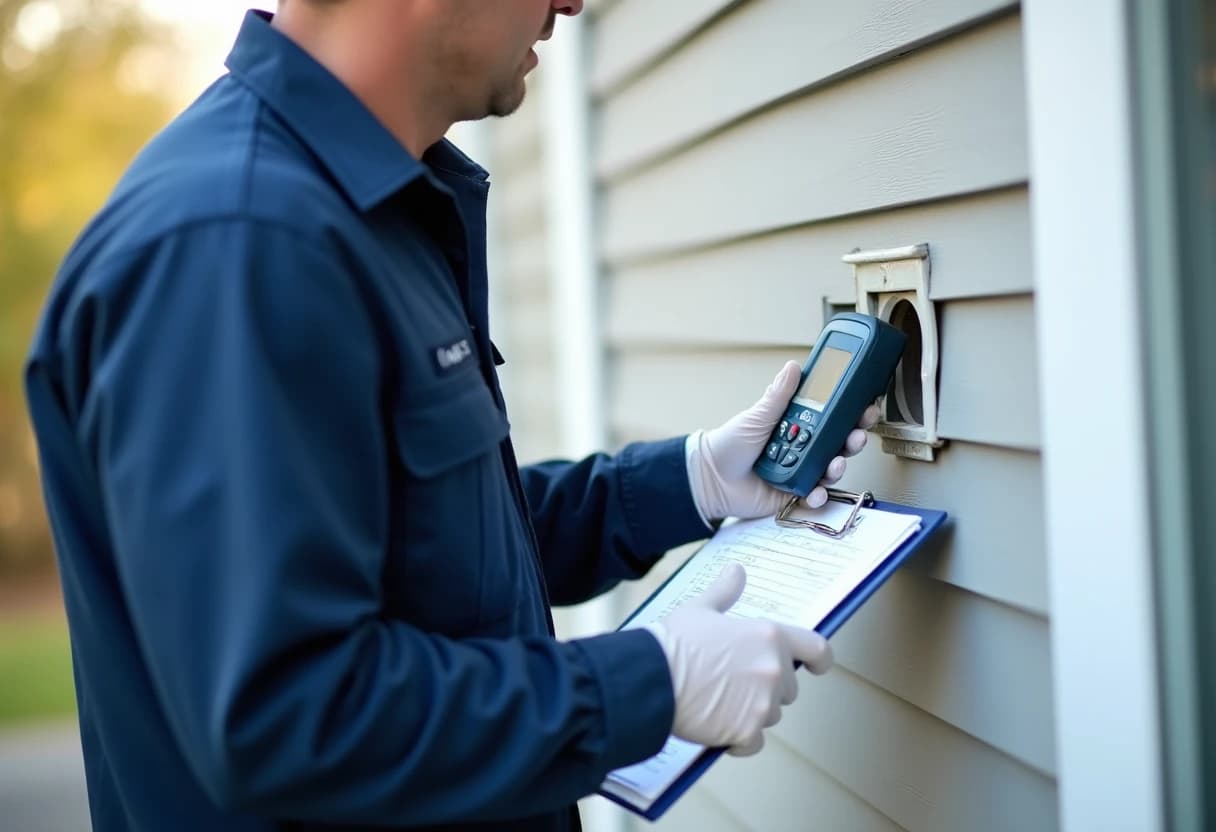
FEMA estimates around 2,900 home clothes dryer fires occur in the United States every year, and failure to clean the vent is the leading contributing factor. The trouble is that the danger is invisible: the lint that matters is not in the trap you clear after each load, it is packed inside the wall, ceiling or crawlspace duct you never see. Our East Bridgewater dryer vent inspection makes the invisible visible. A camera travels the entire exhaust run from the dryer connection to the outdoor termination, airflow is measured and compared against healthy benchmarks, and every finding is documented in a written report you can act on, file with your insurer, or hand to a home buyer.
Why Dryer Vent Inspection & Safety Check Matters for East Bridgewater Homes
Dryer fires are among the most preventable house fires in America, and the statistics are stubbornly consistent: FEMA and NFPA data attribute roughly 2,900 residential clothes dryer fires per year to U.S. homes, causing deaths, injuries and tens of millions of dollars in property loss — with lint the leading ignition source and failure to clean the leading contributing factor. What makes these fires preventable is that the hazard builds slowly and measurably. Lint accumulates in the duct, airflow drops, drying times stretch, the dryer cabinet runs hotter, and eventually a heating element or a spark meets a fuel supply that has been growing for years. An annual inspection interrupts that chain at the first link. Airflow measurement detects restriction long before it becomes dangerous; camera imaging shows exactly where lint is packing and whether the duct itself — crushed sections, separated joints, an accordion foil transition — is contributing. For less than the cost of a dinner out, you convert an invisible risk into a documented, managed one.
Condo and multi-family living shapes dryer safety in East Bridgewater more than most owners realize. East Bridgewater pairs antique colonials and Greek Revivals around its classic town common with capes and ranches from the postwar years and a large crop of 1980s-2000s colonial subdivisions carved from former farmland. The newer homes run standard basement trunk-duct systems, while several of the antiques carry creative attic and closet-chase retrofits. In triple-deckers and converted buildings, dryer ducts often run long distances through shared walls and ceilings to reach an outside face, and the termination may be three stories up where nobody has looked at it in years. Seasonal camps that became year-round homes around Robbins Pond often struggle with damp crawlspaces feeding musty air into duct systems. The town's remaining hay fields and the Satucket River wetlands add rural pollen and humidity that make summer air-quality complaints common here. Association boards across Plymouth County increasingly require documented dryer vent verification for exactly this reason — one unit's neglected duct is every unit's fire risk. Our inspection reports are formatted for board and property-manager submission: photos, airflow numbers, code notes and a dated finding for each unit, delivered after a single visit.
Our Dryer Vent Inspection & Safety Check Process in East Bridgewater
1Interview & Visual Assessment
We start by listening: how long do loads take, has anything changed, when was the vent last cleaned, any moisture or odor issues? Then the technician examines the laundry area — dryer position, transition duct type and condition, visible connections — because the interview and the first look often predict exactly what the instruments will find.
2Airflow Measurement at the Termination
We quantify before we diagnose. An anemometer reading at the outside hood, taken while the dryer runs, measures delivered airflow against the benchmark a dryer needs to operate safely. Strong flow with a clean camera pass means a pass; weak flow tells us restriction exists and the camera's job is to find it.
3Full-Length Camera Inspection
This is the step no flashlight can replace: a camera pass of the complete exhaust run, wall cavities and ceiling sections included. You can watch live as it travels. Lint depth, joint condition, duct material transitions and any obstructions are recorded, and representative frames go into your written report as evidence for every finding.
4Termination Hood & Damper Check
Outside, we evaluate the termination: does the damper open fully under dryer airflow and close cleanly at rest? Is the hood intact, sealed to the wall, and free of lint beards, paint-overs or screening that traps lint? A surprising share of vent failures live entirely at this last twelve inches of the system.
5Lint-Load Assessment & Fire-Risk Scoring
We translate the inspection into a plain-English risk score. You will know approximately what percentage of the duct's cross-section remains open, where the worst accumulation sits, and how urgent intervention is. FEMA attributes roughly 2,900 dryer fires a year primarily to lint — the score tells you honestly where your vent stands relative to that risk.
6Code-Compliance Review
We review the installation against the residential mechanical code for dryer exhaust: smooth rigid metal duct (not foil or plastic flex in concealed runs), a maximum of 35 feet equivalent length with deductions for each elbow, no screws penetrating the airstream, proper termination with a backdraft damper and no screen. Violations are photographed and explained.
7Written Safety Report & Recommendations
You receive a dated written report: airflow measurement, camera findings with photos, termination condition, lint-load score, code observations and a clear recommendation. It is formatted for practical reuse — insurance files, condo boards, real-estate disclosures — and it establishes the baseline every future annual inspection is compared against.
Benefits of Professional Dryer Vent Inspection & Safety Check in East Bridgewater
Lower Drying Costs & Longer Appliance Life
A restricted vent makes every load take longer, and longer cycles cost real money in electricity or gas — often hundreds of dollars a year in heavy-laundry households. Inspection catches restriction at the stage where a single cleaning restores one-cycle drying and normal operating costs.
Protection From Moisture & Carbon Monoxide
Gas dryer owners get an extra layer of safety from inspection: the same duct carrying lint and moisture carries combustion exhaust. Verified airflow and a tight, intact run mean carbon monoxide leaves the house completely — a check that takes minutes and covers a risk most homeowners never consider.
Hidden Code Violations Exposed
Plastic flex duct in a wall, a 50-foot equivalent run, screws bristling into the airstream, a screened termination — these violations hide inside structures and cause chronic problems until someone cameras the run. Finding them converts a recurring symptom into a one-time fix.
Fire Risk Caught Before It Matters
Lint fires do not announce themselves; they accumulate. An inspection converts that slow, invisible buildup into a number and a photograph you can act on. Homeowners who inspect annually essentially never experience a vent-related fire, because the fuel never gets the chance to reach a dangerous load.
Real-Estate & Insurance Documentation
Our report format was designed for transactions: dated findings, photographs, measurements and code notes that slide directly into a seller's disclosure package or answer an insurer's maintenance questionnaire. It is a small document that removes a large question mark from any file.
A Written Report You Can Actually Use
Every inspection creates a baseline. Next year's airflow number is compared against this year's, which turns a single snapshot into a trend line — and trend lines catch developing problems that any single visit might reasonably pass. It is the difference between a photo and a medical history.
Signs Your East Bridgewater Home Needs Dryer Vent Inspection & Safety Check
No Visible Exhaust at the Outside Hood
Step outside while the dryer runs: you should see the damper held open by strong airflow and feel a confident stream of warm air. A flap barely moving — or not moving at all — means severe restriction or a stuck damper, and the system needs professional attention.
The Dryer or Laundry Room Feels Hot
A dryer cabinet that is hot to the touch, or a laundry room that turns into a sauna mid-cycle, means exhaust heat is staying in the house instead of leaving through the duct. That trapped heat is the same heat that ignites lint. It warrants a measurement promptly.
Insurance, Condo or Sale Requirements
Listing your home this season? Handle the vent before the buyer's inspector does. A pre-listing inspection either produces a clean report for your disclosure package or surfaces a modest repair you control the pricing of — versus a finding that becomes a closing-table concession.
You Cannot Remember the Last Service
New homeowners inherit the previous owners' laundry habits inside their duct. Unless the sellers produced a dated inspection report, the vent's condition is unknown — and unknown is exactly the wrong state for the home's most fire-prone duct. A move-in inspection resolves it for under $150.
Burning or Musty Smells During Operation
Trust your nose. Scorched smells mean lint meeting heat; sour smells mean water pooling where it should not; animal odors mean something has moved into the duct or hood. Each has a distinct cause and a distinct fix, and a single camera inspection distinguishes among them definitively.
Clothes Take More Than One Cycle
Two cycles to dry a normal load is the classic symptom of a restricted vent. The dryer produces the same heat as always — the moisture simply has nowhere to go, so it recirculates through the drum. An inspection will measure exactly how much airflow the duct is stealing.
Dryer Vent Inspection & Safety Check Cost in East Bridgewater, MA
It helps to price the inspection against what it prevents. A restricted vent adds 20 to 40 minutes to every load; at Massachusetts electricity rates, heavy-laundry households can burn through several hundred dollars a year in wasted drying energy alone — several times the inspection fee. A thermal fuse or high-limit failure from chronic overheating means an appliance repair visit starting around $150 plus parts. A moisture leak inside a wall from a separated joint means drywall, paint and possibly mold remediation. And a lint fire, even a small contained one, means smoke damage, insurance claims and premiums that never quite come back down. Against that menu, $79–$149 once a year with a written report is the least expensive line item in home fire safety. We keep the price deliberately low because inspection is how responsible vent maintenance should start — measurement first, then only the work the measurements justify.
Want the full pricing picture? See our complete Boston-area cost guide or call (617) 390-7145 for an exact flat quote for your East Bridgewater home.
Local Knowledge: East Bridgewater, Plymouth County
What makes East Bridgewater different? East Bridgewater pairs antique colonials and Greek Revivals around its classic town common with capes and ranches from the postwar years and a large crop of 1980s-2000s colonial subdivisions carved from former farmland. The newer homes run standard basement trunk-duct systems, while several of the antiques carry creative attic and closet-chase retrofits. Seasonal camps that became year-round homes around Robbins Pond often struggle with damp crawlspaces feeding musty air into duct systems. The town's remaining hay fields and the Satucket River wetlands add rural pollen and humidity that make summer air-quality complaints common here. For duct and dryer vent systems, those local factors translate into specific, predictable problems — and predictable problems are the ones we solve fastest. Call (617) 390-7145, tell us your street and home style, and we will quote the job accurately the first time, usually in under five minutes.
The Best Time of Year in East Bridgewater
New England's housing stock gives dryer vents a distinctive seasonal biography. In the triple-deckers, capes and colonials that dominate Greater Boston, laundry migrated into basements and upper floors decades after construction, producing long runs through unheated spaces where every winter adds condensation cycles and every summer adds humidity. Many of these ducts also predate modern code — foil flex, excessive length, screened terminations — so seasonal stress lands on installations that were marginal to begin with. That is exactly why the annual inspection matters more here than in newer markets: the older and more improvised the run, the shorter the distance between 'fine last year' and 'hazard this year.'
Why Choose Boston Air Duct Cleaners
Choosing a duct cleaner is really a trust decision — you are letting a crew work inside the system that feeds air to your family. We make that decision easy: a local West Newton company with insured, uniformed technicians, transparent flat-rate quotes, NADCA-standard equipment and methods, and photographic proof of the finished work. No door-to-door sales, no bait-and-switch coupons, no invented 'mold emergencies.' Just honest mechanical cleaning done properly the first time, backed by a written guarantee.
Serving East Bridgewater and Surrounding Communities
East Bridgewater sits in the heart of our service area, and neighboring Bridgewater, Whitman, Hanson, Abington, Brockton, Easton appointments share the same routes. That density is why our response times in this part of Plymouth County are among our fastest — and why you will see our trucks in the area week after week.