
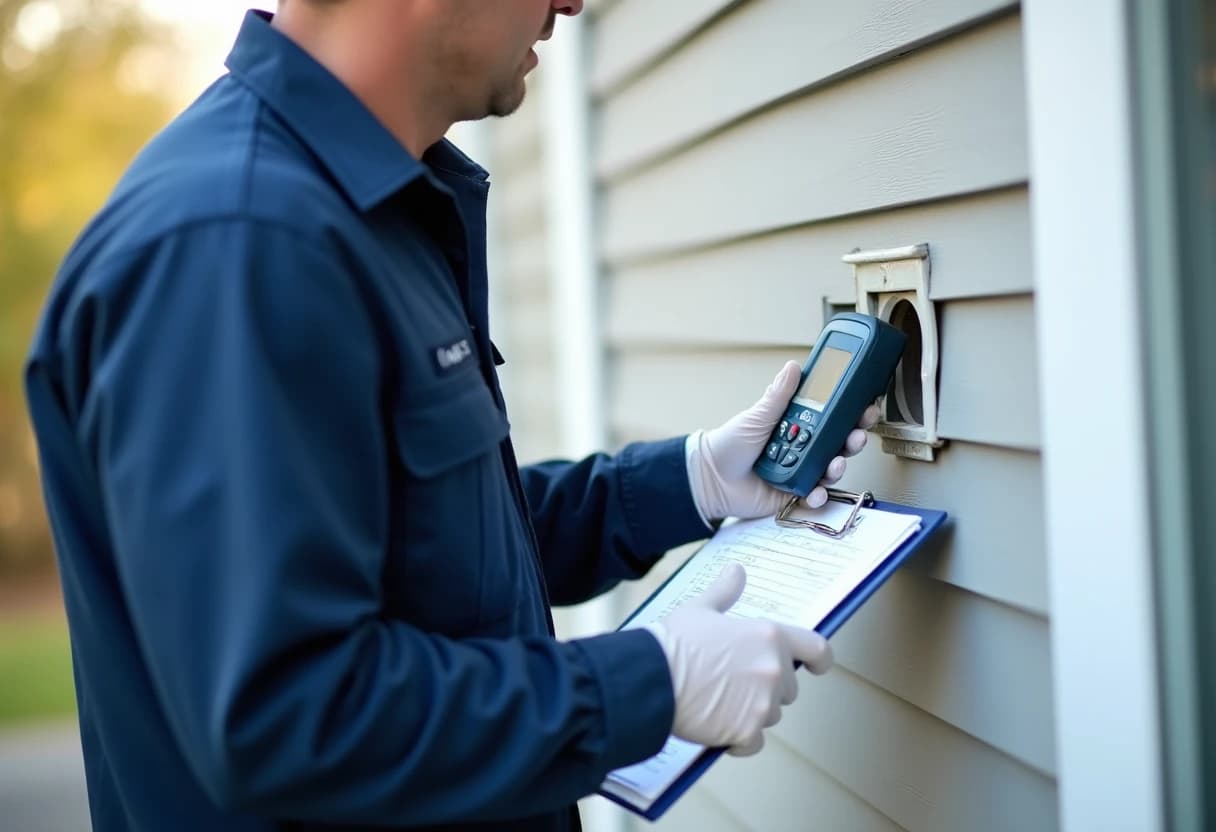
Not every dryer vent needs cleaning every year — but every dryer vent deserves inspecting every year, because the failure modes are silent and the worst-case outcome is a fire. Our Bridgewater inspection service exists for homeowners who want the truth about their vent without committing to a service they may not need. We measure exhaust airflow, camera the complete duct run, check the termination hood, verify the installation against code, and score the lint load. Roughly a third of the vents we inspect are fine, and we say so in writing. The rest get a documented finding and a flat-rate path to fixing it — your call, no pressure.
Why Dryer Vent Inspection & Safety Check Matters for Bridgewater Homes
The dryer vent is the only exhaust duct in your home that moves flammable material by design. Every load sheds lint; the trap catches most of it, and the rest travels the duct — where some fraction sticks at every elbow, joint, screw tip and rough surface along the way. Whether that accumulation is trivial or dangerous depends on the duct's length, geometry, material and history, which is exactly what an inspection evaluates. The residential code (IRC M1502) exists because these variables matter: it specifies smooth rigid metal duct, limits runs to 35 feet of equivalent length with deductions for every elbow, and prohibits screws that protrude into the airstream because each protruding tip becomes a lint anchor. Many Massachusetts homes — especially older ones retrofitted with laundry in basements or upper floors — violate one or more of these rules, often invisibly inside walls. A camera inspection is the only practical way to find out, and a written report is the only way to prove the vent's condition to an insurer, a buyer or a condo board.
Ask a Bridgewater firefighter what they think about dryer vents and you will get a strong opinion — lint fires are a call they run every year, and nearly all of them were preventable. Bridgewater blends historic Greek Revival and Victorian homes around Central Square and the university with big 1990s-2000s colonial subdivisions carved out of former farmland, plus student-oriented rentals near campus. The rental stock sees hard use and infrequent maintenance, while the newer subdivisions run standard builder-grade duct systems now reaching the twenty-to-thirty-year mark. Bridgewater borders the Hockomock Swamp, and the low water table keeps many basements and crawlspaces damp enough that mold-tinged returns are a recurring find, especially in the Scotland and Titicut sections. Around the university, rental turnovers are the natural moment for a duct cleaning, and we work with several local landlords on that schedule. That combination of aging housing and hardworking laundry rooms is precisely where annual inspections earn their keep. Our Bridgewater inspections take under an hour: airflow measured at the hood, camera run the length of the duct, termination and damper checked, lint load scored, code compliance reviewed. About a third of local vents pass clean. The rest get caught early — which is the entire point.
Our Dryer Vent Inspection & Safety Check Process in Bridgewater
1Interview & Visual Assessment
Every inspection opens with a short conversation and a visual survey. Drying times, error codes, humidity in the laundry room and the age of the installation all steer the inspection. The technician checks the transition duct behind the dryer first — foil accordion duct and plastic flex are immediate findings, since both are recognized fire hazards.
2Airflow Measurement at the Termination
With the dryer running on air-only, we measure exhaust velocity at the exterior termination using a calibrated anemometer and convert it to airflow volume. A healthy vent typically delivers strong, steady flow; a weak reading quantifies restriction before we ever look inside. This number anchors the whole report — objective, repeatable and comparable year over year.
3Full-Length Camera Inspection
The camera answers the question the airflow number raises. We feed it the full length of the duct, documenting interior condition foot by foot: where lint is packing, whether joints have pulled apart inside the wall, whether a previous installer used screws or materials the code prohibits. Nothing in the run stays hidden or hypothetical.
4Termination Hood & Damper Check
We check the exit as carefully as the run. A damper that will not open steals airflow; one that will not close invites cold air, moisture and animals. We also flag code and safety issues here: mesh screens that catch lint, terminations too close to openings or grade, and hoods damaged by weather or renovation work.
5Lint-Load Assessment & Fire-Risk Scoring
Not all lint findings are equal. A light, even film is normal; wet, matted accumulation at a low point signals condensation problems; heavy packing at elbows signals a duct working beyond its geometry. We grade what the camera found against how your household uses the dryer, so the recommendation matches your actual risk.
6Code-Compliance Review
Code exists because dryer ducts start fires, so compliance is a safety checklist, not paperwork. The technician verifies duct material and diameter, tallies the equivalent length including elbow penalties, checks joint construction and fastening method, and confirms the termination is damper-equipped and screen-free. Each violation goes in the report with a photo and a recommended fix.
7Written Safety Report & Recommendations
The visit ends with documentation, not a verbal shrug. Your report states plainly whether the vent passed, what was found where, and what — if anything — we recommend, with flat-rate pricing for any corrective work so you can decide on your own schedule. No findings are invented to sell a cleaning; the photos speak for themselves.
Benefits of Professional Dryer Vent Inspection & Safety Check in Bridgewater
Real-Estate & Insurance Documentation
Condo associations and landlords in Massachusetts are steadily adding dryer vent verification to their maintenance requirements after well-publicized multi-family lint fires. Our per-unit reports satisfy property managers and boards in one visit, with scheduling built for buildings — multiple units, one appointment block, individual documentation.
A Written Report You Can Actually Use
Every inspection creates a baseline. Next year's airflow number is compared against this year's, which turns a single snapshot into a trend line — and trend lines catch developing problems that any single visit might reasonably pass. It is the difference between a photo and a medical history.
Lower Drying Costs & Longer Appliance Life
Dryers fail early for one dominant reason: heat stress from poor exhaust. High-limit switches, thermal fuses and heating elements all die young in restricted systems. An annual inspection keeps the appliance operating within its design envelope, which routinely doubles the useful life of components that cost $150+ per repair visit.
Protection From Moisture & Carbon Monoxide
Every load of laundry evaporates roughly a gallon of water, and all of it must exit through this one duct. Joints that separated inside a ceiling deliver that gallon into your structure instead. The camera pass finds hidden leaks that no exterior symptom would reveal until damage was done.
Hidden Code Violations Exposed
Code review matters most at transactions. A non-compliant vent discovered by a buyer's inspector becomes a negotiation weapon; the same finding surfaced by your own inspection becomes a controlled, competitively priced repair. Knowing first is worth far more than the inspection fee.
Fire Risk Caught Before It Matters
You insure your house against fire for thousands a year; an inspection actively prevents the most preventable category of fire for a fraction of one premium payment. The camera and anemometer find what smoke detectors only react to — the hazard itself, while it is still just lint in a duct.
Signs Your Bridgewater Home Needs Dryer Vent Inspection & Safety Check
You Cannot Remember the Last Service
If the vent has no service history you can name, assume it has never been inspected — most have not. NFPA guidance is simple: dryer exhaust should be checked at least annually. The first inspection establishes your baseline; every year after tracks the trend.
No Visible Exhaust at the Outside Hood
The outdoor hood is the one part of the system you can check yourself, and a weak or absent exhaust stream there is diagnostic. But the hood cannot tell you where the problem lives — the duct, the damper or the dryer. The anemometer and camera answer that in one visit.
Recent Renovation, New Dryer or New Home
Renovations disturb dryer ducts constantly — runs get crushed by new framing, terminations get sided or painted over, and 'temporary' flex connections become permanent. If contractors have worked near your laundry area or exterior walls, an inspection verifies the exhaust path survived the project.
Clothes Take More Than One Cycle
When towels come out damp after a full cycle, most people blame the dryer and call an appliance tech. In our experience the appliance is usually fine — the exhaust path is not. A twenty-minute airflow measurement settles the question before you pay for a repair visit the machine never needed.
The Dryer or Laundry Room Feels Hot
Modern dryers protect themselves from restricted vents by cycling their high-limit switch — you experience this as a hot machine, lukewarm loads and mysteriously long cycles. The safety is working, but it was not designed for daily duty. An inspection identifies the restriction before the safety component fails.
Insurance, Condo or Sale Requirements
If your carrier, condo board or property manager has asked for proof of dryer vent maintenance, that is the sign — the requirement itself. Our written report is built to satisfy exactly these requests: dated, photographed, measured and signed, delivered after a single visit.
Dryer Vent Inspection & Safety Check Cost in Bridgewater, MA
It helps to price the inspection against what it prevents. A restricted vent adds 20 to 40 minutes to every load; at Massachusetts electricity rates, heavy-laundry households can burn through several hundred dollars a year in wasted drying energy alone — several times the inspection fee. A thermal fuse or high-limit failure from chronic overheating means an appliance repair visit starting around $150 plus parts. A moisture leak inside a wall from a separated joint means drywall, paint and possibly mold remediation. And a lint fire, even a small contained one, means smoke damage, insurance claims and premiums that never quite come back down. Against that menu, $79–$149 once a year with a written report is the least expensive line item in home fire safety. We keep the price deliberately low because inspection is how responsible vent maintenance should start — measurement first, then only the work the measurements justify.
Want the full pricing picture? See our complete Boston-area cost guide or call (617) 390-7145 for an exact flat quote for your Bridgewater home.
Local Knowledge: Bridgewater, Plymouth County
Serving Bridgewater means knowing Bridgewater. Bridgewater blends historic Greek Revival and Victorian homes around Central Square and the university with big 1990s-2000s colonial subdivisions carved out of former farmland, plus student-oriented rentals near campus. The rental stock sees hard use and infrequent maintenance, while the newer subdivisions run standard builder-grade duct systems now reaching the twenty-to-thirty-year mark. Bridgewater borders the Hockomock Swamp, and the low water table keeps many basements and crawlspaces damp enough that mold-tinged returns are a recurring find, especially in the Scotland and Titicut sections. Around the university, rental turnovers are the natural moment for a duct cleaning, and we work with several local landlords on that schedule. Those conditions shape how we work here: which brush heads come off the truck, how we protect finishes in older interiors, and what we expect to find when the camera goes into a 02324 duct system. Our crews are in and around Bridgewater nearly every week — often for neighbors of past customers — so scheduling is fast and our arrival windows hold.
The Best Time of Year in Bridgewater
Massachusetts winters stress the exhaust side of a dryer in ways most owners never see. Warm, moist exhaust meeting sub-freezing duct sections condenses, and that condensation turns dry lint into wet mats that cling and clog. Terminations ice up; damper flaps freeze shut overnight and get forced by the morning's first load; snow drifts bury low wall hoods entirely. A mid-winter inspection is often the year's most revealing one — we routinely find seasonal blockages that did not exist in September. If drying times slow every January in your house, that pattern itself is a finding worth investigating.
Why Choose Boston Air Duct Cleaners
Choosing a duct cleaner is really a trust decision — you are letting a crew work inside the system that feeds air to your family. We make that decision easy: a local West Newton company with insured, uniformed technicians, transparent flat-rate quotes, NADCA-standard equipment and methods, and photographic proof of the finished work. No door-to-door sales, no bait-and-switch coupons, no invented 'mold emergencies.' Just honest mechanical cleaning done properly the first time, backed by a written guarantee.
Serving Bridgewater and Surrounding Communities
We serve every community around Bridgewater as well: East Bridgewater, Brockton, Easton, Whitman, Hanson all fall inside our regular service routes. If you have a second property, a rental, or family nearby, ask about multi-home scheduling — grouped appointments on the same route are our most requested discount.