
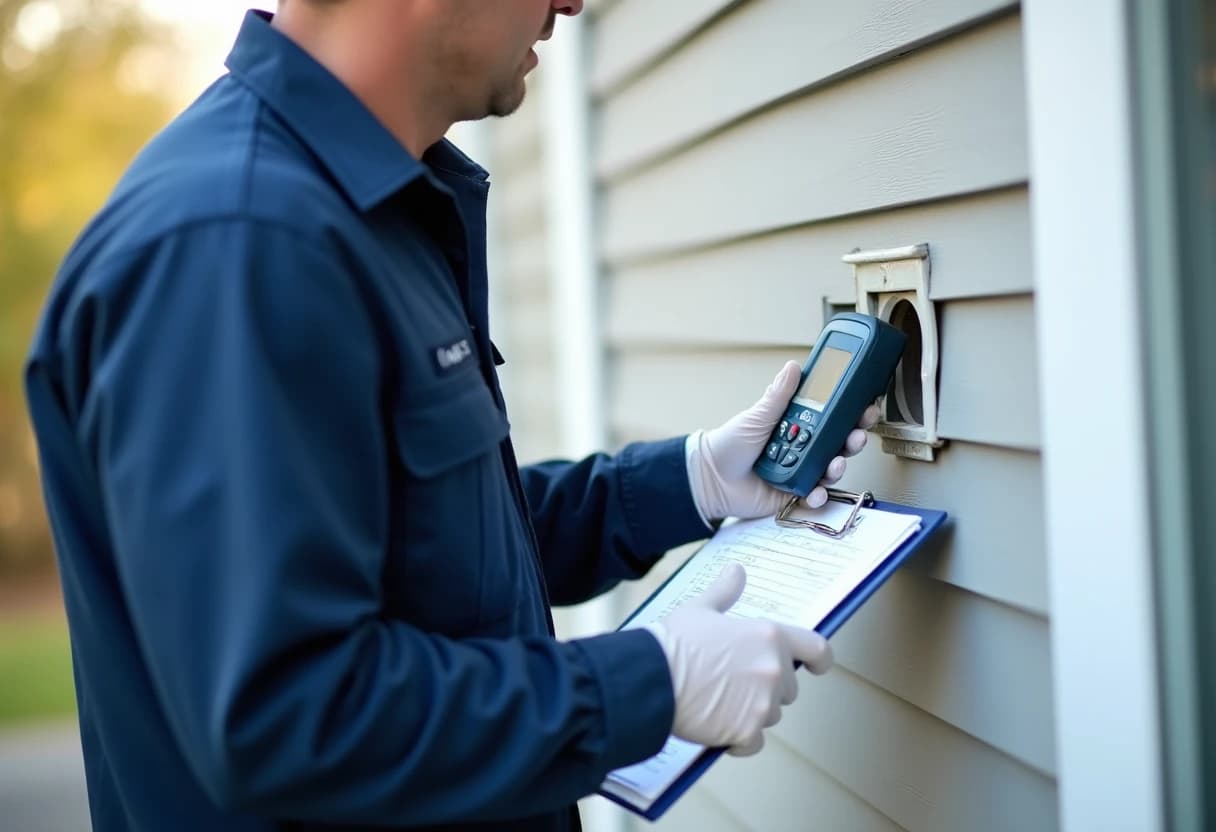
Your dryer cannot tell you when its vent is half-blocked — it just runs longer, hotter and closer to the edge. By the time clothes need two cycles, the duct is often carrying a serious lint load and the high-limit safety switch is doing regular overtime. A professional inspection catches the problem while it is still just an airflow number. In Essex, our technicians combine instrument measurements with a full camera pass of the duct, so the assessment is objective: cubic feet per minute at the hood, percent restriction visible in the run, condition of every joint and elbow. You get facts, photos and a recommendation — never a scare pitch.
Why Dryer Vent Inspection & Safety Check Matters for Essex Homes
Dryer fires are among the most preventable house fires in America, and the statistics are stubbornly consistent: FEMA and NFPA data attribute roughly 2,900 residential clothes dryer fires per year to U.S. homes, causing deaths, injuries and tens of millions of dollars in property loss — with lint the leading ignition source and failure to clean the leading contributing factor. What makes these fires preventable is that the hazard builds slowly and measurably. Lint accumulates in the duct, airflow drops, drying times stretch, the dryer cabinet runs hotter, and eventually a heating element or a spark meets a fuel supply that has been growing for years. An annual inspection interrupts that chain at the first link. Airflow measurement detects restriction long before it becomes dangerous; camera imaging shows exactly where lint is packing and whether the duct itself — crushed sections, separated joints, an accordion foil transition — is contributing. For less than the cost of a dinner out, you convert an invisible risk into a documented, managed one.
We inspect dryer vents all over Essex — around Essex Shipbuilding Museum, out toward Woodman's of Essex, and everywhere between — and the local pattern is clear: the age of the home predicts the condition of the vent. Essex is a compact shipbuilding town whose Main Street is lined with 18th- and 19th-century capes and shipwright's colonials, joined by summer cottages at Conomo Point and a modest number of newer homes on the wooded uplands. Central air is usually a retrofit here, squeezed into low-ceilinged antique frames with short basement or attic duct runs. Many of these properties still carry original or improvised exhaust runs: plastic or foil flex duct that predates modern code, terminations without functioning dampers, and lengths that exceed the 35-foot equivalent limit once the elbows are counted. The Essex River's vast salt marsh wraps the town in briny, humid air that corrodes vent hoods and keeps antique basements damp, so we inspect coastal homes' ductwork for rust and microbial growth as a matter of course. The famous clam-shack and restaurant strip along Route 133 also brings us regular commercial kitchen ventilation work. Because our shop is in West Newton, about 33 miles away, a Essex inspection is an easy route stop — most appointments are available within days, and combined inspection-plus-cleaning visits are our most-booked option in the area.
Our Dryer Vent Inspection & Safety Check Process in Essex
1Interview & Visual Assessment
We start by listening: how long do loads take, has anything changed, when was the vent last cleaned, any moisture or odor issues? Then the technician examines the laundry area — dryer position, transition duct type and condition, visible connections — because the interview and the first look often predict exactly what the instruments will find.
2Airflow Measurement at the Termination
We quantify before we diagnose. An anemometer reading at the outside hood, taken while the dryer runs, measures delivered airflow against the benchmark a dryer needs to operate safely. Strong flow with a clean camera pass means a pass; weak flow tells us restriction exists and the camera's job is to find it.
3Full-Length Camera Inspection
The camera answers the question the airflow number raises. We feed it the full length of the duct, documenting interior condition foot by foot: where lint is packing, whether joints have pulled apart inside the wall, whether a previous installer used screws or materials the code prohibits. Nothing in the run stays hidden or hypothetical.
4Termination Hood & Damper Check
Outside, we evaluate the termination: does the damper open fully under dryer airflow and close cleanly at rest? Is the hood intact, sealed to the wall, and free of lint beards, paint-overs or screening that traps lint? A surprising share of vent failures live entirely at this last twelve inches of the system.
5Lint-Load Assessment & Fire-Risk Scoring
We translate the inspection into a plain-English risk score. You will know approximately what percentage of the duct's cross-section remains open, where the worst accumulation sits, and how urgent intervention is. FEMA attributes roughly 2,900 dryer fires a year primarily to lint — the score tells you honestly where your vent stands relative to that risk.
6Code-Compliance Review
We review the installation against the residential mechanical code for dryer exhaust: smooth rigid metal duct (not foil or plastic flex in concealed runs), a maximum of 35 feet equivalent length with deductions for each elbow, no screws penetrating the airstream, proper termination with a backdraft damper and no screen. Violations are photographed and explained.
7Written Safety Report & Recommendations
The visit ends with documentation, not a verbal shrug. Your report states plainly whether the vent passed, what was found where, and what — if anything — we recommend, with flat-rate pricing for any corrective work so you can decide on your own schedule. No findings are invented to sell a cleaning; the photos speak for themselves.
Benefits of Professional Dryer Vent Inspection & Safety Check in Essex
Lower Drying Costs & Longer Appliance Life
The economics are simple: restricted airflow taxes every single load, and the tax grows as the restriction does. Measurement catches the problem when it is small. Customers consistently report faster drying and lower utility bills after acting on inspection findings — savings that repeat weekly, every laundry day.
Hidden Code Violations Exposed
Code review matters most at transactions. A non-compliant vent discovered by a buyer's inspector becomes a negotiation weapon; the same finding surfaced by your own inspection becomes a controlled, competitively priced repair. Knowing first is worth far more than the inspection fee.
Protection From Moisture & Carbon Monoxide
Every load of laundry evaporates roughly a gallon of water, and all of it must exit through this one duct. Joints that separated inside a ceiling deliver that gallon into your structure instead. The camera pass finds hidden leaks that no exterior symptom would reveal until damage was done.
A Written Report You Can Actually Use
Documentation has quiet value that compounds. After a kitchen fire two streets over, your insurer asks about dryer maintenance — you have a dated report. A buyer's inspector flags the vent — you produce this year's inspection and the issue evaporates. The paper trail costs nothing extra; it comes standard.
Real-Estate & Insurance Documentation
Buyers increasingly ask about dryer vents because their inspectors increasingly flag them. A pre-listing inspection removes the issue from the table before it appears; a pre-purchase inspection prices it before you own it. Agents across Greater Boston refer us for exactly this reason.
No Unnecessary Cleanings
The $79 inspection frequently saves the $200 cleaning. When airflow measures strong and the camera shows light accumulation, we say so in writing and leave. Customers who used to buy blind annual cleanings routinely discover their actual interval is longer — and their total maintenance spend drops accordingly.
Signs Your Essex Home Needs Dryer Vent Inspection & Safety Check
The Dryer or Laundry Room Feels Hot
Modern dryers protect themselves from restricted vents by cycling their high-limit switch — you experience this as a hot machine, lukewarm loads and mysteriously long cycles. The safety is working, but it was not designed for daily duty. An inspection identifies the restriction before the safety component fails.
Insurance, Condo or Sale Requirements
If your carrier, condo board or property manager has asked for proof of dryer vent maintenance, that is the sign — the requirement itself. Our written report is built to satisfy exactly these requests: dated, photographed, measured and signed, delivered after a single visit.
You Cannot Remember the Last Service
If the vent has no service history you can name, assume it has never been inspected — most have not. NFPA guidance is simple: dryer exhaust should be checked at least annually. The first inspection establishes your baseline; every year after tracks the trend.
Recent Renovation, New Dryer or New Home
A new dryer on an old duct is a mismatch worth checking: modern high-efficiency machines are sensitive to back pressure, and installers rarely camera the existing run. Manufacturers void heat-related warranty claims on restricted vents, so a post-install inspection protects a four-figure appliance for a two-figure fee.
No Visible Exhaust at the Outside Hood
The outdoor hood is the one part of the system you can check yourself, and a weak or absent exhaust stream there is diagnostic. But the hood cannot tell you where the problem lives — the duct, the damper or the dryer. The anemometer and camera answer that in one visit.
Clothes Take More Than One Cycle
Drying time is the vent's report card. Loads that once took 45 minutes now taking 80 means delivered airflow has fallen substantially — and every extra minute is money and heat stress. If your laundry routine has quietly stretched over the past year, the duct is asking for an inspection.
Dryer Vent Inspection & Safety Check Cost in Essex, MA
Budget-wise, the inspection is designed to be an easy annual yes: $79 to $149 depending on home layout, versus roughly $2,900 dryer fires nationally each year and average fire losses that run into five figures per incident. Price drivers are practical, not mysterious. Ranch homes and first-floor laundries with side-wall terminations book at $79–$99. Colonials and multi-story homes where the duct rises through the structure to a high or roof termination run $99–$129, reflecting ladder work and longer camera runs. Complicated situations — inaccessible dryers, runs exceeding 25 feet, multiple elbows requiring segment-by-segment documentation — reach $149. There are no add-on fees for the report, the photos or the code review; they are the service. Compare that with an appliance repair visit ($150+ before parts) that a simple airflow measurement might have prevented, and the inspection typically pays for itself the first time it changes a decision.
Want the full pricing picture? See our complete Boston-area cost guide or call (617) 390-7145 for an exact flat quote for your Essex home.
Local Knowledge: Essex, Essex County
Serving Essex means knowing Essex. Essex is a compact shipbuilding town whose Main Street is lined with 18th- and 19th-century capes and shipwright's colonials, joined by summer cottages at Conomo Point and a modest number of newer homes on the wooded uplands. Central air is usually a retrofit here, squeezed into low-ceilinged antique frames with short basement or attic duct runs. The Essex River's vast salt marsh wraps the town in briny, humid air that corrodes vent hoods and keeps antique basements damp, so we inspect coastal homes' ductwork for rust and microbial growth as a matter of course. The famous clam-shack and restaurant strip along Route 133 also brings us regular commercial kitchen ventilation work. Those conditions shape how we work here: which brush heads come off the truck, how we protect finishes in older interiors, and what we expect to find when the camera goes into a 01929 duct system. Our crews are in and around Essex nearly every week — often for neighbors of past customers — so scheduling is fast and our arrival windows hold.
The Best Time of Year in Essex
Massachusetts winters stress the exhaust side of a dryer in ways most owners never see. Warm, moist exhaust meeting sub-freezing duct sections condenses, and that condensation turns dry lint into wet mats that cling and clog. Terminations ice up; damper flaps freeze shut overnight and get forced by the morning's first load; snow drifts bury low wall hoods entirely. A mid-winter inspection is often the year's most revealing one — we routinely find seasonal blockages that did not exist in September. If drying times slow every January in your house, that pattern itself is a finding worth investigating.
Why Choose Boston Air Duct Cleaners
Choosing a duct cleaner is really a trust decision — you are letting a crew work inside the system that feeds air to your family. We make that decision easy: a local West Newton company with insured, uniformed technicians, transparent flat-rate quotes, NADCA-standard equipment and methods, and photographic proof of the finished work. No door-to-door sales, no bait-and-switch coupons, no invented 'mold emergencies.' Just honest mechanical cleaning done properly the first time, backed by a written guarantee.
Serving Essex and Surrounding Communities
We serve every community around Essex as well: Gloucester, Ipswich, Manchester-by-the-Sea, Hamilton, Wenham, Rowley all fall inside our regular service routes. If you have a second property, a rental, or family nearby, ask about multi-home scheduling — grouped appointments on the same route are our most requested discount.