
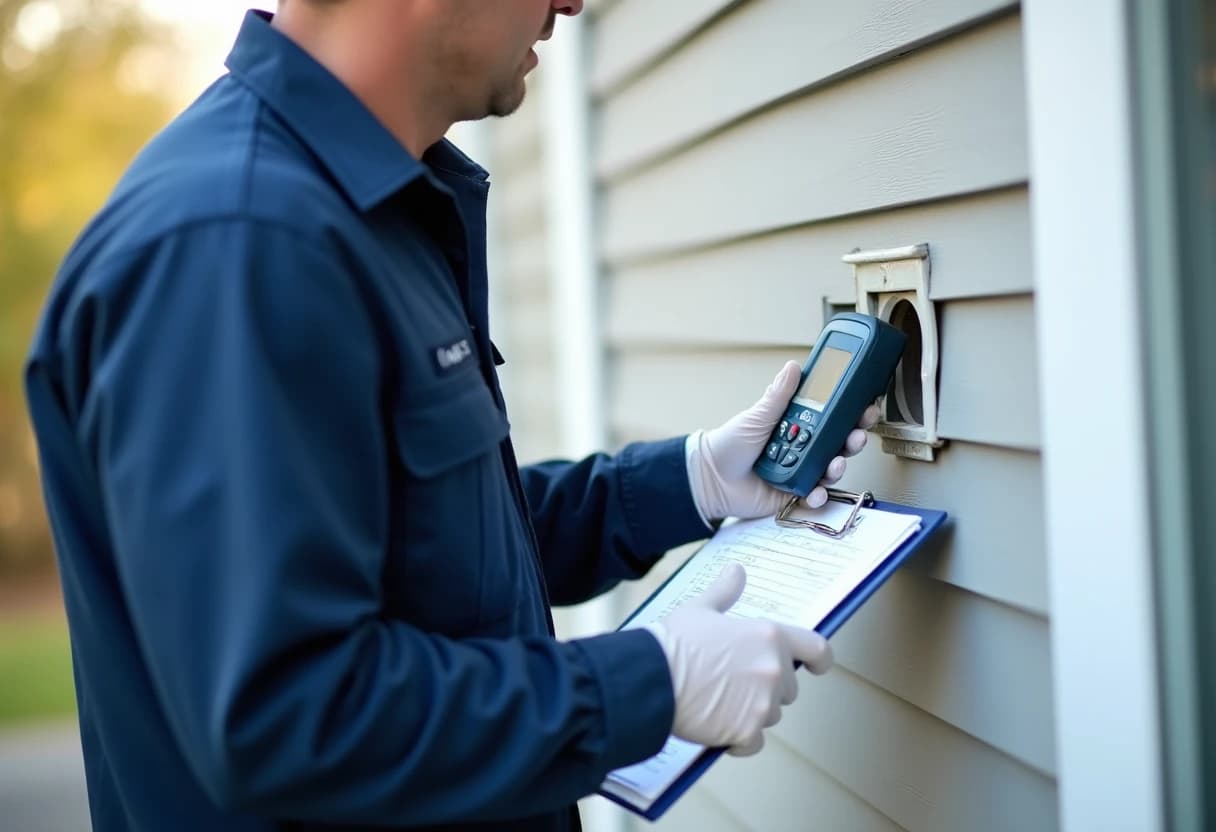
Real-estate closings, condo association requirements, insurance renewals, and plain peace of mind — those are the four most common reasons Wenham homeowners book a dryer vent inspection. Whatever brings you to it, the service is the same rigorous process: full-length camera inspection of the exhaust duct, anemometer airflow measurement at the termination, exterior hood and damper evaluation, lint-load scoring, and a compliance review against the residential mechanical code that governs dryer exhaust. The deliverable is a dated, written safety report with photographs — documentation that satisfies buyers, boards and underwriters, and tells you honestly whether a cleaning is actually needed this year or not.
Why Dryer Vent Inspection & Safety Check Matters for Wenham Homes
There are moments when a dryer vent inspection stops being optional. Buying a home: the general home inspector looks at the dryer connection but almost never cameras the duct or measures airflow, so the one appliance system most associated with house fires goes essentially unexamined at purchase. Selling a home: a documented, dated inspection removes a negotiation point and signals maintenance discipline. Insurance: a growing number of carriers ask about dryer vent maintenance after lint-fire claims, and a written report answers the question definitively. Condo and rental compliance: many Massachusetts associations and landlords now require periodic dryer vent verification, and our report format is written to satisfy them. New dryer installation: manufacturers void warranties for vent-related failures, and installers frequently connect brand-new machines to old, non-compliant ducts. In every one of these situations, the inspection costs a fraction of what it protects, and the paperwork is often the point.
We inspect dryer vents all over Wenham — around Wenham Lake, out toward Pleasant Pond, and everywhere between — and the local pattern is clear: the age of the home predicts the condition of the vent. Wenham's Main Street along Route 1A is a museum of first-period and Federal antiques, some dating to the 1600s, surrounded by horse-country estates and a modest ring of mid-century and 1980s homes on larger lots. Ductwork in the antiques is almost always a retrofit, snaked through fieldstone cellars and hand-hewn framing where runs are tight and access is awkward. Many of these properties still carry original or improvised exhaust runs: plastic or foil flex duct that predates modern code, terminations without functioning dampers, and lengths that exceed the 35-foot equivalent limit once the elbows are counted. Wenham's centuries-old homes sit over damp fieldstone foundations that feed moisture into retrofit duct systems, and we often find rust and organic debris in trunk lines that have never been opened since installation. With Wenham Lake and the Great Wenham Swamp nearby, seasonal humidity and pollen loads are heavier here than the town's small size might suggest. Because our shop is in West Newton, about 28 miles away, a Wenham inspection is an easy route stop — most appointments are available within days, and combined inspection-plus-cleaning visits are our most-booked option in the area.
Our Dryer Vent Inspection & Safety Check Process in Wenham
1Interview & Visual Assessment
First, context: your answers about drying performance and service history frame the inspection, and a walk of the laundry area frames the system. We identify the duct material, count visible elbows, locate where the run enters the structure, and note anything — crushing, kinks, tape-only joints — that already tells part of the story.
2Airflow Measurement at the Termination
We quantify before we diagnose. An anemometer reading at the outside hood, taken while the dryer runs, measures delivered airflow against the benchmark a dryer needs to operate safely. Strong flow with a clean camera pass means a pass; weak flow tells us restriction exists and the camera's job is to find it.
3Full-Length Camera Inspection
The camera answers the question the airflow number raises. We feed it the full length of the duct, documenting interior condition foot by foot: where lint is packing, whether joints have pulled apart inside the wall, whether a previous installer used screws or materials the code prohibits. Nothing in the run stays hidden or hypothetical.
4Termination Hood & Damper Check
We check the exit as carefully as the run. A damper that will not open steals airflow; one that will not close invites cold air, moisture and animals. We also flag code and safety issues here: mesh screens that catch lint, terminations too close to openings or grade, and hoods damaged by weather or renovation work.
5Lint-Load Assessment & Fire-Risk Scoring
Not all lint findings are equal. A light, even film is normal; wet, matted accumulation at a low point signals condensation problems; heavy packing at elbows signals a duct working beyond its geometry. We grade what the camera found against how your household uses the dryer, so the recommendation matches your actual risk.
6Code-Compliance Review
We review the installation against the residential mechanical code for dryer exhaust: smooth rigid metal duct (not foil or plastic flex in concealed runs), a maximum of 35 feet equivalent length with deductions for each elbow, no screws penetrating the airstream, proper termination with a backdraft damper and no screen. Violations are photographed and explained.
7Written Safety Report & Recommendations
You receive a dated written report: airflow measurement, camera findings with photos, termination condition, lint-load score, code observations and a clear recommendation. It is formatted for practical reuse — insurance files, condo boards, real-estate disclosures — and it establishes the baseline every future annual inspection is compared against.
Benefits of Professional Dryer Vent Inspection & Safety Check in Wenham
No Unnecessary Cleanings
Inspection-first service means you only pay for cleaning when measurement says the vent needs it. Short, efficient runs in some homes stay healthy for two or three years between cleanings; heavy-laundry households may need annual service. The instruments decide — not a calendar, and not a salesperson.
Fire Risk Caught Before It Matters
The roughly 2,900 dryer fires U.S. homes suffer each year share a common history: a restriction that built silently for years. Annual inspection breaks that pattern by catching declining airflow and accumulating lint at the measurement stage — years before the ignition stage. It is the cheapest intervention in fire prevention.
Lower Drying Costs & Longer Appliance Life
Dryers fail early for one dominant reason: heat stress from poor exhaust. High-limit switches, thermal fuses and heating elements all die young in restricted systems. An annual inspection keeps the appliance operating within its design envelope, which routinely doubles the useful life of components that cost $150+ per repair visit.
A Written Report You Can Actually Use
Documentation has quiet value that compounds. After a kitchen fire two streets over, your insurer asks about dryer maintenance — you have a dated report. A buyer's inspector flags the vent — you produce this year's inspection and the issue evaporates. The paper trail costs nothing extra; it comes standard.
Real-Estate & Insurance Documentation
Our report format was designed for transactions: dated findings, photographs, measurements and code notes that slide directly into a seller's disclosure package or answer an insurer's maintenance questionnaire. It is a small document that removes a large question mark from any file.
Protection From Moisture & Carbon Monoxide
A leaking or restricted dryer duct pushes warm, saturated air into wall cavities and framing — a slow moisture problem that shows up later as mold, peeling paint or rot. For gas dryers, exhaust integrity also governs the removal of combustion byproducts, including carbon monoxide. Inspection verifies both.
Signs Your Wenham Home Needs Dryer Vent Inspection & Safety Check
Burning or Musty Smells During Operation
Musty smells on 'clean' laundry point to moisture lingering in the duct — often a low spot where condensation pools and lint mats into a damp plug. Beyond the odor, wet lint accumulations restrict flow badly and hide mold. The camera finds the low spot; the fix follows from there.
Insurance, Condo or Sale Requirements
Listing your home this season? Handle the vent before the buyer's inspector does. A pre-listing inspection either produces a clean report for your disclosure package or surfaces a modest repair you control the pricing of — versus a finding that becomes a closing-table concession.
You Cannot Remember the Last Service
Dryer vents fail on a schedule set by laundry volume, duct length and installation quality — variables you cannot assess from the laundry room. Annual inspection is the standing recommendation of fire-safety agencies precisely because no visible cue reliably announces when a vent crosses from fine to dangerous.
Recent Renovation, New Dryer or New Home
Renovations disturb dryer ducts constantly — runs get crushed by new framing, terminations get sided or painted over, and 'temporary' flex connections become permanent. If contractors have worked near your laundry area or exterior walls, an inspection verifies the exhaust path survived the project.
No Visible Exhaust at the Outside Hood
Step outside while the dryer runs: you should see the damper held open by strong airflow and feel a confident stream of warm air. A flap barely moving — or not moving at all — means severe restriction or a stuck damper, and the system needs professional attention.
Clothes Take More Than One Cycle
When towels come out damp after a full cycle, most people blame the dryer and call an appliance tech. In our experience the appliance is usually fine — the exhaust path is not. A twenty-minute airflow measurement settles the question before you pay for a repair visit the machine never needed.
Dryer Vent Inspection & Safety Check Cost in Wenham, MA
It helps to price the inspection against what it prevents. A restricted vent adds 20 to 40 minutes to every load; at Massachusetts electricity rates, heavy-laundry households can burn through several hundred dollars a year in wasted drying energy alone — several times the inspection fee. A thermal fuse or high-limit failure from chronic overheating means an appliance repair visit starting around $150 plus parts. A moisture leak inside a wall from a separated joint means drywall, paint and possibly mold remediation. And a lint fire, even a small contained one, means smoke damage, insurance claims and premiums that never quite come back down. Against that menu, $79–$149 once a year with a written report is the least expensive line item in home fire safety. We keep the price deliberately low because inspection is how responsible vent maintenance should start — measurement first, then only the work the measurements justify.
Want the full pricing picture? See our complete Boston-area cost guide or call (617) 390-7145 for an exact flat quote for your Wenham home.
Local Knowledge: Wenham, Essex County
Serving Wenham means knowing Wenham. Wenham's Main Street along Route 1A is a museum of first-period and Federal antiques, some dating to the 1600s, surrounded by horse-country estates and a modest ring of mid-century and 1980s homes on larger lots. Ductwork in the antiques is almost always a retrofit, snaked through fieldstone cellars and hand-hewn framing where runs are tight and access is awkward. Wenham's centuries-old homes sit over damp fieldstone foundations that feed moisture into retrofit duct systems, and we often find rust and organic debris in trunk lines that have never been opened since installation. With Wenham Lake and the Great Wenham Swamp nearby, seasonal humidity and pollen loads are heavier here than the town's small size might suggest. Those conditions shape how we work here: which brush heads come off the truck, how we protect finishes in older interiors, and what we expect to find when the camera goes into a 01984 duct system. Our crews are in and around Wenham nearly every week — often for neighbors of past customers — so scheduling is fast and our arrival windows hold.
The Best Time of Year in Wenham
Humid Boston summers change what we find inside dryer ducts. Moisture-laden ambient air combines with exhaust condensation in long or cool runs — basement ducts especially — and lint that would stay loose and fluffy in dry conditions mats into dense, damp accumulations that restrict flow and occasionally host mold. Coastal and near-coastal homes add salt air to the equation, which corrodes hoods, hinge pins and damper springs measurably faster than inland exposure. A summer inspection catches both patterns, and it is also the easiest season to schedule: our calendar is lightest between June and August, which makes it the smart pick for annual-plan customers.
Why Choose Boston Air Duct Cleaners
Choosing a duct cleaner is really a trust decision — you are letting a crew work inside the system that feeds air to your family. We make that decision easy: a local West Newton company with insured, uniformed technicians, transparent flat-rate quotes, NADCA-standard equipment and methods, and photographic proof of the finished work. No door-to-door sales, no bait-and-switch coupons, no invented 'mold emergencies.' Just honest mechanical cleaning done properly the first time, backed by a written guarantee.
Serving Wenham and Surrounding Communities
Beyond Wenham, our crews cover the surrounding communities daily — including Hamilton, Beverly, Danvers, Topsfield, Ipswich, Manchester-by-the-Sea. Because routes cluster geographically, booking alongside a neighboring appointment often unlocks same-day service and combined-visit savings. Wherever you are in Essex County, the same flat-rate pricing, insured technicians and photo-documented process applies.