
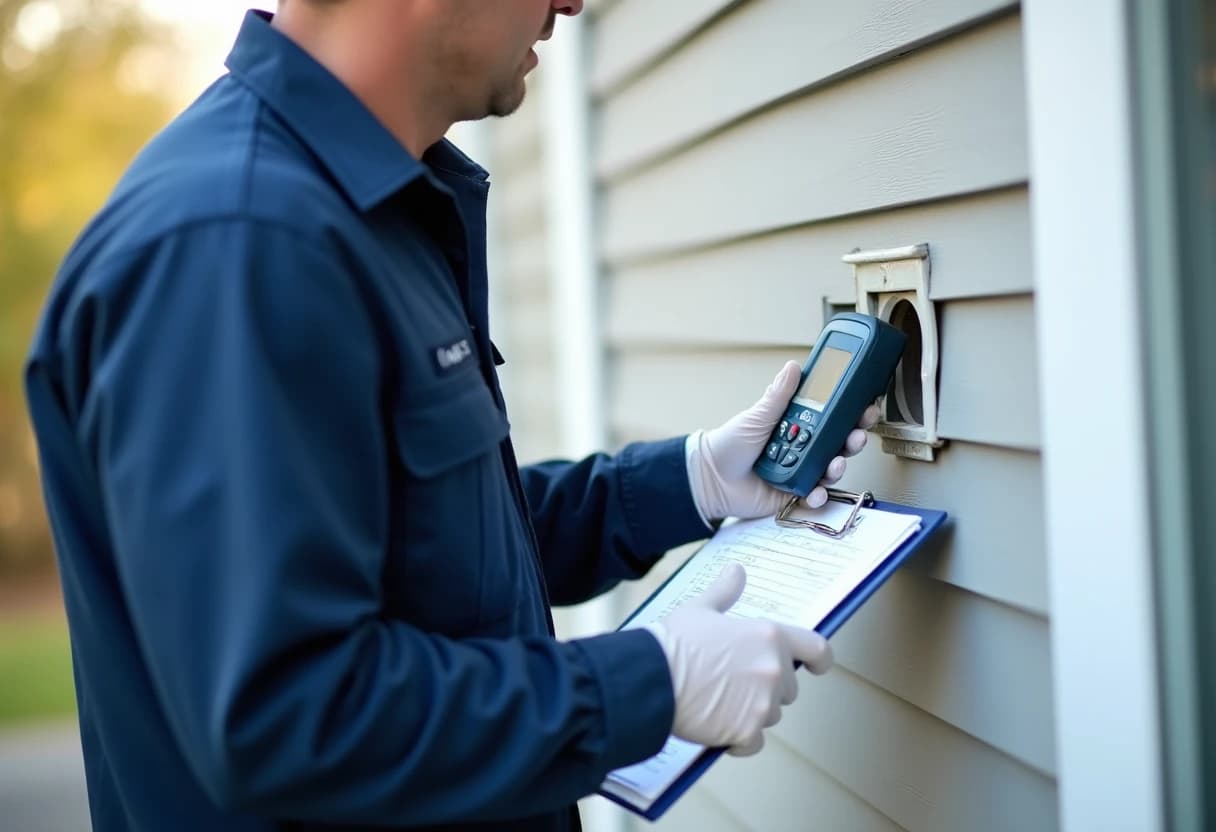
Real-estate closings, condo association requirements, insurance renewals, and plain peace of mind — those are the four most common reasons Topsfield homeowners book a dryer vent inspection. Whatever brings you to it, the service is the same rigorous process: full-length camera inspection of the exhaust duct, anemometer airflow measurement at the termination, exterior hood and damper evaluation, lint-load scoring, and a compliance review against the residential mechanical code that governs dryer exhaust. The deliverable is a dated, written safety report with photographs — documentation that satisfies buyers, boards and underwriters, and tells you honestly whether a cleaning is actually needed this year or not.
Why Dryer Vent Inspection & Safety Check Matters for Topsfield Homes
The mechanical case for annual inspection is about heat and moisture, not just fire. A restricted vent forces the dryer to run longer per load, which costs electricity or gas, wears the appliance, and cooks fabrics. It also raises the temperature inside the dryer cabinet, cycling the high-limit thermostat — a safety component designed for occasional intervention, not daily duty — until it fails, which in Massachusetts usually means a repair call in the middle of winter laundry season. Meanwhile, every minute of restricted exhaust pushes warm, moisture-laden air backward through leaks in the duct, and for gas dryers, impedes the removal of combustion byproducts including carbon monoxide. A vent that measures healthy protects the appliance, the utility bill, the indoor air and the house at once. A vent that measures weak announces the problem years before it announces itself — and an annual inspection is the only way anyone ever hears it.
Condo and multi-family living shapes dryer safety in Topsfield more than most owners realize. Topsfield surrounds one of New England's finest town commons with First Period and Federal homes, including the 1683 Parson Capen House, while its outer roads carry gentleman-farm properties and 1960s-1990s colonials on generous wooded lots. The antique center-village homes demand sensitive HVAC retrofits around original timber frames, and the larger modern colonials run full multi-zone duct systems. In triple-deckers and converted buildings, dryer ducts often run long distances through shared walls and ceilings to reach an outside face, and the termination may be three stories up where nobody has looked at it in years. Home of America's oldest agricultural fair, Topsfield keeps a genuinely rural character, and the hay, livestock and field dust of fair season and working farms show up in the duct systems of nearby homes. Properties along the Ipswich River and its wetlands also deal with persistent ground moisture that encourages musty odors in basement duct runs. Association boards across Essex County increasingly require documented dryer vent verification for exactly this reason — one unit's neglected duct is every unit's fire risk. Our inspection reports are formatted for board and property-manager submission: photos, airflow numbers, code notes and a dated finding for each unit, delivered after a single visit.
Our Dryer Vent Inspection & Safety Check Process in Topsfield
1Interview & Visual Assessment
First, context: your answers about drying performance and service history frame the inspection, and a walk of the laundry area frames the system. We identify the duct material, count visible elbows, locate where the run enters the structure, and note anything — crushing, kinks, tape-only joints — that already tells part of the story.
2Airflow Measurement at the Termination
The single most telling test takes two minutes: dryer on, anemometer at the hood. Exhaust volume tells us how much of the dryer's rated airflow actually survives the trip through the duct. We record the reading in your report so future inspections can track the trend — a slow year-over-year decline is the earliest possible warning of developing blockage.
3Full-Length Camera Inspection
The camera answers the question the airflow number raises. We feed it the full length of the duct, documenting interior condition foot by foot: where lint is packing, whether joints have pulled apart inside the wall, whether a previous installer used screws or materials the code prohibits. Nothing in the run stays hidden or hypothetical.
4Termination Hood & Damper Check
The exterior hood gets a hands-on inspection — flap movement, spring tension, seal condition, evidence of pest entry, and clearance from grade and snow lines. New England weather is hard on terminations; corroded hinges and stuck dampers are among our most common findings, and both restrict airflow as effectively as a clogged duct.
5Lint-Load Assessment & Fire-Risk Scoring
We translate the inspection into a plain-English risk score. You will know approximately what percentage of the duct's cross-section remains open, where the worst accumulation sits, and how urgent intervention is. FEMA attributes roughly 2,900 dryer fires a year primarily to lint — the score tells you honestly where your vent stands relative to that risk.
6Code-Compliance Review
Code exists because dryer ducts start fires, so compliance is a safety checklist, not paperwork. The technician verifies duct material and diameter, tallies the equivalent length including elbow penalties, checks joint construction and fastening method, and confirms the termination is damper-equipped and screen-free. Each violation goes in the report with a photo and a recommended fix.
7Written Safety Report & Recommendations
Everything we measured and saw goes into a written safety report delivered the same day. Pass or fail, you have proof of the vent's condition — the document buyers ask for, insurers accept and associations require. If work is warranted, the report doubles as a precise scope, so any quote you gather is comparing the same job.
Benefits of Professional Dryer Vent Inspection & Safety Check in Topsfield
Lower Drying Costs & Longer Appliance Life
A restricted vent makes every load take longer, and longer cycles cost real money in electricity or gas — often hundreds of dollars a year in heavy-laundry households. Inspection catches restriction at the stage where a single cleaning restores one-cycle drying and normal operating costs.
A Written Report You Can Actually Use
Every inspection creates a baseline. Next year's airflow number is compared against this year's, which turns a single snapshot into a trend line — and trend lines catch developing problems that any single visit might reasonably pass. It is the difference between a photo and a medical history.
Hidden Code Violations Exposed
Many chronic lint problems are really installation problems: the duct violates length, material or fastening rules and will clog on schedule forever until corrected. The compliance review identifies the root cause, so you can stop paying to clean a duct that was built to fail.
Protection From Moisture & Carbon Monoxide
Every load of laundry evaporates roughly a gallon of water, and all of it must exit through this one duct. Joints that separated inside a ceiling deliver that gallon into your structure instead. The camera pass finds hidden leaks that no exterior symptom would reveal until damage was done.
Real-Estate & Insurance Documentation
Our report format was designed for transactions: dated findings, photographs, measurements and code notes that slide directly into a seller's disclosure package or answer an insurer's maintenance questionnaire. It is a small document that removes a large question mark from any file.
No Unnecessary Cleanings
Inspection-first service means you only pay for cleaning when measurement says the vent needs it. Short, efficient runs in some homes stay healthy for two or three years between cleanings; heavy-laundry households may need annual service. The instruments decide — not a calendar, and not a salesperson.
Signs Your Topsfield Home Needs Dryer Vent Inspection & Safety Check
Burning or Musty Smells During Operation
Musty smells on 'clean' laundry point to moisture lingering in the duct — often a low spot where condensation pools and lint mats into a damp plug. Beyond the odor, wet lint accumulations restrict flow badly and hide mold. The camera finds the low spot; the fix follows from there.
You Cannot Remember the Last Service
Dryer vents fail on a schedule set by laundry volume, duct length and installation quality — variables you cannot assess from the laundry room. Annual inspection is the standing recommendation of fire-safety agencies precisely because no visible cue reliably announces when a vent crosses from fine to dangerous.
No Visible Exhaust at the Outside Hood
Step outside while the dryer runs: you should see the damper held open by strong airflow and feel a confident stream of warm air. A flap barely moving — or not moving at all — means severe restriction or a stuck damper, and the system needs professional attention.
Clothes Take More Than One Cycle
When towels come out damp after a full cycle, most people blame the dryer and call an appliance tech. In our experience the appliance is usually fine — the exhaust path is not. A twenty-minute airflow measurement settles the question before you pay for a repair visit the machine never needed.
The Dryer or Laundry Room Feels Hot
Modern dryers protect themselves from restricted vents by cycling their high-limit switch — you experience this as a hot machine, lukewarm loads and mysteriously long cycles. The safety is working, but it was not designed for daily duty. An inspection identifies the restriction before the safety component fails.
Recent Renovation, New Dryer or New Home
Just bought the house? Your home inspector almost certainly did not camera the dryer duct or measure its airflow — general inspections do not include it. Given that lint fires are among the most common preventable house fires, a dedicated vent inspection belongs on every new-owner checklist.
Dryer Vent Inspection & Safety Check Cost in Topsfield, MA
A standalone dryer vent inspection in Greater Boston runs $79 to $149, with most single-family homes landing near the middle. The variables are access and complexity: a first-floor laundry with a short run to a reachable exterior hood sits at the low end, while roof terminations, multi-story runs, stacked or hard-to-move appliances, and long concealed ducts requiring extended camera work move the price up. Multi-unit buildings are quoted per unit with volume discounts for associations and property managers booking a full building. What the fee always includes: anemometer airflow measurement, full-length camera inspection, exterior hood and damper evaluation, lint-load scoring, code-compliance review, and the written photographic report. What it never includes: pressure to buy anything. If cleaning or repair is warranted, you receive a flat-rate quote alongside the findings — and if we perform the cleaning during the same visit, the inspection fee is credited toward it, which is how most customers who need work choose to proceed.
Want the full pricing picture? See our complete Boston-area cost guide or call (617) 390-7145 for an exact flat quote for your Topsfield home.
Local Knowledge: Topsfield, Essex County
Serving Topsfield means knowing Topsfield. Topsfield surrounds one of New England's finest town commons with First Period and Federal homes, including the 1683 Parson Capen House, while its outer roads carry gentleman-farm properties and 1960s-1990s colonials on generous wooded lots. The antique center-village homes demand sensitive HVAC retrofits around original timber frames, and the larger modern colonials run full multi-zone duct systems. Home of America's oldest agricultural fair, Topsfield keeps a genuinely rural character, and the hay, livestock and field dust of fair season and working farms show up in the duct systems of nearby homes. Properties along the Ipswich River and its wetlands also deal with persistent ground moisture that encourages musty odors in basement duct runs. Those conditions shape how we work here: which brush heads come off the truck, how we protect finishes in older interiors, and what we expect to find when the camera goes into a 01983 duct system. Our crews are in and around Topsfield nearly every week — often for neighbors of past customers — so scheduling is fast and our arrival windows hold.
The Best Time of Year in Topsfield
Fall is dryer vent inspection season in New England for good reason: laundry loads get heavier as the weather cools — jeans, flannels, bedding, towels — exactly when a marginal vent is least able to keep up. NFPA data also shows home dryer fires peak in the colder months, when the appliance works hardest and lint accumulates fastest. An October inspection catches summer's accumulation, verifies the termination damper before snow and ice test it, and sets the system up for the six heaviest laundry months of the year. Book it alongside the furnace tune-up; the two together cover the season's biggest hidden-heat risks in one week.
Why Choose Boston Air Duct Cleaners
Boston Air Duct Cleaners is a local, owner-operated company based at 1121 Washington St in West Newton — not a national franchise dispatching subcontractors. Every crew is our own: background-checked, factory-trained on commercial negative-pressure equipment, and fully insured. We quote flat prices before work begins, document every job with before-and-after photos, and follow NADCA-standard source-removal methods on every system we touch. That is why so much of our work comes from repeat customers, property managers and word-of-mouth referrals across Essex County.
Serving Topsfield and Surrounding Communities
Beyond Topsfield, our crews cover the surrounding communities daily — including Middleton, Danvers, Ipswich, Hamilton, Rowley, Wenham. Because routes cluster geographically, booking alongside a neighboring appointment often unlocks same-day service and combined-visit savings. Wherever you are in Essex County, the same flat-rate pricing, insured technicians and photo-documented process applies.