
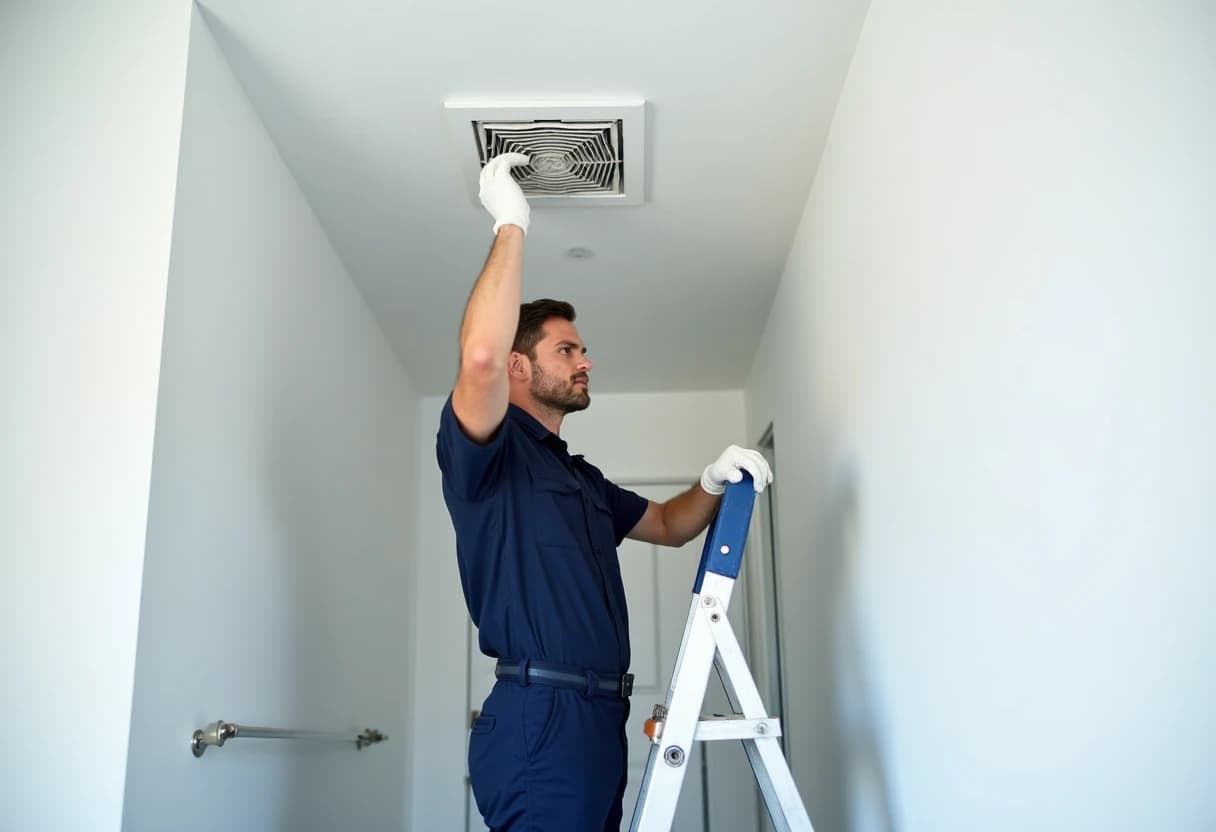
Mold in a bathroom is rarely a cleaning-product problem — it is an airflow problem. Every shower releases moisture that must leave the room through one small duct, and when that duct and its fan are choked with years of dust, the moisture stays: fogging mirrors long after the shower ends, feeding the black speckling on ceilings and grout, and condensing inside walls where you cannot see it. Our Ipswich technicians clean the complete system — grille, blades, motor housing, and the full duct run to its exterior termination — then verify the restored airflow. EPA guidance on mold control starts with ventilation for a reason: fix the airflow and the bathroom finally dries the way it was designed to.
Why Bathroom Exhaust Fan Cleaning Matters for Ipswich Homes
The part of the system nobody thinks about is the duct — and in Greater Boston housing, the duct is usually the biggest problem. Bathroom fans here typically exhaust through a run of flexible or rigid duct crossing an unconditioned attic to a roof cap, or snaking through framing to a soffit or gable termination. Those runs accumulate the same humid-air felt as the fan, and they add failure modes of their own: sagging flex duct that collects condensation in its low spots, terminations whose dampers stick shut or whose screens mat over with lint and dust, and disconnected joints quietly dumping shower moisture straight into the attic insulation. That last one is the silent disaster — a bathroom fan venting into the attic saturates insulation, breeds mold on roof sheathing, and in winter contributes to the frost-and-ice-dam cycle New England roofs suffer. Our cleaning covers the complete path and inspects it as we go, so a hidden disconnection or an attic-venting fan gets caught and flagged instead of festering for another decade.
Condo and multi-family living makes bathroom exhaust a shared concern in Ipswich. Ipswich holds more surviving First Period houses than any other community in America, and its downtown streets are lined with 17th- and 18th-century homes where any forced-air system is by definition a careful retrofit through hand-hewn framing. Beyond the historic core, seasonal cottage colonies on Great Neck and Little Neck have largely converted to year-round living, alongside mid-century and newer homes out the Linebrook corridor. In stacked buildings, one unit's failed fan raises humidity that neighbors feel, and duct runs to roof terminations often cross common attics or chases the unit owner has never seen. Between the tidal Ipswich River, the salt marshes and Crane Beach, humidity and salt air press on this town from three sides, keeping duct interiors and crawlspaces damp deep into fall. In the First Period homes downtown, retrofit duct runs snake through centuries-old cavities that accumulate dust from plaster, timber and long-settled chimneys. Associations across Essex County increasingly ask owners to verify their exhaust fans are actually functional, and our service answers that request completely: full cleaning, duct-path inspection, termination check and an airflow reading, documented per unit. Boards booking whole buildings get block scheduling and per-unit pricing that makes compliance genuinely affordable.
Our Bathroom Exhaust Fan Cleaning Process in Ipswich
1Airflow Test & System Assessment
Every visit opens with a functional test and a short interview. How long do mirrors stay fogged? Does mold return in the same spots? When did the fan last sound smooth? We record a baseline airflow measurement so that when the cleaning is done, the improvement is demonstrated rather than promised.
2Protect the Bathroom & Drop the Grille
Setup takes minutes but matters: surfaces below the work area get covered, and power to the fan is switched off before disassembly. The grille is removed and cleaned separately while we work on the housing — it goes back gleaming, which is the part you will see every day.
3Clean the Fan Blades, Motor & Housing
The fan assembly gets detailed by hand: every blade surface cleared, the motor housing cleaned so the motor stops running hot under its dust blanket, and the interior of the unit HEPA-vacuumed. Where the assembly is designed to drop out, we remove it for a more thorough bench cleaning at the site.
4Clean the Full Duct Run
From the fan housing, we clean the duct itself — brush and vacuum for rigid runs, gentler methods for flexible duct that tears easily — working toward the termination. This is where most of the lost airflow lives: years of humid-air dust lining every inch of a duct only a few inches across.
5Check the Roof or Soffit Termination
The termination check regularly produces the visit's biggest finding. Fans 'vented' into attics with no termination at all, roof caps whose flappers froze shut years ago, soffit runs crushed by stored boxes — each one explains a chronically damp bathroom. We photograph what we find and quote any repair flat, separately and without pressure.
6Verify Airflow & Reassemble
Proof beats promises: the same tissue or anemometer test from the start of the visit is repeated at the end, and you see the difference yourself. Reassembly is careful — grille seated properly, no rattles, damper motion confirmed one more time — and every surface we covered is uncovered and wiped.
7Report, Recommendations & Maintenance Notes
Documentation comes standard because bathroom fans intersect with real decisions: condo compliance requests, mold remediation follow-ups, pre-sale punch lists. Our summary — findings, photos, airflow figures — slots into all of them. And if we spotted anything beyond our scope, like active mold in the surrounding drywall, you will hear it straight, with referral guidance rather than an upsell.
Benefits of Professional Bathroom Exhaust Fan Cleaning in Ipswich
A Quieter, Longer-Lived Fan
The rattle and drone of an old bathroom fan is usually dirt, not age: dust-loaded blades run out of balance, and buildup around the motor makes it labor. Cleaned and rebalanced, most fans run dramatically quieter — customers regularly assume we replaced the unit.
Mold Prevention at the Source
Bathroom mold is a moisture symptom, and moisture is an airflow symptom. A cleaned, verified exhaust system removes shower humidity before it can condense on ceilings, grout and window frames — cutting off the water supply mold depends on. It is the fix that makes the scrubbing finally stick.
A Bathroom That Actually Dries
The everyday difference is immediate and obvious: mirrors clear while you are still in the room, towels dry between uses instead of souring, and that lingering post-shower dampness disappears. A bathroom that dries fast is more pleasant every single day — and far cheaper to maintain over the years.
Protection for the Attic & Structure
The exhaust duct's hidden failures — sagging runs, separated joints, terminations that never worked — send shower moisture into attics and wall cavities, where it wets insulation, breeds mold on sheathing and feeds winter ice-dam cycles. Our full-path cleaning finds and flags these problems before they become structural bills.
Lower Whole-Home Humidity
Dust mites and mold throughout the house track indoor humidity, and indoor humidity tracks bathroom ventilation more than most owners realize. Fixing the exhaust path is one of the cheapest whole-home humidity interventions available — a fraction of the purchase and running cost of the dehumidifier it often replaces.
Fresher Air & Odor Control
Guest bathrooms, powder rooms, rental units: anywhere odors and freshness matter to people beyond the household, a properly exhausting fan is the difference between a bathroom that resets itself and one that broadcasts its history. Landlords bundle this service across units for exactly that reason.
Signs Your Ipswich Home Needs Bathroom Exhaust Fan Cleaning
Mirrors Stay Fogged Long After Showers
A working exhaust fan should clear mirror fog within minutes of shower's end. Fog that lingers a half hour is humidity with nowhere to go — the fan is running but not exhausting, which is the signature of a blocked duct or a dust-choked fan assembly.
Mold Keeps Returning on Ceiling or Grout
Recurring mold in a bathroom with a running fan is a contradiction that points straight at the duct: the fan spins, but blockage means little air actually leaves. The EPA's moisture-first guidance applies exactly here — no amount of surface treatment outperforms restored ventilation.
Ceiling Stains or Winter Drips Around the Fan
If stains reappear after every repaint, stop repainting and check the exhaust path. Paint hides the symptom for a season; airflow removes the cause permanently. We photograph the duct conditions behind chronic stains, so you finally see what the ceiling has been protesting about.
Musty Smells When the Fan Runs
In winter, an intermittent sour smell from the fan often means condensate is collecting in the cold duct and wetting years of accumulated dust. That damp mass blocks airflow, breeds odor and drips back toward the ceiling — three symptoms, one cause, one cleaning.
The Tissue Test Fails
Hold a single square of toilet paper against the running fan's grille: a healthy fan pins it firmly in place; a failing fan lets it fall. It is the simplest diagnostic in home maintenance, takes ten seconds, and if your fan fails it, the exhaust path needs cleaning.
Visible Dust Fur on the Grille
Dust streaking on the ceiling around the grille adds a detail: air is leaking around the housing rather than moving through the duct, often because the duct side is blocked. The streak pattern is diagnostic, and it points to a cleaning plus a housing-seal check.
Bathroom Exhaust Fan Cleaning Cost in Ipswich, MA
Bathroom exhaust fan cleaning in Greater Boston runs $99 to $199 per fan as a standalone visit, with the price driven by access and duct complexity rather than the fan itself. A first-floor fan with a short, reachable duct run sits at the low end; a top-floor fan ducted across an attic to a roof cap — requiring attic access or ladder work at the termination — sits at the top. Every visit includes the full scope: grille removal and washing, fan blade and motor housing cleaning, cleaning of the complete duct run, termination and damper check, and before-and-after airflow verification. Multiple fans in the same home are discounted steeply — the second and third bathrooms typically add $59–$89 each, since setup and travel are already covered. The most economical booking of all is the bundle: added to an air duct or dryer vent appointment, bathroom fans slot in at reduced per-fan rates because the crew and equipment are already on site. Ask about the combined price when you book; most customers find the bundle makes cleaning every fan in the house an easy decision.
Want the full pricing picture? See our complete Boston-area cost guide or call (617) 390-7145 for an exact flat quote for your Ipswich home.
Local Knowledge: Ipswich, Essex County
Serving Ipswich means knowing Ipswich. Ipswich holds more surviving First Period houses than any other community in America, and its downtown streets are lined with 17th- and 18th-century homes where any forced-air system is by definition a careful retrofit through hand-hewn framing. Beyond the historic core, seasonal cottage colonies on Great Neck and Little Neck have largely converted to year-round living, alongside mid-century and newer homes out the Linebrook corridor. Between the tidal Ipswich River, the salt marshes and Crane Beach, humidity and salt air press on this town from three sides, keeping duct interiors and crawlspaces damp deep into fall. In the First Period homes downtown, retrofit duct runs snake through centuries-old cavities that accumulate dust from plaster, timber and long-settled chimneys. Those conditions shape how we work here: which brush heads come off the truck, how we protect finishes in older interiors, and what we expect to find when the camera goes into a 01938 duct system. Our crews are in and around Ipswich nearly every week — often for neighbors of past customers — so scheduling is fast and our arrival windows hold.
The Best Time of Year in Ipswich
Fall is the strategic season for bathroom fan cleaning in New England, for the same reason it is furnace season: the system is about to face its hardest months. From November through April, every shower sends humid air into ducts crossing freezing attics, and only brisk airflow clears the run before condensation forms. A fan cleaned in October enters winter at full capacity — mirrors clear, ceilings dry, ducts moving air fast enough to beat the dew point. A dirty fan enters the same winter already losing the race, and the losses compound: condensate wets the duct's dust lining, the wet lining blocks more flow, and by February the bathroom is growing its annual crop of ceiling spots.
Why Choose Boston Air Duct Cleaners
Boston Air Duct Cleaners is a local, owner-operated company based at 1121 Washington St in West Newton — not a national franchise dispatching subcontractors. Every crew is our own: background-checked, factory-trained on commercial negative-pressure equipment, and fully insured. We quote flat prices before work begins, document every job with before-and-after photos, and follow NADCA-standard source-removal methods on every system we touch. That is why so much of our work comes from repeat customers, property managers and word-of-mouth referrals across Essex County.
Serving Ipswich and Surrounding Communities
Beyond Ipswich, our crews cover the surrounding communities daily — including Rowley, Hamilton, Essex, Topsfield, Georgetown, Gloucester. Because routes cluster geographically, booking alongside a neighboring appointment often unlocks same-day service and combined-visit savings. Wherever you are in Essex County, the same flat-rate pricing, insured technicians and photo-documented process applies.