
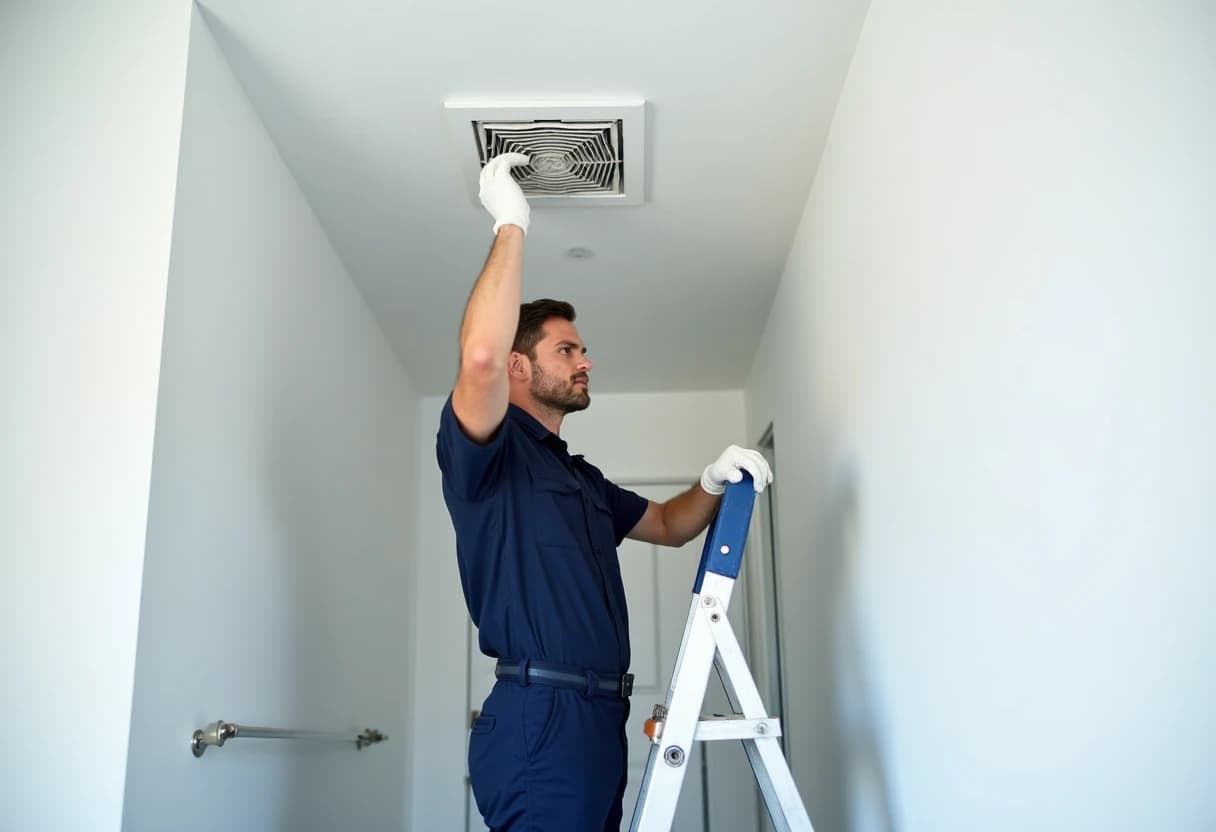
Mold in a bathroom is rarely a cleaning-product problem — it is an airflow problem. Every shower releases moisture that must leave the room through one small duct, and when that duct and its fan are choked with years of dust, the moisture stays: fogging mirrors long after the shower ends, feeding the black speckling on ceilings and grout, and condensing inside walls where you cannot see it. Our Georgetown technicians clean the complete system — grille, blades, motor housing, and the full duct run to its exterior termination — then verify the restored airflow. EPA guidance on mold control starts with ventilation for a reason: fix the airflow and the bathroom finally dries the way it was designed to.
Why Bathroom Exhaust Fan Cleaning Matters for Georgetown Homes
Bathroom exhaust fans fail slowly and invisibly, and the consequences land on the house rather than the fan. The physics are simple: a typical bathroom needs its air replaced several times over during and after a shower, and a fan choked with dust cannot do it. The moisture that should have been exhausted instead condenses on the coldest surfaces available — mirrors first, then ceilings, window frames and grout lines, and eventually surfaces inside the walls and attic where nobody sees the damage until it is expensive. The EPA's core guidance on residential mold control is moisture control, and in bathrooms that means working ventilation above all else. Cleaning is what keeps ventilation working. Dust that accumulates on grilles, blades and duct walls in a humid environment does not sit loosely the way dry household dust does; it bonds into a dense felt that narrows the air path and unbalances the fan. A thorough cleaning of the full system — not just a vacuumed grille — routinely doubles or triples delivered airflow, which is the difference between a bathroom that dries in twenty minutes and one that stays damp for hours.
Ask anyone renovating near Brocklebank Museum what they found when the bathroom ceiling came down: the fan duct tells the story of the house. Georgetown pairs antique center-chimney Colonials and Victorians clustered around the town common with large 1990s and 2000s Colonial subdivisions carved out of former woodland along its rural roads. The newer homes run big - often 2,500 square feet and up - with long duct runs to bonus rooms over garages that are notorious for weak airflow and dust accumulation at the far ends of the system. We regularly find original fans wired decades ago, ducts of every improvised material, and terminations that stopped functioning years back — all still running daily against total blockage. Many Georgetown properties sit on well water and are surrounded by woods and hayfields, so seasonal pollen and fine organic debris load up return grilles quickly here. The oversized colonials common in town also mean second-floor duct branches that have often never been cleaned since the house was built. A cleaning visit is the inexpensive way to learn what your own bathroom is hiding: we open the system, clean it end to end, photograph anything that needs attention, and restore the airflow that keeps Georgetown bathrooms dry through the heating season. Most visits finish inside an hour per fan.
Our Bathroom Exhaust Fan Cleaning Process in Georgetown
1Airflow Test & System Assessment
Every visit opens with a functional test and a short interview. How long do mirrors stay fogged? Does mold return in the same spots? When did the fan last sound smooth? We record a baseline airflow measurement so that when the cleaning is done, the improvement is demonstrated rather than promised.
2Protect the Bathroom & Drop the Grille
Setup takes minutes but matters: surfaces below the work area get covered, and power to the fan is switched off before disassembly. The grille is removed and cleaned separately while we work on the housing — it goes back gleaming, which is the part you will see every day.
3Clean the Fan Blades, Motor & Housing
This step returns the fan to its rated performance. Dust on blades changes their shape and steals capacity; dust packed around motors traps heat and shortens their lives. We clean both thoroughly, check that the wheel spins free and true, and inspect wiring and mounts while the housing is open — problems get photographed and flagged.
4Clean the Full Duct Run
The duct gets cleaned end to end, not just where it meets the fan. In attic runs we follow the duct physically where access allows, correcting sags that trap condensation and verifying every joint is still connected — a surprising number are not, and a disconnected bathroom duct is quietly raining moisture into the insulation.
5Check the Roof or Soffit Termination
Terminations take the weather for the whole system: dampers stick with corrosion and paint, caps crack, screens mat over into felt pads, and soffit terminations get blocked by later insulation work. We check and clear the exit point, because a perfectly cleaned duct still fails if its door will not open.
6Verify Airflow & Reassemble
Proof beats promises: the same tissue or anemometer test from the start of the visit is repeated at the end, and you see the difference yourself. Reassembly is careful — grille seated properly, no rattles, damper motion confirmed one more time — and every surface we covered is uncovered and wiped.
7Report, Recommendations & Maintenance Notes
Documentation comes standard because bathroom fans intersect with real decisions: condo compliance requests, mold remediation follow-ups, pre-sale punch lists. Our summary — findings, photos, airflow figures — slots into all of them. And if we spotted anything beyond our scope, like active mold in the surrounding drywall, you will hear it straight, with referral guidance rather than an upsell.
Benefits of Professional Bathroom Exhaust Fan Cleaning in Georgetown
Mold Prevention at the Source
Every mold treatment that ignores ventilation is temporary by design — the humidity that fed the last colony feeds the next one. Restoring two to three times the airflow changes the bathroom's daily moisture budget permanently, which is why cleaning the fan system outperforms another round of bleach every time.
Lower Whole-Home Humidity
In condos and triple-deckers, one bathroom's moisture becomes the unit's moisture and sometimes the neighbor's. Restored exhaust keeps humidity where it can be removed, which is why associations increasingly treat working bathroom fans as building infrastructure rather than a private convenience.
A Quieter, Longer-Lived Fan
Fan motors die early for one main reason: heat trapped by the dust packed around them, working against blades made heavy and unbalanced by the same dust. Cleaning removes both stressors, routinely adding years to a motor's life and deferring the cost and ceiling-patching of a full replacement.
Cheap Insurance Bundled Conveniently
At $99–$199 per bathroom — less when bundled with air duct or dryer vent service — this is among the least expensive preventive services in home maintenance, weighed against what chronic bathroom moisture costs: remediation, repainting, regrouting, fan replacement, attic repairs. The economics are not close.
Protection for the Attic & Structure
Ceiling stains around bathroom fans are usually condensation dripping back from cold, dirty ducts — not roof leaks. Cleaning restores the airflow that outruns condensation, and our inspection of the run corrects the sags and gaps that let water collect. The stain stops growing because its source is gone.
A Bathroom That Actually Dries
The everyday difference is immediate and obvious: mirrors clear while you are still in the room, towels dry between uses instead of souring, and that lingering post-shower dampness disappears. A bathroom that dries fast is more pleasant every single day — and far cheaper to maintain over the years.
Signs Your Georgetown Home Needs Bathroom Exhaust Fan Cleaning
Mirrors Stay Fogged Long After Showers
If you have started cracking the bathroom window in January because the fan cannot cope, the workaround is telling you the system has failed — and the open window is pouring heated air out of the house all winter. Cleaning the exhaust path is cheaper than the habit.
Musty Smells When the Fan Runs
Musty odor from the grille can also signal trouble upstream: condensation pooling in a sagging duct run, or moisture problems at a failed termination. Either way the nose knows before the eyes do, and a full-path cleaning with duct inspection identifies which problem you have.
Mold Keeps Returning on Ceiling or Grout
Scrub-recur, scrub-recur: when the same speckling returns to the same spots every few weeks, the bathroom's moisture budget is broken, and the fan system is almost always why. Cleaning restores the airflow that keeps surfaces below the moisture threshold mold needs.
Ceiling Stains or Winter Drips Around the Fan
Actual dripping from the fan on cold mornings is the same condensation cycle at full strength, and it deserves prompt attention: the water is also soaking the duct's low spots and the ceiling cavity. Cleaning plus correcting duct sags typically resolves it in one visit.
The Fan Has Grown Loud, Rattly or Labored
Fans do not naturally get louder with age — they get louder with dirt. Dust bonds unevenly to blades, unbalancing the wheel; buildup around the motor makes it labor. The rattle, hum or grind you have learned to ignore is the sound of a system asking to be cleaned.
The Tissue Test Fails
Weak suction at the grille means weak protection for the room — and the tissue test measures it honestly. If the paper drops, or clings only weakly, the system is likely moving a fraction of its rated airflow, and every shower is depositing the difference on your walls and ceiling.
Bathroom Exhaust Fan Cleaning Cost in Georgetown, MA
Three factors set your exact price. First, termination type: soffit and wall terminations are quick to access and verify; roof caps require ladder or roof work that adds cost, especially on steep New England rooflines. Second, duct length and material: a four-foot rigid run cleans quickly, while twenty feet of aging flex duct across an attic takes time and care — flexible duct tears if cleaned aggressively, so it is slower by necessity. Third, fan condition: a unit serviced within recent memory cleans faster than one untouched since installation, where bonded buildup needs soaking and hand work. What does not change the price: surprises we find along the way. Discovered problems — disconnected joints, failed dampers, fans venting into the attic — get photographed and quoted separately as flat-rate repairs, never folded into the cleaning bill or performed without approval. And if a fan proves to be at genuine end of life, we say so plainly; charging full cleaning price for a motor with months to live helps nobody, and we would rather quote the replacement honestly.
Want the full pricing picture? See our complete Boston-area cost guide or call (617) 390-7145 for an exact flat quote for your Georgetown home.
Local Knowledge: Georgetown, Essex County
Serving Georgetown means knowing Georgetown. Georgetown pairs antique center-chimney Colonials and Victorians clustered around the town common with large 1990s and 2000s Colonial subdivisions carved out of former woodland along its rural roads. The newer homes run big - often 2,500 square feet and up - with long duct runs to bonus rooms over garages that are notorious for weak airflow and dust accumulation at the far ends of the system. Many Georgetown properties sit on well water and are surrounded by woods and hayfields, so seasonal pollen and fine organic debris load up return grilles quickly here. The oversized colonials common in town also mean second-floor duct branches that have often never been cleaned since the house was built. Those conditions shape how we work here: which brush heads come off the truck, how we protect finishes in older interiors, and what we expect to find when the camera goes into a 01833 duct system. Our crews are in and around Georgetown nearly every week — often for neighbors of past customers — so scheduling is fast and our arrival windows hold.
The Best Time of Year in Georgetown
Spring earns its place on the bathroom fan calendar as inspection season. Winter is hard on the hidden parts of the system: freeze-thaw cycles loosen duct joints as framing moves, ice and snow stress roof caps and dampers, and months of condensation may have soaked accumulated dust into blocking mats at the duct's low points. A spring visit cleans out winter's damp accumulation and verifies the system survived intact — joints connected, damper swinging free, termination undamaged. It also positions the bathroom for summer, when the challenge flips from condensation to ambient humidity and a strong fan becomes the difference between a bathroom that resets after each shower and one that stays muggy all season.
Why Choose Boston Air Duct Cleaners
As a West Newton-based company, we treat Georgetown like the neighborhood it is — because for us, it is. Our reputation lives or dies on local referrals, so every job gets the full process: complete system cleaning under negative pressure, mechanical agitation of every run, blower compartment service, and a documented walkthrough before we leave. We are licensed and insured, our estimates are free and flat, and our schedule holds same-day slots for urgent calls. One visit and you will understand why neighbors keep our magnet on the fridge.
Serving Georgetown and Surrounding Communities
Georgetown sits in the heart of our service area, and neighboring Rowley, Topsfield, North Andover, Ipswich, Middleton, Andover appointments share the same routes. That density is why our response times in this part of Essex County are among our fastest — and why you will see our trucks in the area week after week.