
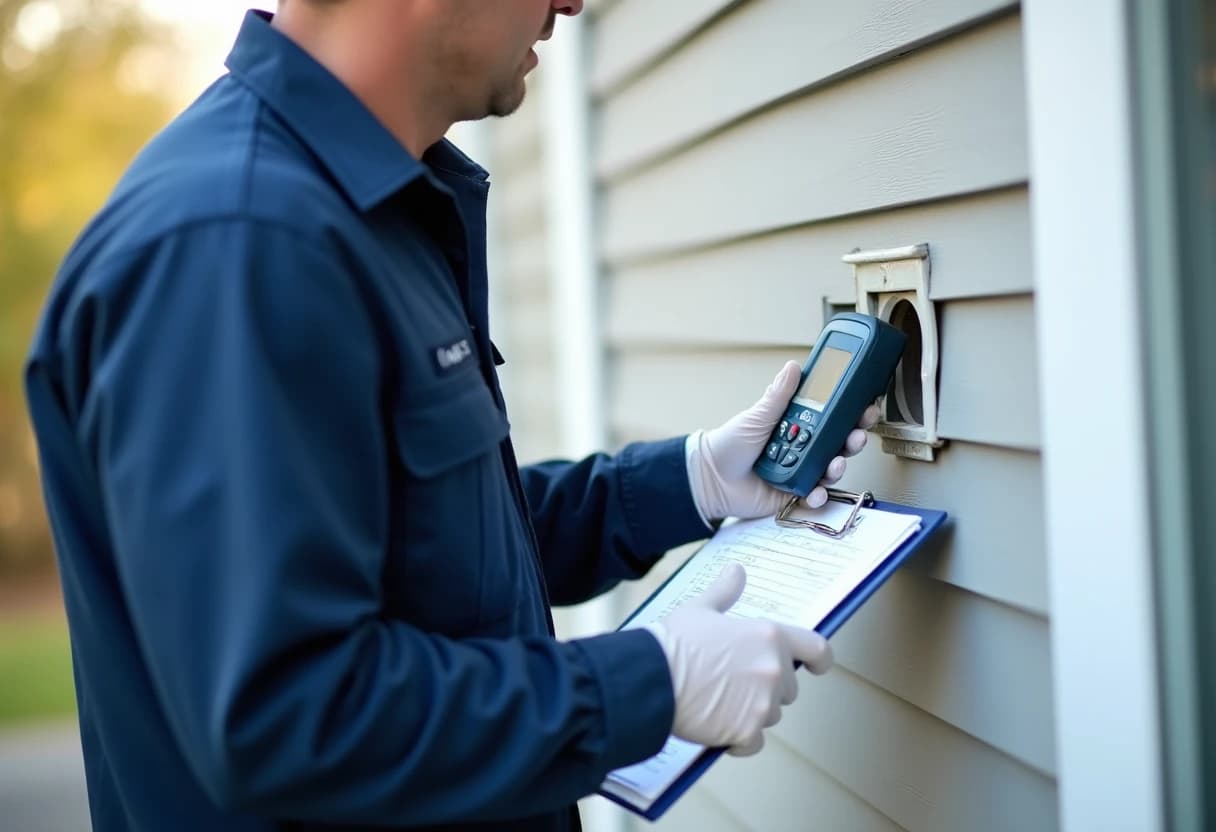
Think of a dryer vent inspection as an annual physical for the hardest-working exhaust duct in your house. In one visit, our Lynn technician verifies four things: that air is actually moving at the volume a dryer requires, that the duct interior is not accumulating a dangerous lint load, that the exterior hood and damper open freely and seal properly, and that the installation follows the code rules written to prevent dryer fires — smooth metal duct, legal length, proper joints. Most inspections take under an hour. Many end with good news; the rest catch a developing hazard years before it becomes a house-fire statistic or a dead heating element.
Why Dryer Vent Inspection & Safety Check Matters for Lynn Homes
An inspection is also how you avoid paying for cleaning you do not need. The dryer vent industry has its share of fear-based selling — alarming flashlight photos, on-the-spot 'emergency' upsells — and the antidote is measurement. Airflow in cubic feet per minute is not an opinion; a camera image of the duct interior is not a sales pitch. When we inspect a Lynn home, the verdict follows the evidence: a short, straight, recently cleaned run that measures strong gets a clean bill of health and a reminder for next year. A long run with visible packing, a stuck damper or a code violation gets a specific, photographed finding and a flat-rate quote to fix exactly that. Homeowners who start with an inspection consistently spend less over time than those who buy blind cleanings on a calendar schedule — and they carry documentation the calendar-cleaners never have.
We inspect dryer vents all over Lynn — around Lynn Auditorium, out toward Lynn Woods Reservation, and everywhere between — and the local pattern is clear: the age of the home predicts the condition of the vent. Lynn is one of the North Shore's densest triple-decker cities, layered with Victorian two-families in the Diamond District, shoe-factory-era workers' housing near downtown and post-war capes out toward Wyoma. Many multifamilies have had gas furnaces and ducted systems squeezed into basements and closets over the decades, producing tight, kinked runs that trap dust and lint. Many of these properties still carry original or improvised exhaust runs: plastic or foil flex duct that predates modern code, terminations without functioning dampers, and lengths that exceed the 35-foot equivalent limit once the elbows are counted. Between salt air off Lynn Shore Drive and the sheer age of the city's triple-decker stock, we see more corroded vent terminations and moisture-streaked ductwork here than almost anywhere on the North Shore. Shared basements and stacked units also mean one clogged dryer duct can affect three households at once. Because our shop is in West Newton, about 18 miles away, a Lynn inspection is an easy route stop — most appointments are available within days, and combined inspection-plus-cleaning visits are our most-booked option in the area.
Our Dryer Vent Inspection & Safety Check Process in Lynn
1Interview & Visual Assessment
Every inspection opens with a short conversation and a visual survey. Drying times, error codes, humidity in the laundry room and the age of the installation all steer the inspection. The technician checks the transition duct behind the dryer first — foil accordion duct and plastic flex are immediate findings, since both are recognized fire hazards.
2Airflow Measurement at the Termination
With the dryer running on air-only, we measure exhaust velocity at the exterior termination using a calibrated anemometer and convert it to airflow volume. A healthy vent typically delivers strong, steady flow; a weak reading quantifies restriction before we ever look inside. This number anchors the whole report — objective, repeatable and comparable year over year.
3Full-Length Camera Inspection
This is the step no flashlight can replace: a camera pass of the complete exhaust run, wall cavities and ceiling sections included. You can watch live as it travels. Lint depth, joint condition, duct material transitions and any obstructions are recorded, and representative frames go into your written report as evidence for every finding.
4Termination Hood & Damper Check
Outside, we evaluate the termination: does the damper open fully under dryer airflow and close cleanly at rest? Is the hood intact, sealed to the wall, and free of lint beards, paint-overs or screening that traps lint? A surprising share of vent failures live entirely at this last twelve inches of the system.
5Lint-Load Assessment & Fire-Risk Scoring
We translate the inspection into a plain-English risk score. You will know approximately what percentage of the duct's cross-section remains open, where the worst accumulation sits, and how urgent intervention is. FEMA attributes roughly 2,900 dryer fires a year primarily to lint — the score tells you honestly where your vent stands relative to that risk.
6Code-Compliance Review
We review the installation against the residential mechanical code for dryer exhaust: smooth rigid metal duct (not foil or plastic flex in concealed runs), a maximum of 35 feet equivalent length with deductions for each elbow, no screws penetrating the airstream, proper termination with a backdraft damper and no screen. Violations are photographed and explained.
7Written Safety Report & Recommendations
You receive a dated written report: airflow measurement, camera findings with photos, termination condition, lint-load score, code observations and a clear recommendation. It is formatted for practical reuse — insurance files, condo boards, real-estate disclosures — and it establishes the baseline every future annual inspection is compared against.
Benefits of Professional Dryer Vent Inspection & Safety Check in Lynn
Fire Risk Caught Before It Matters
Lint fires do not announce themselves; they accumulate. An inspection converts that slow, invisible buildup into a number and a photograph you can act on. Homeowners who inspect annually essentially never experience a vent-related fire, because the fuel never gets the chance to reach a dangerous load.
A Written Report You Can Actually Use
Documentation has quiet value that compounds. After a kitchen fire two streets over, your insurer asks about dryer maintenance — you have a dated report. A buyer's inspector flags the vent — you produce this year's inspection and the issue evaporates. The paper trail costs nothing extra; it comes standard.
Real-Estate & Insurance Documentation
Condo associations and landlords in Massachusetts are steadily adding dryer vent verification to their maintenance requirements after well-publicized multi-family lint fires. Our per-unit reports satisfy property managers and boards in one visit, with scheduling built for buildings — multiple units, one appointment block, individual documentation.
Protection From Moisture & Carbon Monoxide
Gas dryer owners get an extra layer of safety from inspection: the same duct carrying lint and moisture carries combustion exhaust. Verified airflow and a tight, intact run mean carbon monoxide leaves the house completely — a check that takes minutes and covers a risk most homeowners never consider.
No Unnecessary Cleanings
The $79 inspection frequently saves the $200 cleaning. When airflow measures strong and the camera shows light accumulation, we say so in writing and leave. Customers who used to buy blind annual cleanings routinely discover their actual interval is longer — and their total maintenance spend drops accordingly.
Lower Drying Costs & Longer Appliance Life
A restricted vent makes every load take longer, and longer cycles cost real money in electricity or gas — often hundreds of dollars a year in heavy-laundry households. Inspection catches restriction at the stage where a single cleaning restores one-cycle drying and normal operating costs.
Signs Your Lynn Home Needs Dryer Vent Inspection & Safety Check
Insurance, Condo or Sale Requirements
Listing your home this season? Handle the vent before the buyer's inspector does. A pre-listing inspection either produces a clean report for your disclosure package or surfaces a modest repair you control the pricing of — versus a finding that becomes a closing-table concession.
Recent Renovation, New Dryer or New Home
A new dryer on an old duct is a mismatch worth checking: modern high-efficiency machines are sensitive to back pressure, and installers rarely camera the existing run. Manufacturers void heat-related warranty claims on restricted vents, so a post-install inspection protects a four-figure appliance for a two-figure fee.
Clothes Take More Than One Cycle
Drying time is the vent's report card. Loads that once took 45 minutes now taking 80 means delivered airflow has fallen substantially — and every extra minute is money and heat stress. If your laundry routine has quietly stretched over the past year, the duct is asking for an inspection.
You Cannot Remember the Last Service
If the vent has no service history you can name, assume it has never been inspected — most have not. NFPA guidance is simple: dryer exhaust should be checked at least annually. The first inspection establishes your baseline; every year after tracks the trend.
Burning or Musty Smells During Operation
Trust your nose. Scorched smells mean lint meeting heat; sour smells mean water pooling where it should not; animal odors mean something has moved into the duct or hood. Each has a distinct cause and a distinct fix, and a single camera inspection distinguishes among them definitively.
No Visible Exhaust at the Outside Hood
Step outside while the dryer runs: you should see the damper held open by strong airflow and feel a confident stream of warm air. A flap barely moving — or not moving at all — means severe restriction or a stuck damper, and the system needs professional attention.
Dryer Vent Inspection & Safety Check Cost in Lynn, MA
Three honest questions set your price. Where does the vent terminate — ground-level wall, second story, or roof? How long and complicated is the run — a straight 8-foot shot or 30 feet with four elbows through two floors? And is this a single home or a multi-unit building? Simple answers put you at $79; complex ones at $149; buildings get per-unit rates that drop with unit count. Two pricing notes worth knowing. First, our inspection fee is credited in full toward any cleaning we perform at the same visit, so the diagnostic never costs extra when work follows it. Second, beware of free inspections from cleaning companies — an inspection whose only revenue comes from selling you a cleaning is a sales call with a camera. Ours is priced as a standalone professional service precisely so the verdict can honestly be 'your vent is fine,' which it is roughly a third of the time.
Want the full pricing picture? See our complete Boston-area cost guide or call (617) 390-7145 for an exact flat quote for your Lynn home.
Local Knowledge: Lynn, Essex County
Serving Lynn means knowing Lynn. Lynn is one of the North Shore's densest triple-decker cities, layered with Victorian two-families in the Diamond District, shoe-factory-era workers' housing near downtown and post-war capes out toward Wyoma. Many multifamilies have had gas furnaces and ducted systems squeezed into basements and closets over the decades, producing tight, kinked runs that trap dust and lint. Between salt air off Lynn Shore Drive and the sheer age of the city's triple-decker stock, we see more corroded vent terminations and moisture-streaked ductwork here than almost anywhere on the North Shore. Shared basements and stacked units also mean one clogged dryer duct can affect three households at once. Those conditions shape how we work here: which brush heads come off the truck, how we protect finishes in older interiors, and what we expect to find when the camera goes into a 01902 duct system. Our crews are in and around Lynn nearly every week — often for neighbors of past customers — so scheduling is fast and our arrival windows hold.
The Best Time of Year in Lynn
Spring earns its own place on the inspection calendar because of what moves into vents between March and June: nesting birds. Starlings and house sparrows treat an uncapped or damaged dryer termination as prime real estate, and a nest turns a healthy vent into a near-total blockage within days. Our spring inspections put extra attention on the termination — damper integrity, hood condition, evidence of nesting activity — and catch bird problems before eggs complicate a humane removal. Spring is also when winter's damage surfaces: hoods cracked by ice, dampers stiffened by corrosion, joints loosened by months of freeze-thaw movement in the structure.
Why Choose Boston Air Duct Cleaners
Homeowners across Essex County choose Boston Air Duct Cleaners for three reasons. First, honesty: our inspection camera tells you whether your system actually needs cleaning — and sometimes the answer is no. Second, capability: truck-grade negative-air machines, rotary brush systems and HEPA filtration handle everything from antique gravity-furnace conversions to brand-new high-velocity systems. Third, accountability: flat quoted pricing, before-and-after photos, insured technicians, and a real local office you can call at (617) 390-7145. That combination is rarer in this industry than it should be.
Serving Lynn and Surrounding Communities
We serve every community around Lynn as well: Swampscott, Nahant, Saugus, Salem, Peabody, Revere all fall inside our regular service routes. If you have a second property, a rental, or family nearby, ask about multi-home scheduling — grouped appointments on the same route are our most requested discount.