
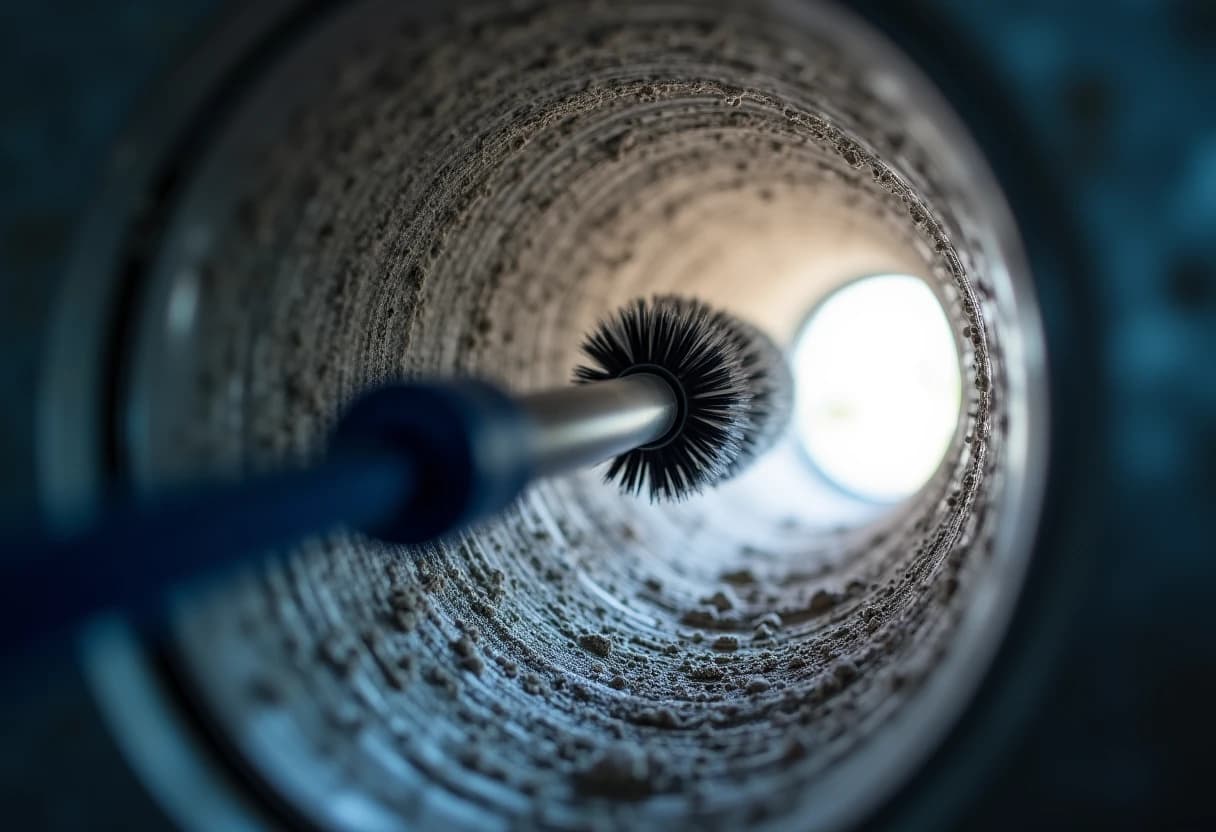
If you can write your name in the dust on a supply register, imagine what is coating the ductwork behind it. Air duct cleaning is one of the most effective single steps a Milford homeowner can take to improve indoor air quality, and it is one of the most commonly skipped. We clean the complete system — every supply run, every return, the main trunks, and the components around your air handler — using commercial negative-pressure equipment that pulls debris out of the home rather than blowing it around. Most homes are finished in a few hours, and the difference in air quality is noticeable the same day.
Why Air Duct Cleaning Matters for Milford Homes
Most duct systems have never been cleaned since the day they were installed. Over a decade or two, they accumulate a startling load: drywall dust from renovations, sawdust from the original construction, decades of household dust, pet hair, insect debris, and in humid basements, active microbial growth. That material does three damaging things. First, it degrades air quality — fine particles recirculate into living spaces and aggravate allergies, asthma and sinus issues. Second, it chokes airflow — a thin mat of dust on duct walls and blower blades measurably reduces system output, forcing longer run times and higher utility bills. Third, it holds odors — pet, smoke and cooking smells cling to dust and re-release every time air moves. Professional cleaning addresses all three at once. It is especially important after renovations, water events, or buying a home, when you inherit the previous owner's decades of accumulation, whatever pets they kept, and whatever they smoked.
From condos near Draper Memorial Park to single-families out toward Louisa Lake, Milford duct systems share a common biography: installed decades ago, modified during every renovation since, and cleaned rarely if ever. Milford's downtown blocks are filled with two-family homes and workers' cottages from the town's pink-granite quarrying era, many built between 1870 and 1930, while the outer neighborhoods added split-levels, raised ranches and subdivision Colonials from the 1960s onward. The older multifamilies were built for coal and steam heat, so their forced-air systems are retrofits with ducts squeezed through balloon-framed walls. Newer condo developments near the Upper Charles Trail run compact, builder-grade duct systems. The result is a hidden layer of dust, dander and debris that recirculates through living spaces every time the blower starts. Milford's granite-era two-families often share tight basements where the furnace, laundry and storage compete for space, and we frequently find lint-choked dryer runs and crushed flex duct in them. The town's steady conversion of older homes into rentals means many systems change hands without ever having been cleaned. As a local company based just 26 miles away in West Newton, we have cleaned hundreds of systems like these across Worcester County. We quote flat, honest pricing by system — never per-vent teaser rates that balloon on site.
Our Air Duct Cleaning Process in Milford
1Whole-Home Inspection & System Assessment
We begin by walking the entire system with you: air handler, returns, supplies, and trunk lines. The technician documents pre-cleaning conditions with photos, identifies any damaged or disconnected runs, and flags anything unusual — moisture staining, pest evidence, crushed flex duct. Only after you approve the confirmed scope and price does cleaning begin.
2Protect the Home & Seal the System
Before any equipment starts, we lay floor protection along work paths, use corner guards on tight stairways, and wear boot covers indoors. Every register is then sealed with magnetic covers or poly sheeting so that once negative pressure is established, air can only flow where we direct it — through the debris-collection system, never into your rooms.
3Establish Negative Pressure
A commercial vacuum unit is coupled to the trunk lines near the air handler, placing the full system under strong negative pressure. This is the heart of source-removal cleaning: with the ducts depressurized, agitated debris cannot drift back into rooms — it is pulled the length of the system and captured in HEPA filtration.
4Mechanical Agitation of Every Duct Run
This is where the real cleaning happens. Pneumatic whips, rotating brushes and directional air nozzles are fed through every supply and return run, physically dislodging the mat of dust, hair and debris bonded to duct surfaces. The negative pressure immediately carries everything to the collection unit. Stubborn buildup gets repeat passes until camera checks show bare metal.
5Clean the Air Handler Components
While the ducts drain into the vacuum, your technician opens the furnace or air handler and details the components air actually touches: blower assembly, housing interior, plenums and accessible panels. This step matters because a freshly cleaned duct system fed by a dust-caked blower re-contaminates in months.
6Optional Sanitizing & Deodorizing Treatment
If your system showed microbial staining or holds onto smells, we finish with an antimicrobial fogging treatment — EPA-registered chemistry, applied at label rates, safe for occupied homes once dry. Customers dealing with musty summer odors or lingering previous-owner smells consistently rate this the most noticeable part of the service.
7Final Verification & Walkthrough
Before we pack up, everything goes back exactly as it was: registers remounted, furniture returned, floors vacuumed with our HEPA equipment. Your technician reviews the photo documentation with you, answers questions, and registers your service date so we can remind you when the next inspection is actually due — typically two to three years out.
Benefits of Professional Air Duct Cleaning in Milford
Measurably Cleaner Indoor Air
Removing the duct-borne reservoir of dust, dander, pollen and spores means the air leaving your registers is no longer recontaminated on its way to you. Households consistently report less airborne dust, fresher-smelling rooms and easier breathing within a day of a proper source-removal cleaning — because the source really is gone.
Relief for Allergy & Asthma Sufferers
If antihistamines are a daily ritual in your house, look at what the return grilles have been inhaling for years. Cleaning the system removes the allergen bank feeding your symptoms — dander from pets past and present, dust-mite debris, and the pollen load of many springs — instead of treating the symptoms one tissue at a time.
Lower Energy Bills & Better Airflow
Static pressure is the silent tax on dirty systems: every gram of dust on blower blades and duct walls makes the fan work harder for less delivered air. After a full cleaning, registers blow noticeably stronger, cycles shorten, and the utility bill reflects it — savings that recur every month afterward.
Elimination of Musty & Stale Odors
Odors live in dust. Pet smells, cooking residue, smoke and general staleness bind to the organic film inside ducts and re-release with every air cycle — which is why the smell returns no matter how much you clean the rooms. Remove the film and the odor source leaves with it.
Less Dust on Every Surface
If you dust on Saturday and see a fresh film by Wednesday, your ducts are the supplier. Every blower cycle lifts particles off contaminated duct walls and distributes them across shelves, screens and furniture. Customers repeatedly tell us the two-week dusting cycle stretches to six or more after cleaning.
Longer HVAC Equipment Life
Your blower motor was engineered to push air through clean ducts. Ask it to push through dust-choked runs year after year and it wears out early — usually mid-January. Keeping the air path clean lets every component run cooler and last longer, deferring the biggest repair bills a homeowner faces.
Signs Your Milford Home Needs Air Duct Cleaning
Recent Renovation or Construction Work
Drywall sanding produces microscopic gypsum dust that infiltrates every open register and rides the airstream for months, coating rooms far from the work zone. If you renovated without sealing and cleaning the ducts afterward, the system is still distributing construction dust today.
Visible Dust Blowing From Registers
If you see puffs of dust when the system starts, or gray streaking on walls and ceilings around supply registers, the ducts are shedding their accumulation into your rooms. That visible fraction is a small sample of what the airstream carries invisibly — a classic, unambiguous sign the system needs cleaning.
Allergies or Asthma Acting Up Indoors
When symptoms flare at home but ease outdoors or at work, your indoor air is the suspect — and ducts are its distribution system. Sneezing on waking, congestion that tracks the heating season, and asthma that worsens when the AC runs all point toward duct-borne allergen circulation.
Musty Smell When Heat or AC Turns On
A damp, earthy odor in the first minutes of a cycle usually means microbial growth or odor-saturated dust inside the ducts or on the coil. It is most common after humid summers and in systems with basement returns. The smell is a symptom; the biology producing it is the problem.
Mold, Moisture or Pest Evidence
Visible growth on registers, insulation or duct interiors is an EPA-listed trigger for immediate professional cleaning. So are droppings, nesting material or insect debris. Both contaminate the airstream serving every room and warrant prompt, documented remediation.
It Has Simply Never Been Done
NADCA guidance is inspection every couple of years, cleaning as conditions warrant. For a system with no service history at all, the probability that cleaning is warranted approaches certainty — Greater Boston's older housing stock virtually guarantees it.
Air Duct Cleaning Cost in Milford, MA
For budgeting purposes: routine residential cleanings cluster between $350 and $700; post-renovation cleanings run 20–40% higher due to the volume of fine debris; and cleanings paired with confirmed microbial growth may add $75–$300 for EPA-registered antimicrobial application. Commercial and multi-family work is quoted per system after a walkthrough. Two factors work in your favor. First, cleaning is infrequent — a properly cleaned system in a typical home stays clean for three to five years, so the annualized cost is modest. Second, the efficiency recovery is real: restoring full airflow trims runtime on every heating and cooling cycle, and customers with previously choked systems often recoup a meaningful share of the cost in the first year's utility bills. We offer bundled pricing when duct cleaning is combined with dryer vent cleaning — the most popular package we sell.
Want the full pricing picture? See our complete Boston-area cost guide or call (617) 390-7145 for an exact flat quote for your Milford home.
Local Knowledge: Milford, Worcester County
What makes Milford different? Milford's downtown blocks are filled with two-family homes and workers' cottages from the town's pink-granite quarrying era, many built between 1870 and 1930, while the outer neighborhoods added split-levels, raised ranches and subdivision Colonials from the 1960s onward. The older multifamilies were built for coal and steam heat, so their forced-air systems are retrofits with ducts squeezed through balloon-framed walls. Newer condo developments near the Upper Charles Trail run compact, builder-grade duct systems. Milford's granite-era two-families often share tight basements where the furnace, laundry and storage compete for space, and we frequently find lint-choked dryer runs and crushed flex duct in them. The town's steady conversion of older homes into rentals means many systems change hands without ever having been cleaned. For duct and dryer vent systems, those local factors translate into specific, predictable problems — and predictable problems are the ones we solve fastest. Call (617) 390-7145, tell us your street and home style, and we will quote the job accurately the first time, usually in under five minutes.
The Best Time of Year in Milford
Greater Boston's climate works ducts hard from both directions: a heating season that can run October into April, and increasingly humid summers that push indoor moisture into the duct network. That cycle — damp organic dust in summer, baked dust in winter — is precisely what generates odor complaints and microbial growth in local systems. Homes that close up tight for winter also concentrate whatever the ducts hold, which is why indoor air complaints peak in January and February. A clean system heading into the closed-window months is the single best air-quality preparation a Massachusetts homeowner can make.
Why Choose Boston Air Duct Cleaners
Choosing a duct cleaner is really a trust decision — you are letting a crew work inside the system that feeds air to your family. We make that decision easy: a local West Newton company with insured, uniformed technicians, transparent flat-rate quotes, NADCA-standard equipment and methods, and photographic proof of the finished work. No door-to-door sales, no bait-and-switch coupons, no invented 'mold emergencies.' Just honest mechanical cleaning done properly the first time, backed by a written guarantee.
Serving Milford and Surrounding Communities
Milford sits in the heart of our service area, and neighboring Hopkinton, Holliston, Mendon, Bellingham, Medway, Upton appointments share the same routes. That density is why our response times in this part of Worcester County are among our fastest — and why you will see our trucks in the area week after week.