
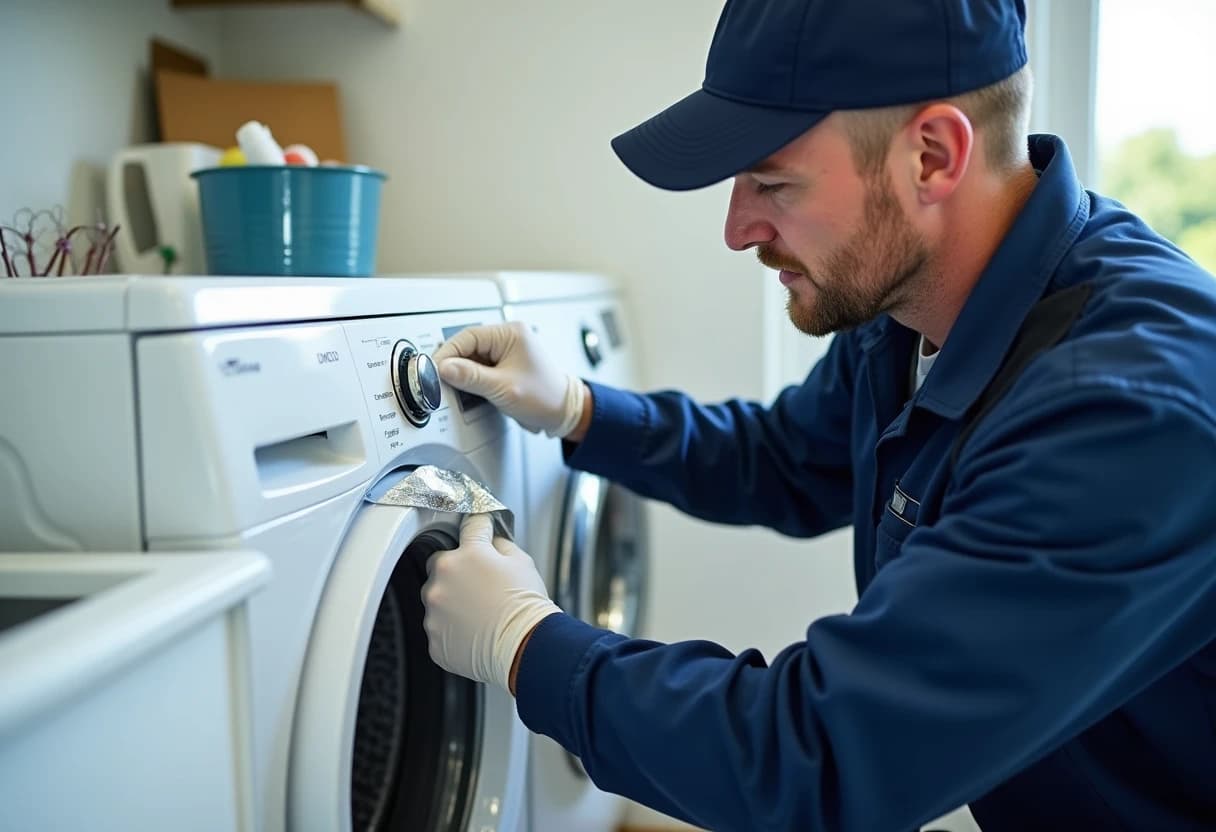
Dryer exhaust is hot, humid, lint-laden air, and every foot of duct it travels through must be intact and sealed. A single disconnected joint dumps a gallon of moisture per load into a wall cavity or ceiling — along with a steady supply of highly flammable lint. We repair dryer vents throughout Milford: reconnecting and properly securing separated ducts, replacing damaged runs and non-compliant flex materials with smooth rigid metal, curing chronic condensation problems, and replacing broken exterior hoods and bird-guard dampers. Repairs are quoted flat after diagnosis, typically $150 to $450, and every job ends with an airflow verification and photos of the completed work.
Why Dryer Vent Repair Matters for Milford Homes
The materials in your dryer vent matter as much as its condition, and much of Greater Boston's housing stock carries materials that should never have been installed. White vinyl accordion hose — sold for decades and still lurking behind older dryers — is a documented fire hazard: it melts, its ridges pack with lint, and manufacturers and codes alike have disowned it. Thin foil accordion duct is only marginally better, crushing at a touch and snagging lint on every corrugation. Long concealed runs of flex duct, plastic terminations, screen-covered hoods that mat over with lint, and duct-taped seams round out the list of what we routinely find and replace. Modern code — the IRC's dryer exhaust provisions — calls for smooth-interior rigid metal duct, joints without protruding fasteners, and a proper damper-equipped termination, because decades of fire data show those details are where dryer venting goes wrong. Repairing with compliant materials is not bureaucratic box-checking: it is the difference between a vent that needs annual cleaning and a vent that builds a new hazard every year.
Ask a home inspector working around Memorial Hall what they flag most in Milford laundry areas and dryer venting is near the top of the list: vinyl accordion hose, duct-taped joints, screened hoods, runs far beyond code length. Milford's downtown blocks are filled with two-family homes and workers' cottages from the town's pink-granite quarrying era, many built between 1870 and 1930, while the outer neighborhoods added split-levels, raised ranches and subdivision Colonials from the 1960s onward. The older multifamilies were built for coal and steam heat, so their forced-air systems are retrofits with ducts squeezed through balloon-framed walls. Newer condo developments near the Upper Charles Trail run compact, builder-grade duct systems. Milford's granite-era two-families often share tight basements where the furnace, laundry and storage compete for space, and we frequently find lint-choked dryer runs and crushed flex duct in them. The town's steady conversion of older homes into rentals means many systems change hands without ever having been cleaned. We do the corrective work those inspection reports call for — rigid metal replacement, code-compliant reconnections, proper terminations — with documentation that satisfies buyers, sellers and insurers alike. Neighbors in Hopkinton and Holliston use us for the same pre-sale and post-purchase repairs, which keeps our trucks in this corner of Worcester County nearly every week.
Our Dryer Vent Repair Process in Milford
1Diagnose the Full Exhaust Path
Repair starts with finding every failure, not just the obvious one. We trace the duct from the dryer's outlet to the exterior termination, inspecting each accessible section and joint, and test airflow at both ends with the dryer running. Weak exterior flow with strong drum heat means the exhaust is escaping en route — and we find where.
2Protect the Area & Open Access
Laundry areas are tight, finished spaces, and we work in them accordingly: drop cloths, boot covers, and careful handling of the appliance and its gas or electrical connections. Gas dryers get particular care around the flexible connector — we never strain a gas line to reach a duct.
3Reconnect & Properly Fasten Separated Joints
Where lint and moisture have escaped into a cavity through a long-standing disconnection, we vacuum accessible accumulation with HEPA equipment and document conditions with photos. Removing that hidden fuel load matters as much as the reconnection itself — and the photos give you a record for insurance or future renovation planning.
4Replace Crushed, Corroded or Non-Compliant Sections
Duct that is crushed, kinked, rusted through or made of prohibited material gets replaced, not patched. We install 4-inch smooth-interior rigid metal duct — the material the IRC's dryer exhaust rules specify — cut to fit, joined without airstream-piercing fasteners, and supported so it cannot sag into water-pooling bellies.
5Cure Condensation: Slope, Seal & Insulate
Condensation repairs follow the water. We restore continuous slope toward the termination so condensate drains out instead of pooling; seal the joints it has been leaking through with foil tape rated for the duty; and insulate duct sections crossing unheated basements, garages, attics and exterior wall bays so exhaust stays above its dew point until it exits.
6Repair or Replace the Exterior Hood & Damper
Where pests have entered through a failed damper, we remove nesting material from the duct, clean the affected section, and install a termination with pest protection that does not restrict airflow. If the old hood was painted shut — common on older multi-family buildings — we free or replace it and note the repaint risk for the future.
7Replace the Transition Duct & Reset the Dryer
The appliance connection is rebuilt to spec: a UL-listed semi-rigid aluminum transition duct, as short and straight as the layout allows, secured with clamps at both ends. We position the dryer so the connector keeps its full diameter — not crushed against the wall — and mark the safe distance so future pushes do not recreate the old kink.
8Verify Airflow & Document the Repair
You receive photo documentation of the failures found and the repairs made — valuable for insurance files, condo associations, home sales and your own records. We also note the condition of everything we did not repair, so you have an honest picture of the vent's remaining lifespan and its next likely maintenance date.
Benefits of Professional Dryer Vent Repair in Milford
Code Compliance & Inspection-Ready Documentation
For condo owners, documented code-compliant repair satisfies association requirements and insurance due diligence in one visit. We provide written scopes for board approval beforehand and completion records with photos afterward — paperwork that matters when a shared building's fire safety is the subject.
A Serious Fire Hazard, Eliminated
A breached or restricted dryer vent combines the two ingredients of the roughly 2,900 annual US dryer fires: accumulating lint and rising exhaust temperatures. Repair removes both — the escape points that seed wall cavities with fuel, and the crush points and blockages that overheat the system. It is fire prevention with a wrench, and it lasts for decades.
Decades of Reliable Service From One Repair
Done with rigid metal, mechanical fastening and a quality termination, a dryer vent repair is not a patch — it is infrastructure. Properly installed rigid duct routinely outlasts the dryers connected to it, needing only annual cleaning. The failure-prone materials and joints that caused your problem simply are not there anymore.
Pest Entry Points Closed
Pest damage rarely stays at the hood: rodents that enter a duct chew insulation and nest against warm sections deep in the run. Closing the entry point promptly is far cheaper than the extended cleaning and repair an established rodent presence demands — one more reason failing dampers deserve fast attention.
Lower Energy and Repair Bills
A dryer fighting a damaged vent runs longer per load and hotter per minute — both metered directly on your utility bill, often $10 to $20 a month for a busy household. Repair returns cycles to design length. The savings recur every laundry day, quietly repaying the one-time repair cost within the first year or two.
Restored Drying Performance
Customers are often startled by the change: a vent we repaired after years of gradual crushing gives them back the dryer they bought. If your drying times worsened after an appliance delivery, a renovation, or a move of the machine — events that crush transitions and separate joints — repair, not replacement, is very likely the answer.
Signs Your Milford Home Needs Dryer Vent Repair
Musty or Mildew Smell in the Laundry Area
If freshly dried clothes pick up a sour or musty note, moisture is lingering somewhere in the exhaust path — often damp lint mats in a bellied or leaking duct section. Cleaning removes the mats; repair fixes the sag or leak that created them. Without the repair, the mats and the smell return.
Water Stains, Drips or Peeling Paint Near the Vent Path
Rust streaks on duct exteriors, corroded clamps and white mineral tracks at joints are the slow-motion version of the same evidence: repeated internal condensation escaping over months. Left alone it rusts through the duct wall; caught early, the fix is sealing and insulation rather than replacement.
Lint Appearing Where It Shouldn't
Check the floor and framing along the vent's path, especially in basements where runs hang exposed: a dusting of gray fiber below any joint is a positive test for leakage there. The joint may look intact from below while a gap on top sheds lint and moisture into the cavity above it.
Exterior Damper Broken, Stuck or Missing
Cold drafts in the laundry room trace to the damper more often than to windows: a flap that no longer closes turns the duct into a 4-inch outside-air inlet. If the laundry area runs noticeably colder in winter than adjacent rooms, put the hood on your inspection list — the heating-season savings from a tight new damper are immediate.
Visibly Damaged, Kinked or Sagging Duct
Accordion-style foil or vinyl duct anywhere in the run is damage by definition — materials that codes and manufacturers rejected because they crush, snag lint and (in vinyl's case) melt. If you can see corrugations along your vent path, the repair recommendation writes itself: replace with smooth rigid metal.
Slow Drying That Cleaning Didn't Fix
If a vent cleaning did not restore drying performance, the airflow restriction is structural: a crushed section, a collapsed inner liner, a separated joint dumping exhaust short of the hood, or a damper that cannot open. The next step is diagnosis, not another cleaning — we trace the path, find the mechanical fault, and quote its repair flat.
Dryer Vent Repair Cost in Milford, MA
Dryer vent repair in Greater Boston typically runs $150 to $450, and the spread is about what failed and where. At the low end: transition hose replacement with a compliant semi-rigid connector, exterior hood and damper replacement, or reconnecting an accessible separated joint — each roughly $150 to $250 including parts. Mid-range, $250 to $350, covers replacing damaged duct sections with rigid metal, curing condensation with re-sloping, sealing and insulation, or repairs involving moderate access work. The top of the range, $350 to $450, reflects concealed-joint repairs requiring access openings, multi-failure jobs combining several fixes, corroded runs needing substantial replacement, or difficult terminations on upper walls and roofs. Every quote is flat and follows a diagnosis you can see — photos of the actual failure — so you know what you are paying to fix. If damage is extensive enough that full replacement or rerouting makes better sense than repair, we say so and quote that option separately rather than selling repairs onto a duct that has reached its end.
Want the full pricing picture? See our complete Boston-area cost guide or call (617) 390-7145 for an exact flat quote for your Milford home.
Local Knowledge: Milford, Worcester County
Every town's ductwork tells the story of its housing. Milford's downtown blocks are filled with two-family homes and workers' cottages from the town's pink-granite quarrying era, many built between 1870 and 1930, while the outer neighborhoods added split-levels, raised ranches and subdivision Colonials from the 1960s onward. The older multifamilies were built for coal and steam heat, so their forced-air systems are retrofits with ducts squeezed through balloon-framed walls. Newer condo developments near the Upper Charles Trail run compact, builder-grade duct systems. Milford's granite-era two-families often share tight basements where the furnace, laundry and storage compete for space, and we frequently find lint-choked dryer runs and crushed flex duct in them. The town's steady conversion of older homes into rentals means many systems change hands without ever having been cleaned. We plan Milford jobs around those realities, from equipment selection to time on site, and it shows in the results. If you live near Draper Memorial Park or anywhere across Milford's 01757 area, we have almost certainly cleaned a system like yours before — and we can tell you exactly what to expect before we arrive.
The Best Time of Year in Milford
Humid Massachusetts summers stress the concealed portions of the vent. High dew points mean exhaust barely cools before reaching saturation, so any bellied, unsloped or leaking duct section collects water through the muggy months — soaking lint into mats, feeding the mildew smells homeowners notice in August, and rusting galvanized duct from the inside. Basement laundry areas, already fighting ambient summer humidity, compound the effect. Summer is consequently when condensation damage advances fastest and when its symptoms — sour-smelling laundry, damp walls near the vent path, visible drips at joints — are easiest to catch. A summer diagnostic visit finds the moisture while it is active, which makes the repair scope precise rather than speculative.
Why Choose Boston Air Duct Cleaners
We built this company around the jobs other duct cleaners do badly: the 130-year-old Victorian with panned-joist returns, the Milford condo with a 60-foot dryer run to the roof, the post-renovation house full of drywall dust. Our crews see Greater Boston's hardest systems every week, and the experience shows in the details — floor protection on the way in, sealed registers during the work, HEPA-vacuumed work areas on the way out, and imagery that proves the ducts are actually clean. Call (617) 390-7145 and judge the difference from the first conversation.
Serving Milford and Surrounding Communities
We serve every community around Milford as well: Hopkinton, Holliston, Mendon, Bellingham, Medway, Upton all fall inside our regular service routes. If you have a second property, a rental, or family nearby, ask about multi-home scheduling — grouped appointments on the same route are our most requested discount.