
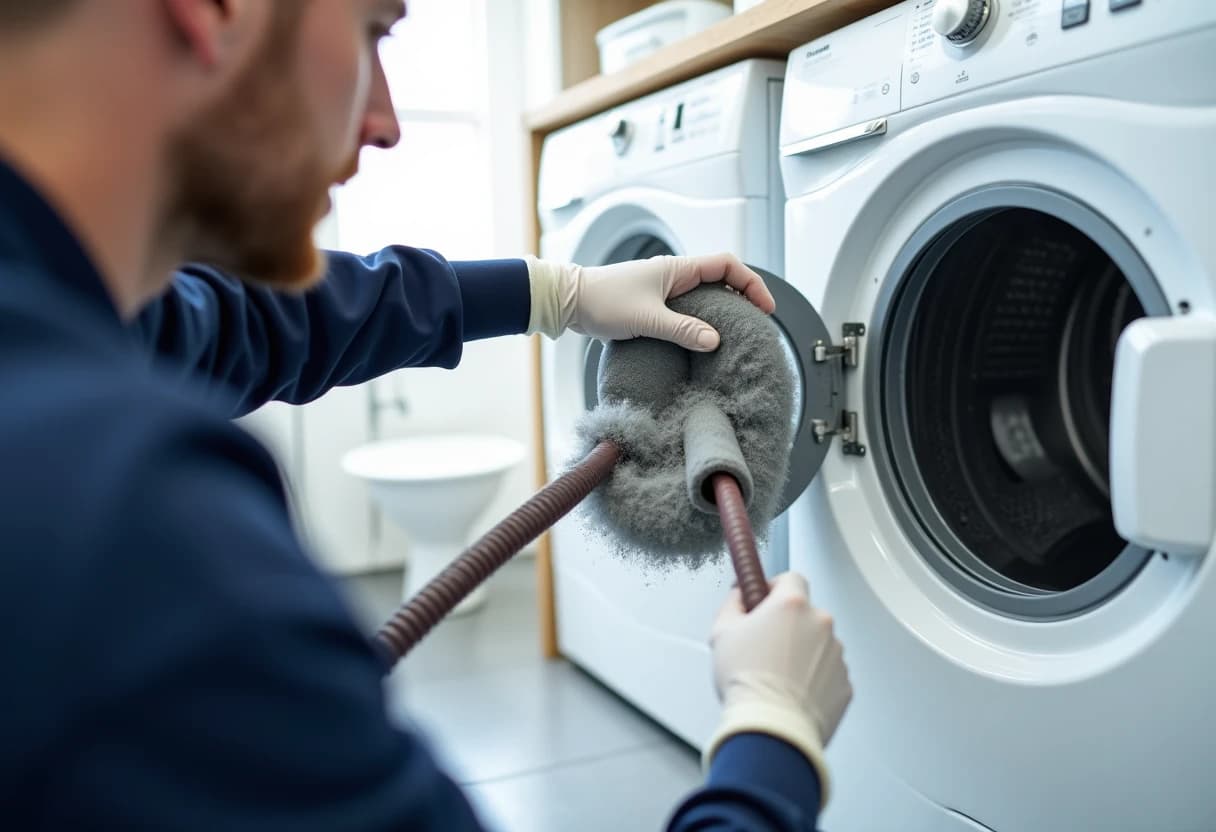
Every load of laundry sheds lint, and your dryer's lint screen catches only a fraction of it. The rest travels into the exhaust duct, where it snags on joints, elbows and screw tips and slowly packs the line shut. FEMA estimates around 2,900 home clothes dryer fires occur in the US every year, and failure to clean the vent is the leading contributing factor. Our Millis dryer vent cleaning service removes that hazard completely: a rotary brush scrubs the full length of the duct while a HEPA vacuum captures the lint, and we clean from both the dryer side and the exterior termination so nothing is left behind.
Why Dryer Vent Cleaning Matters for Millis Homes
There are moments when dryer vent cleaning becomes urgent rather than routine. If you have just bought a home, you inherit a vent with an unknown history — quite possibly never cleaned since installation, and in older Massachusetts homes possibly lined with decades of lint. If your dryer is new, manufacturers require a clear vent for warranty coverage, and installers rarely clean the existing duct. If your vent terminates on the roof, wildlife may have added a nest to the lint; bird and rodent nesting in dryer terminations is one of the most common blockages we clear. And if you have ever smelled something burning during a cycle or had a load come out hot but wet, the vent needs attention now, not at the next convenient interval. In every one of these situations, a single professional cleaning re-establishes a known-clean baseline — after which an annual schedule keeps it that way for a modest, predictable cost.
Ask around Charles River and you will find neighbors who learned about dryer vent fires the hard way — a scorched load, a melted transition hose, a fire department visit. Low-lying stretches of Millis near the Charles River and Bogastow Brook keep basements damp for much of the year, and moisture migrating into basement duct runs is the top issue we see locally. Homes near the town's working farms also pull in more field dust and pollen than owners realize. Millis mixes a small nineteenth-century village center with waves of postwar capes and ranches, followed by 1980s-to-2000s Colonial subdivisions off Orchard and Village Streets. Most of the postwar homes have had central air added onto aging furnace ductwork, creating mismatched systems where new equipment pushes air through fifty-year-old sheet metal. Slab-on-grade ranches here often run ducts through attics, where summer heat stresses every joint. Those local conditions are why we treat Millis dryer vent cleaning as a safety service, not a courtesy add-on: full-length rotary brush cleaning, HEPA capture, termination and damper service, transition duct inspection, and an airflow check at the end that proves the line is clear. Residents of Medway and Medfield book the same service, which is why our trucks are in this part of Norfolk County nearly every week.
Our Dryer Vent Cleaning Process in Millis
1Inspect the Dryer, Transition Duct & Vent Path
First we establish what we are cleaning: duct material, run length, number of bends, and termination type. We also measure baseline airflow at the exterior hood with the dryer running. That number matters — it is how we prove, at the end of the visit, that the cleaning actually restored the exhaust capacity your dryer needs.
2Protect the Laundry Area & Disconnect the Dryer
We treat laundry rooms — often tight, finished spaces — with the same care as any living area: drop cloths down, dryer walked out on protective sliders, and the work zone contained. Disconnecting at the appliance gives us a clean entry point into the duct and a chance to inspect the connection hardware that so often leaks lint into the wall cavity.
3Rotary Brush the Full Length of the Duct
Mechanical agitation is what separates professional cleaning from blow-through methods. The rotary brush physically breaks up compacted lint that air pressure alone would only compress further. We select brush heads sized to your duct — standard 4-inch for code-compliant lines, alternates for older oversized or reduced runs — so the bristles actually contact the duct wall the whole way.
4Capture Everything With HEPA Vacuum Extraction
As the brush works, a HEPA-filtered vacuum runs simultaneously on the duct, pulling loosened lint into a sealed collection system instead of letting it blow into your laundry room or yard. The combination — agitate and extract at once — is what leaves the duct genuinely empty rather than redistributing the clog.
5Clean From the Exterior Termination Inward
We then work the line from the outside in — wall hood, soffit outlet or roof cap. Exterior terminations trap their own debris: lint mats behind the damper, bird and rodent nests, and screening clogged solid. Roof terminations get full ladder or roof access; we carry the gear, and steep or high work is included in the quoted price.
6Service the Transition Duct & Reconnect
The short duct connecting dryer to wall does more harm than its length suggests — crushed, kinked or made of plastic, it can choke an otherwise clean system. We clean it, or if it is damaged or made of hazardous foil or vinyl accordion material, we recommend replacement with a semi-rigid aluminum connector, usually installed on the spot for a small parts charge.
7Verify Airflow & Walk You Through the Results
Final checks: test cycle run, exhaust verified at the hood, laundry area vacuumed and everything returned to place. If we found issues cleaning cannot fix — overlong runs, crushed sections, illegal materials — you get straight documentation and a separate quote, never pressure. Most vents simply need this cleaning, once a year, and nothing more.
Benefits of Professional Dryer Vent Cleaning in Millis
Lower Energy Bills
Every minute of unnecessary drying time is metered energy. A restricted vent that doubles cycle times roughly doubles the dryer's share of your utility bill — often $10 to $20 a month for an average household. Annual cleaning typically pays for a large fraction of itself in the first year of restored efficiency.
Less Moisture, Mildew & Musty Odor
Damp lint inside a restricted duct becomes a mold and bacteria medium — the source of the sour smell some dryers push into freshly washed clothes. Removing the lint removes the colony. If your 'clean' laundry has ever come out smelling worse than it went in, the vent is the likeliest culprit.
Documentation for Insurance, Condos & Peace of Mind
For landlords and multi-family owners, documented dryer vent service is due-diligence gold: it demonstrates fire-safety maintenance across units in a single record. We service whole buildings in one visit with per-unit documentation, which is why property managers across Greater Boston keep us on an annual rotation.
Longer Dryer Lifespan & Fewer Repairs
New dryers deserve clean vents from day one — manufacturers require adequate exhaust airflow for warranty coverage, and delivery crews almost never clean the existing duct. If you have recently replaced your dryer and skipped the vent, you have connected a new engine to a clogged tailpipe.
Safer Operation for Gas Dryers
For gas dryers, vent cleaning is combustion safety, not just lint management. Backdrafting exhaust is odorless and invisible; the protection is a clear duct and a working CO detector. We verify complete, strong exhaust at the exterior termination on every gas dryer job — the confirmation that byproducts are leaving the house.
Faster Drying Times
A blocked vent traps humid air in the drum, so the dryer tumbles wet clothes in wet air. Clearing the line lets each cycle actually exhaust the gallon of water a typical load releases. Drying times commonly drop 30 to 50 percent after cleaning a significantly restricted vent — time you get back every laundry day.
Signs Your Millis Home Needs Dryer Vent Cleaning
Laundry Room Gets Hot and Humid
A laundry area that turns tropical during dryer cycles — fogged windows, sweating pipes, damp walls — is receiving the heat and moisture the vent should be sending outdoors. Each blocked load pushes up to a gallon of water vapor into your home instead of out of it. The room is telling you what the duct cannot.
Burning Smell During a Cycle
That 'hot lint' smell is exactly what it seems: fibers reaching their scorching point somewhere in the airflow path. Sometimes it is a sock against the element; usually it is accumulation. Either way, the difference between a smell and a fire can be one overloaded cycle. We prioritize these calls for same-week service.
Dryer or Clothes Are Hot to the Touch
A dryer cabinet too hot to rest a hand on, or clothes that come out scorching, means exhaust heat is not leaving the machine. That heat is being absorbed by the dryer's components — and by the lint in the duct. This is the pre-ignition condition fire investigators describe; treat it as urgent, not cosmetic.
Lint Building Up Behind or Inside the Dryer
Lint accumulating behind the machine, around the transition hose or under the dryer means the exhaust path is leaking or backing up — lint should travel out, not settle in. It is both a symptom of restriction and a hazard in itself, since this lint sits nearest the heat source. A cleaning addresses the cause and clears the accumulation.
Clothes Take More Than One Cycle to Dry
Modern sensor-dry machines mask the problem by simply running longer, so watch total time rather than dampness. A sensor cycle that used to finish in 45 minutes and now runs 75 is reporting a restricted vent the only way it can. Believe it before the thermal fuse makes the point more expensively.
The Exterior Vent Flap Barely Opens
Lint visible around the exterior hood, on the siding or in the shrubs below means the duct is shedding overflow. Paradoxically, a completely lint-free hood on an older system can be worse news: it may mean nothing is reaching the exit at all. Either extreme warrants a cleaning and airflow check.
Dryer Vent Cleaning Cost in Millis, MA
It helps to weigh the price against the alternatives. A $149 to $299 annual cleaning stands against: $10 to $20 a month in energy waste from a restricted vent; $150 to $400 appliance repair visits for blown thermal fuses and burned elements that blocked vents cause; $800 to $1,200 for the dryer replacement that chronic overheating hastens; and the uncapped cost of a lint fire, which averages five figures in property damage even when contained quickly. Insurance data and FEMA's fire statistics make dryer vent cleaning one of the highest-return maintenance dollars in the home. We keep the pricing flat and published because the service only works as prevention if people actually book it annually — surprise invoices are how homeowners talk themselves into skipping years, and skipped years are how blockages happen.
Want the full pricing picture? See our complete Boston-area cost guide or call (617) 390-7145 for an exact flat quote for your Millis home.
Local Knowledge: Millis, Norfolk County
What makes Millis different? Millis mixes a small nineteenth-century village center with waves of postwar capes and ranches, followed by 1980s-to-2000s Colonial subdivisions off Orchard and Village Streets. Most of the postwar homes have had central air added onto aging furnace ductwork, creating mismatched systems where new equipment pushes air through fifty-year-old sheet metal. Slab-on-grade ranches here often run ducts through attics, where summer heat stresses every joint. Low-lying stretches of Millis near the Charles River and Bogastow Brook keep basements damp for much of the year, and moisture migrating into basement duct runs is the top issue we see locally. Homes near the town's working farms also pull in more field dust and pollen than owners realize. For duct and dryer vent systems, those local factors translate into specific, predictable problems — and predictable problems are the ones we solve fastest. Call (617) 390-7145, tell us your street and home style, and we will quote the job accurately the first time, usually in under five minutes.
The Best Time of Year in Millis
Think of the laundry calendar itself: spring brings pollen-heavy loads and washed winter bedding; summer adds beach towels and daily shirt changes through humid stretches; fall means sweaters, blankets and back-to-school volume; winter piles on the heaviest fabrics of the year while the vent works at its coldest. A Massachusetts dryer rarely gets an off-season — which is why the annual cleaning interval is a floor, not a ceiling, for busy households here. Families running daily loads, multi-family buildings with shared laundry patterns, and anyone drying pet bedding through shedding seasons should consider a six-to-nine-month schedule. We track your interval and remind you, so the vent stays ahead of the laundry rather than behind it.
Why Choose Boston Air Duct Cleaners
Homeowners across Norfolk County choose Boston Air Duct Cleaners for three reasons. First, honesty: our inspection camera tells you whether your system actually needs cleaning — and sometimes the answer is no. Second, capability: truck-grade negative-air machines, rotary brush systems and HEPA filtration handle everything from antique gravity-furnace conversions to brand-new high-velocity systems. Third, accountability: flat quoted pricing, before-and-after photos, insured technicians, and a real local office you can call at (617) 390-7145. That combination is rarer in this industry than it should be.
Serving Millis and Surrounding Communities
Beyond Millis, our crews cover the surrounding communities daily — including Medway, Medfield, Norfolk, Sherborn, Holliston, Franklin. Because routes cluster geographically, booking alongside a neighboring appointment often unlocks same-day service and combined-visit savings. Wherever you are in Norfolk County, the same flat-rate pricing, insured technicians and photo-documented process applies.