
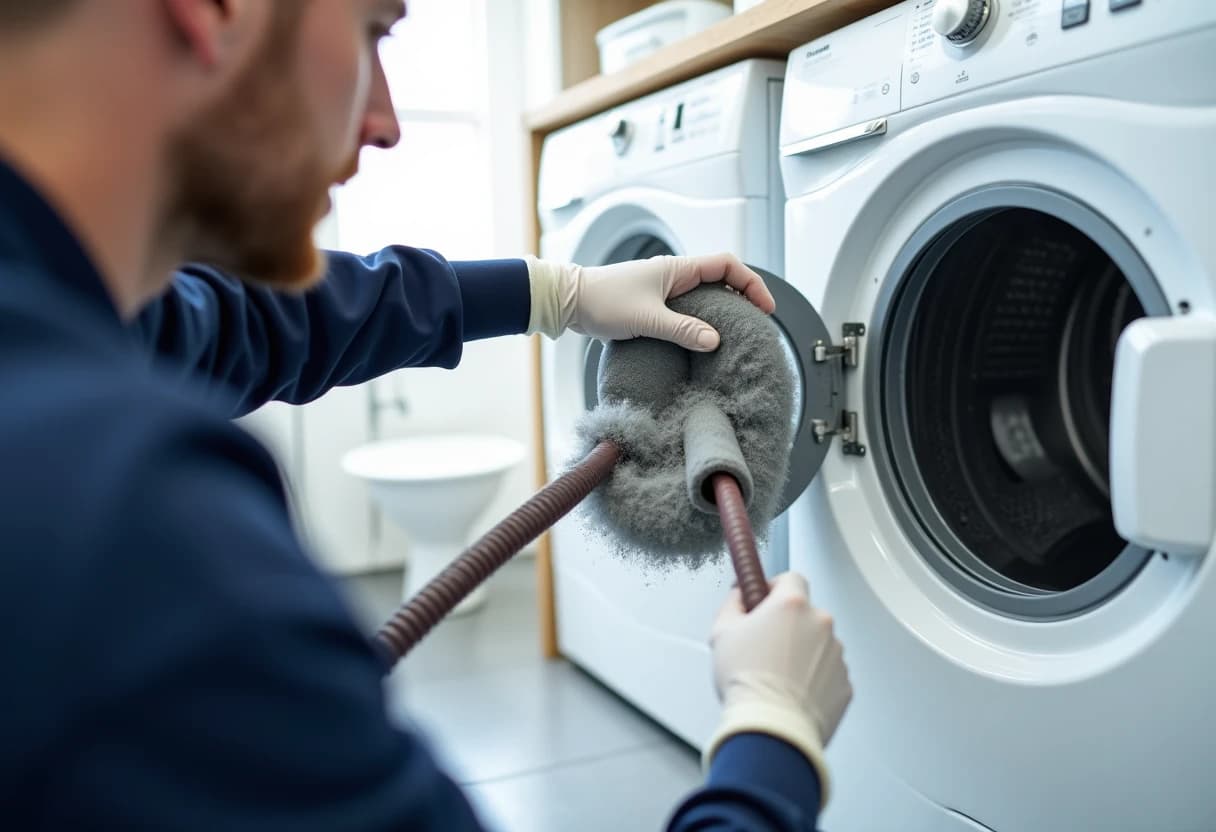
Homeowners in Norfolk typically call us for dryer vent cleaning after one of three moments: a load that will not dry, a burning odor from the laundry area, or a repair technician who condemned the vent while servicing the dryer. All three trace to the same lint accumulation that builds silently for years. Our service removes it completely — rotary brush agitation through the full duct length, HEPA vacuum extraction, exterior hood cleaning, and a check of the transition duct behind the dryer where crushing and kinks hide. We are local, insured, and we quote flat pricing that covers the entire run, roof terminations included.
Why Dryer Vent Cleaning Matters for Norfolk Homes
Beyond fire risk, a clogged dryer vent is a moisture and air-quality problem. Each load of laundry releases roughly a gallon of water as vapor, and all of it is supposed to leave the house through the vent. When lint restricts the line, that moisture lingers in the duct — turning lint into damp mats that block further — and backs up into the laundry area, where it condenses on cold surfaces, peels paint, and feeds mold and mildew growth. Gas dryers raise the stakes further: their exhaust carries combustion byproducts including carbon monoxide, and a blocked vent can push those gases back into living space. The EPA's guidance on indoor moisture and mold is blunt — control the moisture source and you control the growth. For laundry areas, the vent is the moisture source control, and keeping it clear is not optional. Our cleaning restores the full exhaust path so water vapor, heat and combustion byproducts go where they were designed to go: outside.
Norfolk homeowners tend to discover their dryer vent problem in winter, when a marginal vent finally fails: cold-stiffened exterior dampers stick, moist exhaust meets freezing duct sections and condenses into lint cement, and holiday laundry loads push the system past its limit. Norfolk is overwhelmingly a town of 1980s-through-2000s Colonial subdivisions carved out of former woodland and farmland, with only a thin layer of older homes around Town Hill. Nearly every house runs forced-air heat with central air, and the larger builds carry two systems - one in the basement, one in the attic - doubling the ductwork that needs attention. Attic air handlers over long flex-duct runs are the norm in the newer neighborhoods. Norfolk's wooded subdivisions back onto wetlands around Stony Brook, so seasonal pollen and damp shoulder-season air both work their way into duct systems here. With most homes built in the same few decades, we often find twenty-plus years of accumulated dust in systems that have never once been cleaned. We keep winter availability across Norfolk County precisely because blocked-vent calls spike from December through February. Booking a fall cleaning is the smarter move — but whenever you call, our Norfolk route coverage means fast scheduling and a flat price that includes the full run, elbows, and the exterior termination.
Our Dryer Vent Cleaning Process in Norfolk
1Inspect the Dryer, Transition Duct & Vent Path
First we establish what we are cleaning: duct material, run length, number of bends, and termination type. We also measure baseline airflow at the exterior hood with the dryer running. That number matters — it is how we prove, at the end of the visit, that the cleaning actually restored the exhaust capacity your dryer needs.
2Protect the Laundry Area & Disconnect the Dryer
The dryer comes away from the wall and off the duct so we can clean the whole line, not just what a stub brush reaches. This is also when hidden problems surface: lint packed behind the machine, transition hoses crushed flat by the dryer being pushed back too far, and disconnected joints quietly venting into the wall.
3Rotary Brush the Full Length of the Duct
We feed flexible rotary rods through the duct, adding sections until the brush has traveled the complete run from the dryer connection to the exterior hood. The rotating head dislodges packed lint, bird nesting material and debris from every interior surface, including the elbow throats where lint mats form first. Nothing is bypassed; the brush touches every foot of the line.
4Capture Everything With HEPA Vacuum Extraction
As the brush works, a HEPA-filtered vacuum runs simultaneously on the duct, pulling loosened lint into a sealed collection system instead of letting it blow into your laundry room or yard. The combination — agitate and extract at once — is what leaves the duct genuinely empty rather than redistributing the clog.
5Clean From the Exterior Termination Inward
Cleaning from both ends is non-negotiable on longer runs. The last few feet before the termination, and the hood itself, accumulate the densest lint — it is where moist exhaust meets cold outdoor air and fibers mat together. We open the hood, clear the damper, remove nesting if present, and brush the final duct section back toward the vacuum.
6Service the Transition Duct & Reconnect
Before reconnecting, we vacuum the dryer's own lint trap housing and accessible internal ducting, where years of screen bypass collects near the heating element. Then the transition duct is cleaned or replaced, clamped properly — never screwed, since screw tips inside the airstream snag lint — and the dryer is positioned to leave the duct an easy, unkinked path.
7Verify Airflow & Walk You Through the Results
The job ends with proof: we measure airflow at the exterior termination with the dryer running and compare it to the baseline reading from arrival. Strong, steady exhaust and a fully opening damper are the pass conditions. You get the before-and-after numbers, photos of what came out, and honest notes on the duct's condition.
Benefits of Professional Dryer Vent Cleaning in Norfolk
Documentation for Insurance, Condos & Peace of Mind
For landlords and multi-family owners, documented dryer vent service is due-diligence gold: it demonstrates fire-safety maintenance across units in a single record. We service whole buildings in one visit with per-unit documentation, which is why property managers across Greater Boston keep us on an annual rotation.
Safer Operation for Gas Dryers
Gas dryer exhaust carries combustion byproducts, including carbon monoxide, and the vent is the only path designed to remove them. A blocked line can force those gases back into living space. Cleaning restores the engineered exhaust path — a meaningful safety margin for any home with a gas appliance and a real necessity for homes with bedrooms near the laundry.
Dramatically Reduced Fire Risk
Roughly 2,900 home dryer fires occur each year in the US, and the leading factor is simply failure to clean. An annual professional cleaning takes that statistic off your list of worries for about the cost of a dinner out. Few home services offer a clearer safety return on such a modest price.
Less Moisture, Mildew & Musty Odor
Damp lint inside a restricted duct becomes a mold and bacteria medium — the source of the sour smell some dryers push into freshly washed clothes. Removing the lint removes the colony. If your 'clean' laundry has ever come out smelling worse than it went in, the vent is the likeliest culprit.
Faster Drying Times
A blocked vent traps humid air in the drum, so the dryer tumbles wet clothes in wet air. Clearing the line lets each cycle actually exhaust the gallon of water a typical load releases. Drying times commonly drop 30 to 50 percent after cleaning a significantly restricted vent — time you get back every laundry day.
Longer Dryer Lifespan & Fewer Repairs
New dryers deserve clean vents from day one — manufacturers require adequate exhaust airflow for warranty coverage, and delivery crews almost never clean the existing duct. If you have recently replaced your dryer and skipped the vent, you have connected a new engine to a clogged tailpipe.
Signs Your Norfolk Home Needs Dryer Vent Cleaning
Lint Building Up Behind or Inside the Dryer
Check your lint screen pattern too: if the screen suddenly catches less than usual, lint is bypassing it into the machine and duct — often because backpressure from a blocked vent is redirecting airflow. Less lint on the screen frequently means more in the duct, not cleaner laundry.
Laundry Room Gets Hot and Humid
A laundry area that turns tropical during dryer cycles — fogged windows, sweating pipes, damp walls — is receiving the heat and moisture the vent should be sending outdoors. Each blocked load pushes up to a gallon of water vapor into your home instead of out of it. The room is telling you what the duct cannot.
The Exterior Vent Flap Barely Opens
Lint visible around the exterior hood, on the siding or in the shrubs below means the duct is shedding overflow. Paradoxically, a completely lint-free hood on an older system can be worse news: it may mean nothing is reaching the exit at all. Either extreme warrants a cleaning and airflow check.
Clothes Take More Than One Cycle to Dry
Homeowners adapt to slow drying so gradually they stop noticing, until they use a laundromat or a friend's machine and remember what one-cycle drying feels like. If your definition of a drying cycle has quietly stretched past an hour, the vent is overdue for inspection and almost certainly for cleaning.
Burning Smell During a Cycle
That 'hot lint' smell is exactly what it seems: fibers reaching their scorching point somewhere in the airflow path. Sometimes it is a sock against the element; usually it is accumulation. Either way, the difference between a smell and a fire can be one overloaded cycle. We prioritize these calls for same-week service.
It Has Been More Than a Year
New homeowners: assume the vent has never been cleaned unless the sellers documented otherwise. It is one of the most neglected systems in any real-estate transaction. A move-in cleaning costs $149 to $299, establishes your baseline, and starts the annual clock at a date you actually know.
Dryer Vent Cleaning Cost in Norfolk, MA
It helps to weigh the price against the alternatives. A $149 to $299 annual cleaning stands against: $10 to $20 a month in energy waste from a restricted vent; $150 to $400 appliance repair visits for blown thermal fuses and burned elements that blocked vents cause; $800 to $1,200 for the dryer replacement that chronic overheating hastens; and the uncapped cost of a lint fire, which averages five figures in property damage even when contained quickly. Insurance data and FEMA's fire statistics make dryer vent cleaning one of the highest-return maintenance dollars in the home. We keep the pricing flat and published because the service only works as prevention if people actually book it annually — surprise invoices are how homeowners talk themselves into skipping years, and skipped years are how blockages happen.
Want the full pricing picture? See our complete Boston-area cost guide or call (617) 390-7145 for an exact flat quote for your Norfolk home.
Local Knowledge: Norfolk, Norfolk County
What makes Norfolk different? Norfolk is overwhelmingly a town of 1980s-through-2000s Colonial subdivisions carved out of former woodland and farmland, with only a thin layer of older homes around Town Hill. Nearly every house runs forced-air heat with central air, and the larger builds carry two systems - one in the basement, one in the attic - doubling the ductwork that needs attention. Attic air handlers over long flex-duct runs are the norm in the newer neighborhoods. Norfolk's wooded subdivisions back onto wetlands around Stony Brook, so seasonal pollen and damp shoulder-season air both work their way into duct systems here. With most homes built in the same few decades, we often find twenty-plus years of accumulated dust in systems that have never once been cleaned. For duct and dryer vent systems, those local factors translate into specific, predictable problems — and predictable problems are the ones we solve fastest. Call (617) 390-7145, tell us your street and home style, and we will quote the job accurately the first time, usually in under five minutes.
The Best Time of Year in Norfolk
Winter is when Greater Boston dryer vents fail. Cold stiffens exterior damper flaps, snow drifts block grade-level hoods, and warm moist exhaust hitting a freezing duct section condenses — turning loose lint into dense, damp mats that can plug a marginal vent in weeks. Meanwhile laundry loads peak: heavy sweaters, extra blankets, snow-soaked layers. It is no coincidence that dryer fires are most frequent in winter, with January the peak month in federal fire data. The smart schedule is a fall cleaning — clear the system before the heavy season — but if winter has already exposed a problem, we keep cold-month availability across Norfolk County precisely because these calls cannot wait.
Why Choose Boston Air Duct Cleaners
Choosing a duct cleaner is really a trust decision — you are letting a crew work inside the system that feeds air to your family. We make that decision easy: a local West Newton company with insured, uniformed technicians, transparent flat-rate quotes, NADCA-standard equipment and methods, and photographic proof of the finished work. No door-to-door sales, no bait-and-switch coupons, no invented 'mold emergencies.' Just honest mechanical cleaning done properly the first time, backed by a written guarantee.
Serving Norfolk and Surrounding Communities
Beyond Norfolk, our crews cover the surrounding communities daily — including Millis, Medfield, Franklin, Wrentham, Medway, Walpole. Because routes cluster geographically, booking alongside a neighboring appointment often unlocks same-day service and combined-visit savings. Wherever you are in Norfolk County, the same flat-rate pricing, insured technicians and photo-documented process applies.