
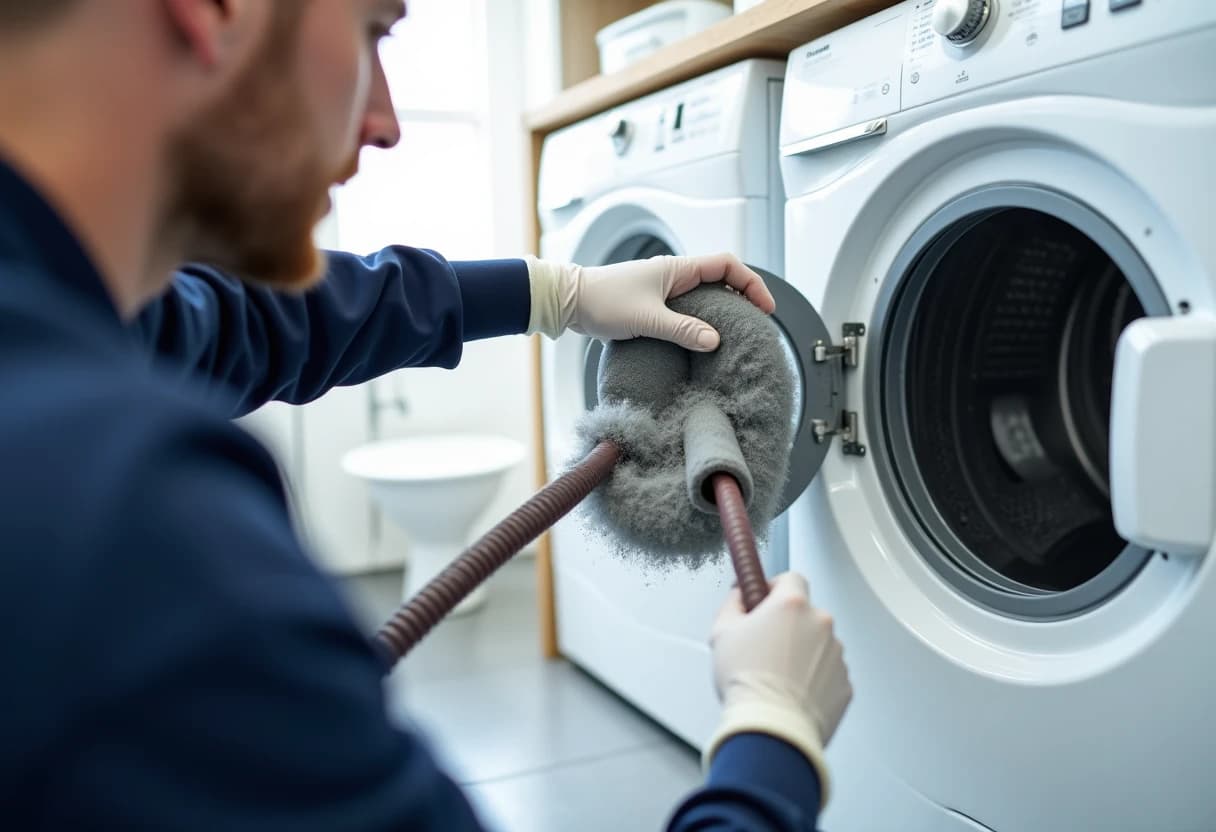
Most homeowners clean the lint screen every load and assume the job is done. But dryer manufacturers, the NFPA and the US Fire Administration all say the same thing: the vent duct itself needs professional cleaning at least once a year. Lint bypasses the screen constantly, and in Greater Boston homes — where vents commonly run twenty feet or more through basements, up wall cavities and across roofs — the accumulation happens out of sight. Our North Reading technicians use full-length rotary brushes driven through the entire run while a HEPA vacuum collects everything, then verify airflow at the termination before we leave.
Why Dryer Vent Cleaning Matters for North Reading Homes
A restricted dryer vent quietly becomes one of the most expensive small problems in the house. When exhaust airflow drops, drying times stretch — a 45-minute load becomes 90 minutes, then two full cycles. Every extra minute burns electricity or gas, and a dryer running double cycles can add $10 to $20 a month to utility bills while wearing out its own components. Heating elements cycle harder against high-limit switches, thermal fuses blow, drum bearings and belts log twice the hours, and moisture-laden exhaust backs up into the machine and the laundry room. Appliance technicians will tell you a large share of 'broken dryer' service calls are actually blocked vents — and many charge you the visit fee to tell you so. Annual professional cleaning keeps airflow at design capacity, which means shorter cycles, lower bills, longer appliance life and clothes that suffer less heat damage. It is maintenance that shows a measurable return on the very next load of laundry.
Dryer vents in North Reading are rarely the short, straight runs the appliance manuals assume. North Reading is classic postwar-to-1990s suburbia: capes and split-levels from the 1950s and 60s near Route 28, ringed by later Colonial subdivisions on wooded lots. Many of the older splits and ranches have had central air bolted onto original heating ducts, and their low crawlspace-style basements make for cramped, kink-prone runs. The newer homes favor two-zone systems with attic-mounted second floors served entirely by flex duct. Laundry hookups in these homes were often added or relocated long after construction, so vents snake through finished basements, chase old framing, and exit wherever a path could be found — sometimes at the roof, sometimes behind shrubbery at grade. Long, elbow-heavy runs collect lint far faster than simple ones. Bordered by the Ipswich River and Harold Parker State Forest, North Reading gets dense spring and fall pollen drops that we find layered inside return trunks all over town. Damp riverside basements also push humidity into ductwork, so musty supply-air odors are one of the most common calls we get here. Our technicians clean North Reading vents every week with equipment sized for exactly these conditions: rotary brush systems that hold power through 35-foot runs and multiple bends, and ladders and roof gear for high terminations.
Our Dryer Vent Cleaning Process in North Reading
1Inspect the Dryer, Transition Duct & Vent Path
First we establish what we are cleaning: duct material, run length, number of bends, and termination type. We also measure baseline airflow at the exterior hood with the dryer running. That number matters — it is how we prove, at the end of the visit, that the cleaning actually restored the exhaust capacity your dryer needs.
2Protect the Laundry Area & Disconnect the Dryer
We treat laundry rooms — often tight, finished spaces — with the same care as any living area: drop cloths down, dryer walked out on protective sliders, and the work zone contained. Disconnecting at the appliance gives us a clean entry point into the duct and a chance to inspect the connection hardware that so often leaks lint into the wall cavity.
3Rotary Brush the Full Length of the Duct
Our core cleaning tool is a motor-driven rotary brush on flexible rods, fed through the entire duct run. The spinning brush head scrubs lint off the duct walls through every elbow and vertical section, in runs up to 35 feet and beyond. Unlike hand brushes, it maintains full scrubbing force at the far end of the line — where the worst accumulation usually hides.
4Capture Everything With HEPA Vacuum Extraction
Extraction runs continuously during brushing so debris moves in one controlled direction. On long or heavily blocked runs we alternate: brush a section, extract, advance. This staged approach clears even fully plugged ducts — the ones where the exterior damper has not opened in years — without compacting the blockage deeper.
5Clean From the Exterior Termination Inward
We then work the line from the outside in — wall hood, soffit outlet or roof cap. Exterior terminations trap their own debris: lint mats behind the damper, bird and rodent nests, and screening clogged solid. Roof terminations get full ladder or roof access; we carry the gear, and steep or high work is included in the quoted price.
6Service the Transition Duct & Reconnect
The short duct connecting dryer to wall does more harm than its length suggests — crushed, kinked or made of plastic, it can choke an otherwise clean system. We clean it, or if it is damaged or made of hazardous foil or vinyl accordion material, we recommend replacement with a semi-rigid aluminum connector, usually installed on the spot for a small parts charge.
7Verify Airflow & Walk You Through the Results
We run the dryer and inspect the termination together — you should see the damper flap standing open under confident airflow, something many homeowners have literally never observed on their own vent. Your technician reviews photos, flags any code or condition issues for future attention, and records your service date for an annual reminder.
Benefits of Professional Dryer Vent Cleaning in North Reading
Less Moisture, Mildew & Musty Odor
Basement laundry areas in New England fight humidity even on good days; a restricted dryer vent turns them into swamp rooms. Post-cleaning, customers consistently report the laundry area feels drier, smells cleaner, and stops fogging windows and sweating pipes during dryer cycles.
Lower Energy Bills
Energy waste from blocked dryer vents is invisible on any single bill but substantial over a year — hundreds of extra kilowatt-hours or therms for a heavy-laundry household. Cleaning converts that waste back into performance. It is one of the few home services with a direct, same-month payback mechanism.
Documentation for Insurance, Condos & Peace of Mind
Every cleaning ends with a written record: date, scope, before-and-after photos, airflow verification and condition notes. Condo associations increasingly require proof of dryer vent maintenance, some insurers ask after claims, and home buyers appreciate the paper trail. One visit satisfies all three — and tells you exactly when the next service is due.
Safer Operation for Gas Dryers
Gas dryer exhaust carries combustion byproducts, including carbon monoxide, and the vent is the only path designed to remove them. A blocked line can force those gases back into living space. Cleaning restores the engineered exhaust path — a meaningful safety margin for any home with a gas appliance and a real necessity for homes with bedrooms near the laundry.
Longer Dryer Lifespan & Fewer Repairs
New dryers deserve clean vents from day one — manufacturers require adequate exhaust airflow for warranty coverage, and delivery crews almost never clean the existing duct. If you have recently replaced your dryer and skipped the vent, you have connected a new engine to a clogged tailpipe.
Dramatically Reduced Fire Risk
Roughly 2,900 home dryer fires occur each year in the US, and the leading factor is simply failure to clean. An annual professional cleaning takes that statistic off your list of worries for about the cost of a dinner out. Few home services offer a clearer safety return on such a modest price.
Signs Your North Reading Home Needs Dryer Vent Cleaning
Lint Building Up Behind or Inside the Dryer
Visible lint at any joint, seam or connection is a flag worth acting on. It usually indicates positive pressure in the duct from a downstream blockage forcing air out through gaps — or a partially disconnected duct dumping exhaust into the wall cavity, which our inspection will catch.
The Exterior Vent Flap Barely Opens
Many North Reading-area vents terminate on roofs or high walls where owners never look — which is exactly why blockages there grow uninterrupted for years. If you cannot see your termination or have never checked it, assume it needs inspection. We check and clean terminations, roof-mounted included, on every visit.
Burning Smell During a Cycle
Never normalize a burning odor from a dryer. Investigators repeatedly find that households smelled scorching lint for weeks before an ignition. A cleaning visit resolves the source in about an hour and includes vacuuming the dryer's internal lint paths near the element — where the smell most often starts.
Laundry Room Gets Hot and Humid
Watch for secondary evidence: peeling paint near the dryer, mildew spots on the ceiling above it, a musty smell that lingers after laundry day, rust on shelf brackets. All are condensation footprints from exhaust escaping into the room through a restricted or leaking duct rather than exiting the house.
Dryer or Clothes Are Hot to the Touch
Some heat is normal; radiating heat is not. When the exhaust cannot escape, the drum, cabinet and surrounding wall absorb it instead. Homes where we measure the highest cabinet temperatures reliably produce the fullest lint bags — the correlation between heat and blockage is nearly one to one.
It Has Been More Than a Year
New homeowners: assume the vent has never been cleaned unless the sellers documented otherwise. It is one of the most neglected systems in any real-estate transaction. A move-in cleaning costs $149 to $299, establishes your baseline, and starts the annual clock at a date you actually know.
Dryer Vent Cleaning Cost in North Reading, MA
For budgeting across property types: single-family homes run $149 to $299 as described; condos are usually $149 to $199 unless the unit vents to the roof; and multi-family buildings get per-unit rates that drop meaningfully when we clean all units in one visit — the arrangement most triple-decker owners and condo associations choose, both for cost and for the single insurance-ready service record covering the building. Commercial laundry and shared-venting systems are quoted after a walkthrough. Frequency matters to lifetime cost too: an annual cleaning is quick and inexpensive because accumulation is light, while a vent neglected for five years often needs blockage-level work at the top of the range, and sometimes reveals damage requiring repair. The cheapest way to own a dryer vent, year over year, is to clean it on schedule — which is why we log your service date and send a reminder when the next one is due.
Want the full pricing picture? See our complete Boston-area cost guide or call (617) 390-7145 for an exact flat quote for your North Reading home.
Local Knowledge: North Reading, Middlesex County
Serving North Reading means knowing North Reading. North Reading is classic postwar-to-1990s suburbia: capes and split-levels from the 1950s and 60s near Route 28, ringed by later Colonial subdivisions on wooded lots. Many of the older splits and ranches have had central air bolted onto original heating ducts, and their low crawlspace-style basements make for cramped, kink-prone runs. The newer homes favor two-zone systems with attic-mounted second floors served entirely by flex duct. Bordered by the Ipswich River and Harold Parker State Forest, North Reading gets dense spring and fall pollen drops that we find layered inside return trunks all over town. Damp riverside basements also push humidity into ductwork, so musty supply-air odors are one of the most common calls we get here. Those conditions shape how we work here: which brush heads come off the truck, how we protect finishes in older interiors, and what we expect to find when the camera goes into a 01864 duct system. Our crews are in and around North Reading nearly every week — often for neighbors of past customers — so scheduling is fast and our arrival windows hold.
The Best Time of Year in North Reading
Winter is when Greater Boston dryer vents fail. Cold stiffens exterior damper flaps, snow drifts block grade-level hoods, and warm moist exhaust hitting a freezing duct section condenses — turning loose lint into dense, damp mats that can plug a marginal vent in weeks. Meanwhile laundry loads peak: heavy sweaters, extra blankets, snow-soaked layers. It is no coincidence that dryer fires are most frequent in winter, with January the peak month in federal fire data. The smart schedule is a fall cleaning — clear the system before the heavy season — but if winter has already exposed a problem, we keep cold-month availability across Middlesex County precisely because these calls cannot wait.
Why Choose Boston Air Duct Cleaners
As a West Newton-based company, we treat North Reading like the neighborhood it is — because for us, it is. Our reputation lives or dies on local referrals, so every job gets the full process: complete system cleaning under negative pressure, mechanical agitation of every run, blower compartment service, and a documented walkthrough before we leave. We are licensed and insured, our estimates are free and flat, and our schedule holds same-day slots for urgent calls. One visit and you will understand why neighbors keep our magnet on the fridge.
Serving North Reading and Surrounding Communities
We serve every community around North Reading as well: Reading, Wilmington, Middleton, Andover, Lynnfield, Tewksbury all fall inside our regular service routes. If you have a second property, a rental, or family nearby, ask about multi-home scheduling — grouped appointments on the same route are our most requested discount.