
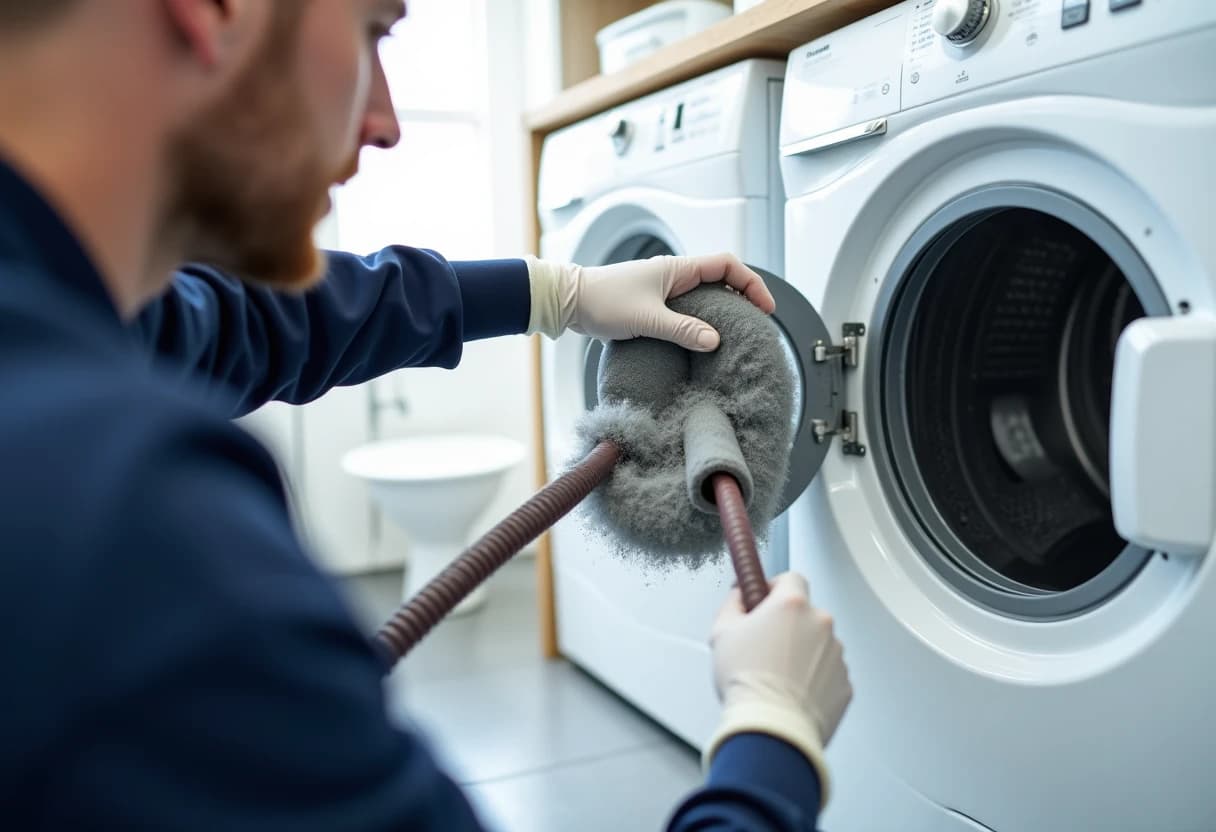
Homeowners in Reading typically call us for dryer vent cleaning after one of three moments: a load that will not dry, a burning odor from the laundry area, or a repair technician who condemned the vent while servicing the dryer. All three trace to the same lint accumulation that builds silently for years. Our service removes it completely — rotary brush agitation through the full duct length, HEPA vacuum extraction, exterior hood cleaning, and a check of the transition duct behind the dryer where crushing and kinks hide. We are local, insured, and we quote flat pricing that covers the entire run, roof terminations included.
Why Dryer Vent Cleaning Matters for Reading Homes
There are moments when dryer vent cleaning becomes urgent rather than routine. If you have just bought a home, you inherit a vent with an unknown history — quite possibly never cleaned since installation, and in older Massachusetts homes possibly lined with decades of lint. If your dryer is new, manufacturers require a clear vent for warranty coverage, and installers rarely clean the existing duct. If your vent terminates on the roof, wildlife may have added a nest to the lint; bird and rodent nesting in dryer terminations is one of the most common blockages we clear. And if you have ever smelled something burning during a cycle or had a load come out hot but wet, the vent needs attention now, not at the next convenient interval. In every one of these situations, a single professional cleaning re-establishes a known-clean baseline — after which an annual schedule keeps it that way for a modest, predictable cost.
In Reading's older housing stock, we regularly find dryer vents that violate every modern guideline — vinyl flex duct sagging through a basement, screws catching lint at every joint, runs far past the 35-foot code maximum. Reading's streets are lined with center-entrance Colonials, gambrel capes and 1920s-40s craftsman-style homes near the Common and the Depot, ringed by larger post-war and 1980s-2000s colonials farther out toward Route 128. Many of the older homes have been converted from oil boilers to forced-air heat pumps or gas furnaces, leaving retrofit duct runs squeezed through original framing and attic chases. These systems clog two or three times faster than a code-compliant rigid duct, which makes annual cleaning genuinely important rather than merely advisable. Reading is a classic commuter-rail renovation town - kitchens, additions and finished basements go in constantly, and construction dust ends up circulating through duct systems for years afterward. The heat-pump conversion wave here has also created many attic-run duct systems where summer condensation can feed dust buildup and musty odors. We clean what is there, document what we find with photos, and tell you honestly whether the duct itself needs repair or replacement — a judgment call our crews make in Reading homes every week.
Our Dryer Vent Cleaning Process in Reading
1Inspect the Dryer, Transition Duct & Vent Path
First we establish what we are cleaning: duct material, run length, number of bends, and termination type. We also measure baseline airflow at the exterior hood with the dryer running. That number matters — it is how we prove, at the end of the visit, that the cleaning actually restored the exhaust capacity your dryer needs.
2Protect the Laundry Area & Disconnect the Dryer
Before cleaning starts, we lay floor protection, carefully slide the dryer out without scarring floors, and disconnect the transition duct. Gas dryers are handled with proper care around the flexible gas connector — we never strain it. With the duct open at the appliance end, we have the access needed to clean the entire run.
3Rotary Brush the Full Length of the Duct
Mechanical agitation is what separates professional cleaning from blow-through methods. The rotary brush physically breaks up compacted lint that air pressure alone would only compress further. We select brush heads sized to your duct — standard 4-inch for code-compliant lines, alternates for older oversized or reduced runs — so the bristles actually contact the duct wall the whole way.
4Capture Everything With HEPA Vacuum Extraction
Extraction runs continuously during brushing so debris moves in one controlled direction. On long or heavily blocked runs we alternate: brush a section, extract, advance. This staged approach clears even fully plugged ducts — the ones where the exterior damper has not opened in years — without compacting the blockage deeper.
5Clean From the Exterior Termination Inward
The exterior hood gets hands-on service: damper flap cleaned and checked for free movement, cage or screen cleared (or removal recommended — screens on dryer terminations trap lint and violate most codes), and the visible duct section brushed. A damper that cannot close invites drafts and pests; one that cannot open blocks the entire system.
6Service the Transition Duct & Reconnect
Reassembly is done to code and to the appliance manual: UL-listed transition duct, proper clamps, no more than the listed connector length, and the dryer set far enough from the wall that the duct keeps its shape. We level the machine, verify the gas connection is undisturbed on gas units, and run a test cycle before calling the mechanical work done.
7Verify Airflow & Walk You Through the Results
We run the dryer and inspect the termination together — you should see the damper flap standing open under confident airflow, something many homeowners have literally never observed on their own vent. Your technician reviews photos, flags any code or condition issues for future attention, and records your service date for an annual reminder.
Benefits of Professional Dryer Vent Cleaning in Reading
Dramatically Reduced Fire Risk
Roughly 2,900 home dryer fires occur each year in the US, and the leading factor is simply failure to clean. An annual professional cleaning takes that statistic off your list of worries for about the cost of a dinner out. Few home services offer a clearer safety return on such a modest price.
Faster Drying Times
Airflow is what dries clothes; heat just helps. Restore full exhaust capacity and loads that limped through two cycles finish in one, towels stop coming out damp at the seams, and the dryer's moisture sensors — which many modern machines rely on — start reading accurately again. Most customers notice the difference on the first load after our visit.
Safer Operation for Gas Dryers
Massachusetts homes rely heavily on natural gas, and gas dryers are common across Greater Boston's housing stock. If yours vents through a long or aging duct, annual cleaning plus an airflow check is the standard of care fire and gas utilities recommend. It takes an hour and removes an entire category of risk.
Less Moisture, Mildew & Musty Odor
Each load exhausts about a gallon of water as vapor. When the vent is blocked, that moisture backs into the laundry room and the duct itself — condensing on walls, peeling paint, and feeding mildew. A clear vent sends the humidity outside, drying out the laundry area and eliminating the damp, musty smell that clings to blocked systems.
Lower Energy Bills
Every minute of unnecessary drying time is metered energy. A restricted vent that doubles cycle times roughly doubles the dryer's share of your utility bill — often $10 to $20 a month for an average household. Annual cleaning typically pays for a large fraction of itself in the first year of restored efficiency.
Longer Dryer Lifespan & Fewer Repairs
New dryers deserve clean vents from day one — manufacturers require adequate exhaust airflow for warranty coverage, and delivery crews almost never clean the existing duct. If you have recently replaced your dryer and skipped the vent, you have connected a new engine to a clogged tailpipe.
Signs Your Reading Home Needs Dryer Vent Cleaning
Burning Smell During a Cycle
That 'hot lint' smell is exactly what it seems: fibers reaching their scorching point somewhere in the airflow path. Sometimes it is a sock against the element; usually it is accumulation. Either way, the difference between a smell and a fire can be one overloaded cycle. We prioritize these calls for same-week service.
Lint Building Up Behind or Inside the Dryer
Visible lint at any joint, seam or connection is a flag worth acting on. It usually indicates positive pressure in the duct from a downstream blockage forcing air out through gaps — or a partially disconnected duct dumping exhaust into the wall cavity, which our inspection will catch.
It Has Been More Than a Year
Households that run a load daily, dry pet bedding, or share laundry across a multi-family building accumulate lint at two to three times the average rate and should clean every six to twelve months. A quiet couple doing weekly laundry can stretch toward the annual mark, but rarely safely beyond it.
Dryer or Clothes Are Hot to the Touch
A dryer cabinet too hot to rest a hand on, or clothes that come out scorching, means exhaust heat is not leaving the machine. That heat is being absorbed by the dryer's components — and by the lint in the duct. This is the pre-ignition condition fire investigators describe; treat it as urgent, not cosmetic.
Clothes Take More Than One Cycle to Dry
The single most reliable symptom. A healthy dryer dries a standard load in 35 to 50 minutes; when towels need a second cycle or jeans come out damp at the waistband, exhaust airflow has dropped. The dryer has not gotten weaker — the vent has gotten narrower. Cleaning restores the original performance in one visit.
The Exterior Vent Flap Barely Opens
Step outside during a drying cycle and look at the termination hood. The damper should stand fully open with a strong, warm airstream you can feel from a foot away. A flap that flutters weakly, opens halfway or stays shut is showing you the blockage directly — the cheapest diagnostic in home maintenance.
Dryer Vent Cleaning Cost in Reading, MA
A note on the low end of the market: you will see dryer vent cleaning advertised for $69 to $99, and occasionally it is legitimate — a short run, a quick brush, done. More often the price assumes ideal conditions that Greater Boston homes rarely offer, and the invoice grows on site with 'extra footage,' 'additional elbows' and 'blockage fees' until it exceeds a transparent quote. Our flat pricing of $149 to $299 is set for real local conditions: 15-to-35-foot runs, three or four elbows, basement laundries, and hoods that have not been opened in a decade. It includes the rotary brush cleaning of the entire duct, HEPA vacuum extraction, exterior termination service, transition duct inspection and a final airflow verification with photos. When comparing quotes, ask one question: does the price cover the complete run and the termination, whatever it takes? Ours does.
Want the full pricing picture? See our complete Boston-area cost guide or call (617) 390-7145 for an exact flat quote for your Reading home.
Local Knowledge: Reading, Middlesex County
What makes Reading different? Reading's streets are lined with center-entrance Colonials, gambrel capes and 1920s-40s craftsman-style homes near the Common and the Depot, ringed by larger post-war and 1980s-2000s colonials farther out toward Route 128. Many of the older homes have been converted from oil boilers to forced-air heat pumps or gas furnaces, leaving retrofit duct runs squeezed through original framing and attic chases. Reading is a classic commuter-rail renovation town - kitchens, additions and finished basements go in constantly, and construction dust ends up circulating through duct systems for years afterward. The heat-pump conversion wave here has also created many attic-run duct systems where summer condensation can feed dust buildup and musty odors. For duct and dryer vent systems, those local factors translate into specific, predictable problems — and predictable problems are the ones we solve fastest. Call (617) 390-7145, tell us your street and home style, and we will quote the job accurately the first time, usually in under five minutes.
The Best Time of Year in Reading
Think of the laundry calendar itself: spring brings pollen-heavy loads and washed winter bedding; summer adds beach towels and daily shirt changes through humid stretches; fall means sweaters, blankets and back-to-school volume; winter piles on the heaviest fabrics of the year while the vent works at its coldest. A Massachusetts dryer rarely gets an off-season — which is why the annual cleaning interval is a floor, not a ceiling, for busy households here. Families running daily loads, multi-family buildings with shared laundry patterns, and anyone drying pet bedding through shedding seasons should consider a six-to-nine-month schedule. We track your interval and remind you, so the vent stays ahead of the laundry rather than behind it.
Why Choose Boston Air Duct Cleaners
Homeowners across Middlesex County choose Boston Air Duct Cleaners for three reasons. First, honesty: our inspection camera tells you whether your system actually needs cleaning — and sometimes the answer is no. Second, capability: truck-grade negative-air machines, rotary brush systems and HEPA filtration handle everything from antique gravity-furnace conversions to brand-new high-velocity systems. Third, accountability: flat quoted pricing, before-and-after photos, insured technicians, and a real local office you can call at (617) 390-7145. That combination is rarer in this industry than it should be.
Serving Reading and Surrounding Communities
We serve every community around Reading as well: North Reading, Wakefield, Stoneham, Wilmington, Woburn, Lynnfield all fall inside our regular service routes. If you have a second property, a rental, or family nearby, ask about multi-home scheduling — grouped appointments on the same route are our most requested discount.