
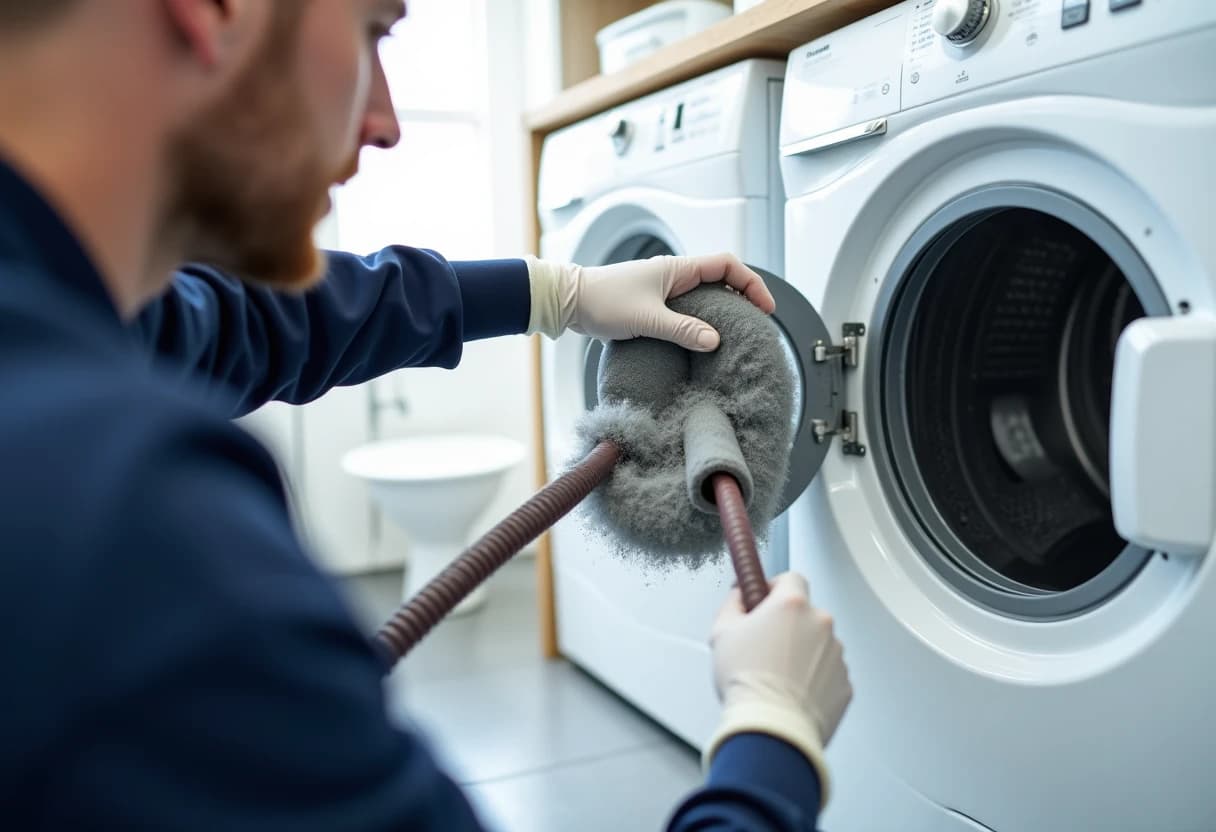
Most homeowners clean the lint screen every load and assume the job is done. But dryer manufacturers, the NFPA and the US Fire Administration all say the same thing: the vent duct itself needs professional cleaning at least once a year. Lint bypasses the screen constantly, and in Greater Boston homes — where vents commonly run twenty feet or more through basements, up wall cavities and across roofs — the accumulation happens out of sight. Our Revere technicians use full-length rotary brushes driven through the entire run while a HEPA vacuum collects everything, then verify airflow at the termination before we leave.
Why Dryer Vent Cleaning Matters for Revere Homes
Some homeowners ask whether they can just clean the vent themselves with a leaf blower or a hardware-store brush kit — and for a short, straight, first-floor vent, a diligent DIY cleaning is better than nothing. The trouble is that most Greater Boston vents are not short or straight. Runs from basement or interior laundry rooms commonly stretch 15 to 35 feet with three or four elbows, and consumer brush kits lose effectiveness with every bend, often compacting lint into a plug instead of removing it. Leaf blowers can blow a soft clog into a dense one, or blow the exterior damper shut. Professional equipment is different in kind: motor-driven rotary brushes that maintain scrubbing force through every elbow, HEPA vacuums that capture lint at the same time, inspection of the transition duct and termination, and an airflow measurement that verifies the result. We also spot the problems a brush cannot fix — crushed duct, disconnected joints, illegal flex materials — before they turn a maintenance visit into an emergency.
In Revere's older housing stock, we regularly find dryer vents that violate every modern guideline — vinyl flex duct sagging through a basement, screws catching lint at every joint, runs far past the 35-foot code maximum. Revere is dense with early-1900s two-families, triple-deckers and closely spaced single-families in Beachmont and along Shirley Avenue, joined by new transit-oriented apartment blocks rising near Wonderland and the beachfront. Older multifamily buildings often have separate systems per unit and long, aging dryer vent runs, while the new buildings stack units on shared vertical vent chases. These systems clog two or three times faster than a code-compliant rigid duct, which makes annual cleaning genuinely important rather than merely advisable. Sitting on America's first public beach means Revere homes live with salt-laden ocean air that corrodes ductwork and vent terminations faster than inland systems. In the multifamily housing that dominates the city, we regularly find dryer vents shared or rerouted over decades of remodels, making lint blockages a genuine fire concern here. We clean what is there, document what we find with photos, and tell you honestly whether the duct itself needs repair or replacement — a judgment call our crews make in Revere homes every week.
Our Dryer Vent Cleaning Process in Revere
1Inspect the Dryer, Transition Duct & Vent Path
Every job opens with a walkthrough of the complete exhaust path. The technician checks the lint screen housing, inspects the transition hose behind the dryer, locates every accessible section of duct, and finds the termination — wall hood, soffit outlet or roof cap. Photos document the starting condition so you can compare against the finished result.
2Protect the Laundry Area & Disconnect the Dryer
We treat laundry rooms — often tight, finished spaces — with the same care as any living area: drop cloths down, dryer walked out on protective sliders, and the work zone contained. Disconnecting at the appliance gives us a clean entry point into the duct and a chance to inspect the connection hardware that so often leaks lint into the wall cavity.
3Rotary Brush the Full Length of the Duct
We feed flexible rotary rods through the duct, adding sections until the brush has traveled the complete run from the dryer connection to the exterior hood. The rotating head dislodges packed lint, bird nesting material and debris from every interior surface, including the elbow throats where lint mats form first. Nothing is bypassed; the brush touches every foot of the line.
4Capture Everything With HEPA Vacuum Extraction
Extraction runs continuously during brushing so debris moves in one controlled direction. On long or heavily blocked runs we alternate: brush a section, extract, advance. This staged approach clears even fully plugged ducts — the ones where the exterior damper has not opened in years — without compacting the blockage deeper.
5Clean From the Exterior Termination Inward
The exterior hood gets hands-on service: damper flap cleaned and checked for free movement, cage or screen cleared (or removal recommended — screens on dryer terminations trap lint and violate most codes), and the visible duct section brushed. A damper that cannot close invites drafts and pests; one that cannot open blocks the entire system.
6Service the Transition Duct & Reconnect
Before reconnecting, we vacuum the dryer's own lint trap housing and accessible internal ducting, where years of screen bypass collects near the heating element. Then the transition duct is cleaned or replaced, clamped properly — never screwed, since screw tips inside the airstream snag lint — and the dryer is positioned to leave the duct an easy, unkinked path.
7Verify Airflow & Walk You Through the Results
The job ends with proof: we measure airflow at the exterior termination with the dryer running and compare it to the baseline reading from arrival. Strong, steady exhaust and a fully opening damper are the pass conditions. You get the before-and-after numbers, photos of what came out, and honest notes on the duct's condition.
Benefits of Professional Dryer Vent Cleaning in Revere
Less Moisture, Mildew & Musty Odor
Basement laundry areas in New England fight humidity even on good days; a restricted dryer vent turns them into swamp rooms. Post-cleaning, customers consistently report the laundry area feels drier, smells cleaner, and stops fogging windows and sweating pipes during dryer cycles.
Safer Operation for Gas Dryers
Massachusetts homes rely heavily on natural gas, and gas dryers are common across Greater Boston's housing stock. If yours vents through a long or aging duct, annual cleaning plus an airflow check is the standard of care fire and gas utilities recommend. It takes an hour and removes an entire category of risk.
Faster Drying Times
Airflow is what dries clothes; heat just helps. Restore full exhaust capacity and loads that limped through two cycles finish in one, towels stop coming out damp at the seams, and the dryer's moisture sensors — which many modern machines rely on — start reading accurately again. Most customers notice the difference on the first load after our visit.
Dramatically Reduced Fire Risk
Roughly 2,900 home dryer fires occur each year in the US, and the leading factor is simply failure to clean. An annual professional cleaning takes that statistic off your list of worries for about the cost of a dinner out. Few home services offer a clearer safety return on such a modest price.
Lower Energy Bills
Dryers are among the most energy-hungry appliances in the home, and a clogged vent makes every load cost more. Restoring design airflow means the heating element runs at intended temperatures for intended durations. The savings recur with every cycle, quietly, for as long as the vent stays clear.
Longer Dryer Lifespan & Fewer Repairs
New dryers deserve clean vents from day one — manufacturers require adequate exhaust airflow for warranty coverage, and delivery crews almost never clean the existing duct. If you have recently replaced your dryer and skipped the vent, you have connected a new engine to a clogged tailpipe.
Signs Your Revere Home Needs Dryer Vent Cleaning
The Exterior Vent Flap Barely Opens
Lint visible around the exterior hood, on the siding or in the shrubs below means the duct is shedding overflow. Paradoxically, a completely lint-free hood on an older system can be worse news: it may mean nothing is reaching the exit at all. Either extreme warrants a cleaning and airflow check.
Clothes Take More Than One Cycle to Dry
The single most reliable symptom. A healthy dryer dries a standard load in 35 to 50 minutes; when towels need a second cycle or jeans come out damp at the waistband, exhaust airflow has dropped. The dryer has not gotten weaker — the vent has gotten narrower. Cleaning restores the original performance in one visit.
Burning Smell During a Cycle
That 'hot lint' smell is exactly what it seems: fibers reaching their scorching point somewhere in the airflow path. Sometimes it is a sock against the element; usually it is accumulation. Either way, the difference between a smell and a fire can be one overloaded cycle. We prioritize these calls for same-week service.
Laundry Room Gets Hot and Humid
Watch for secondary evidence: peeling paint near the dryer, mildew spots on the ceiling above it, a musty smell that lingers after laundry day, rust on shelf brackets. All are condensation footprints from exhaust escaping into the room through a restricted or leaking duct rather than exiting the house.
Dryer or Clothes Are Hot to the Touch
Excess heat is the fire chain's first visible link: restricted airflow, rising temperatures, and a duct lined with fuel. If the top of your dryer doubles as a hand warmer or the laundry room bakes during cycles, stop using the machine for long runs and have the vent cleaned promptly.
Lint Building Up Behind or Inside the Dryer
Visible lint at any joint, seam or connection is a flag worth acting on. It usually indicates positive pressure in the duct from a downstream blockage forcing air out through gaps — or a partially disconnected duct dumping exhaust into the wall cavity, which our inspection will catch.
Dryer Vent Cleaning Cost in Revere, MA
For budgeting across property types: single-family homes run $149 to $299 as described; condos are usually $149 to $199 unless the unit vents to the roof; and multi-family buildings get per-unit rates that drop meaningfully when we clean all units in one visit — the arrangement most triple-decker owners and condo associations choose, both for cost and for the single insurance-ready service record covering the building. Commercial laundry and shared-venting systems are quoted after a walkthrough. Frequency matters to lifetime cost too: an annual cleaning is quick and inexpensive because accumulation is light, while a vent neglected for five years often needs blockage-level work at the top of the range, and sometimes reveals damage requiring repair. The cheapest way to own a dryer vent, year over year, is to clean it on schedule — which is why we log your service date and send a reminder when the next one is due.
Want the full pricing picture? See our complete Boston-area cost guide or call (617) 390-7145 for an exact flat quote for your Revere home.
Local Knowledge: Revere, Suffolk County
Serving Revere means knowing Revere. Revere is dense with early-1900s two-families, triple-deckers and closely spaced single-families in Beachmont and along Shirley Avenue, joined by new transit-oriented apartment blocks rising near Wonderland and the beachfront. Older multifamily buildings often have separate systems per unit and long, aging dryer vent runs, while the new buildings stack units on shared vertical vent chases. Sitting on America's first public beach means Revere homes live with salt-laden ocean air that corrodes ductwork and vent terminations faster than inland systems. In the multifamily housing that dominates the city, we regularly find dryer vents shared or rerouted over decades of remodels, making lint blockages a genuine fire concern here. Those conditions shape how we work here: which brush heads come off the truck, how we protect finishes in older interiors, and what we expect to find when the camera goes into a 02151 duct system. Our crews are in and around Revere nearly every week — often for neighbors of past customers — so scheduling is fast and our arrival windows hold.
The Best Time of Year in Revere
The region's old housing stock gives dryer venting a seasonal twist all its own. Many Massachusetts laundry hookups were retrofitted into basements and back halls generations after the house was built, producing long runs through unheated spaces — crawl areas, garages, exterior wall cavities. In winter, those cold sections become condensation zones where exhaust moisture freezes into lint ice; in the spring thaw, the melt soaks the accumulation into a paste. Homes near the coast add salt-air corrosion at the termination, seizing dampers and rusting hoods. Annual cleaning with a termination inspection catches all of this on a schedule, rather than during a February failure with a full laundry basket waiting.
Why Choose Boston Air Duct Cleaners
As a West Newton-based company, we treat Revere like the neighborhood it is — because for us, it is. Our reputation lives or dies on local referrals, so every job gets the full process: complete system cleaning under negative pressure, mechanical agitation of every run, blower compartment service, and a documented walkthrough before we leave. We are licensed and insured, our estimates are free and flat, and our schedule holds same-day slots for urgent calls. One visit and you will understand why neighbors keep our magnet on the fridge.
Serving Revere and Surrounding Communities
Beyond Revere, our crews cover the surrounding communities daily — including Chelsea, East Boston, Winthrop, Everett, Malden, Saugus. Because routes cluster geographically, booking alongside a neighboring appointment often unlocks same-day service and combined-visit savings. Wherever you are in Suffolk County, the same flat-rate pricing, insured technicians and photo-documented process applies.