
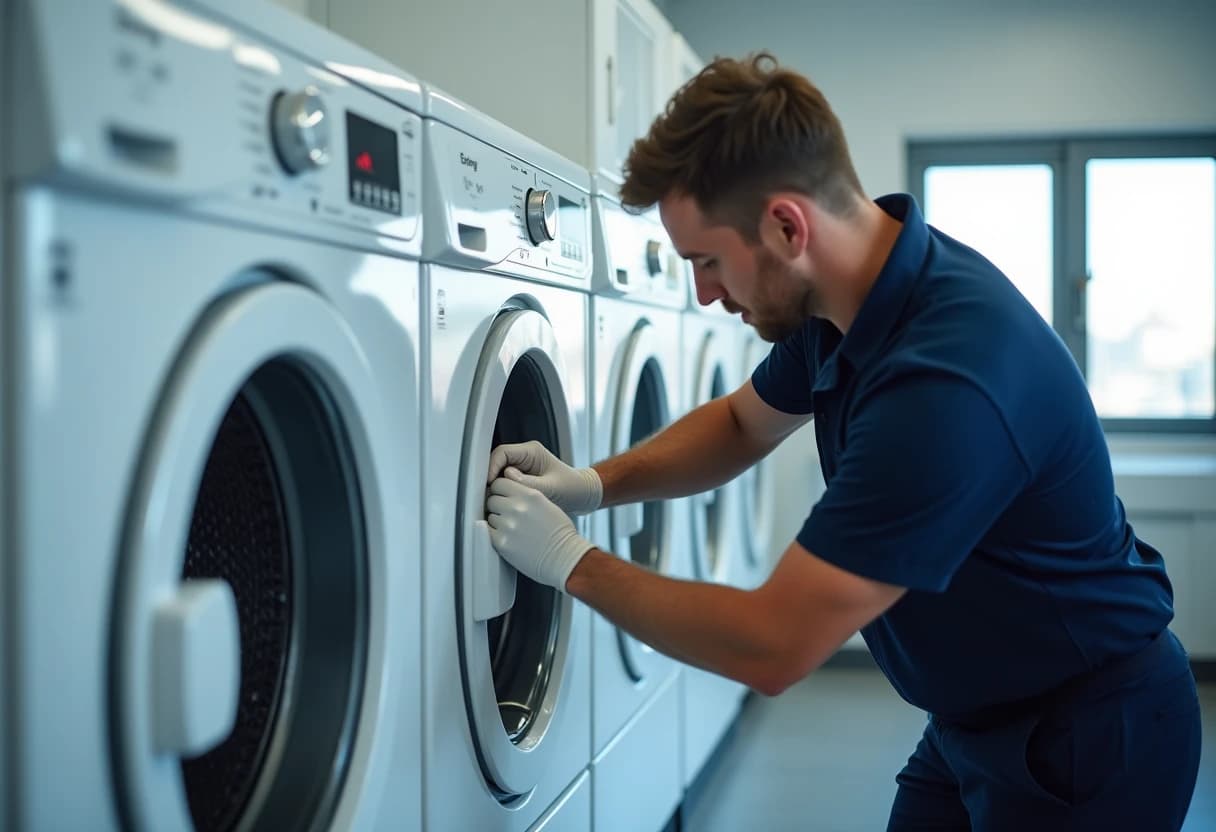
The call we never want to get from South Boston is the one after the fire. Dryer fires are overwhelmingly preventable — lint-clogged venting is the leading cause, per FEMA and NFPA — and in multi-family buildings a single unit's blocked vent endangers every neighbor sharing the structure. That is why insurers, and increasingly master-policy underwriters, ask associations for documented vent maintenance. Our program gives South Boston buildings the complete answer: scheduled whole-building cleanings with resident coordination handled by us, mechanical end-to-end cleaning of every vent and shared riser, immediate flagging of hazards like foil accordion transition ducts and crushed runs, and a unit-by-unit report formatted for board minutes and insurance files. Most buildings are completed in one to three days.
Why Commercial & Multi-Unit Dryer Vent Cleaning Matters for South Boston Homes
Laundromats and high-duty commercial laundry face the same physics at industrial intensity. A commercial dryer cycling ten hours a day produces more lint in a week than a household machine does in a year, and that lint loads into manifolded duct systems that were often sized optimistically to begin with. The operational symptoms arrive before the fire risk peaks: dry times stretch, customers complain and leave, gas consumption climbs, high-limit switches trip, and machines cook their own components in the trapped heat. NFPA 211 and equipment manufacturers alike call for regular exhaust cleaning at commercial duty cycles — quarterly or better in busy stores, not the annual rhythm of a home. Our commercial program matches the interval to your throughput: full mechanical cleaning of each machine's run and every common trunk, termination and damper service, booster fan cleaning where installed, and airflow verification numbers before and after so you can see the recovery. Most operators find the service pays for itself in gas savings and machine uptime before the fire-safety benefit is even counted.
From the residential blocks around Dorchester Heights Monument to the condo buildings near East Broadway, South Boston associations share a common blind spot: nobody can name when the building's dryer vents were last cleaned. South Boston's grid is filled with 19th-century brick rowhouses and wood-frame triple-deckers, a huge share of which have been gut-renovated into upscale condos over the past two decades, with new mid-rise buildings rising along West Broadway and the Dorchester Avenue corridor. Those gut rehabs almost always added central air and new ductwork, but tight rowhouse footprints force ducts through soffits and party-wall chases with plenty of bends. Roof decks and penthouse additions frequently put condensers and air handlers in salt-exposed locations. That means lint accumulating in runs and risers for years across every unit. Southie juts into Boston Harbor, and homes near Castle Island and the beaches live with genuine coastal conditions - salt air that corrodes vent hoods and dampness that finds any duct run passing through an unconditioned space. The neighborhood's condo conversion boom also left a generation of systems installed fast during renovations, and we regularly pull construction debris from ducts in units sold as brand new. Because our shop sits 12 miles away in West Newton, South Boston buildings get responsive scheduling — walkthroughs within days, whole-building projects completed in one to three days with resident notices handled by our coordinator, and volume per-unit pricing that makes an annual program an easy board approval.
Our Commercial & Multi-Unit Dryer Vent Cleaning Process in South Boston
1Building Walkthrough & Per-Unit Proposal
Every building project starts with a walkthrough: we identify how each unit vents — individual wall runs, shared vertical risers, common trunk lines — locate terminations on walls and roofs, note access requirements, and inspect representative runs. The proposal that follows prices the building flat, per unit, with riser and common-duct service itemized, so boards approve a known number.
2Resident Coordination & Scheduling
We treat resident experience as part of the deliverable: clear advance notices, tight arrival windows, uniformed technicians who protect floors and finish each unit in roughly 20 to 40 minutes, and a same-day completion log to management. Units we cannot access are documented — not silently skipped — and a make-up window is scheduled so the building report ends with every unit accounted for.
3Dryer-Side Service: Transition Duct & Connection
The first feet of the vent path fail most often: crushed transition hoses behind the dryer, lint packed at the wall connection, and prohibited foil accordion duct that sags into lint-collecting bellies. We service this section in every unit — machine pulled, area vacuumed, transition cleaned or replacement offered, connection remade properly — because a clean wall duct fed through a clogged transition solves nothing.
4Mechanical Cleaning of the Full Vent Run
The in-wall duct is cleaned end to end with rotary brush systems driven through the full run while a high-powered vacuum captures dislodged lint — the same agitation-plus-extraction principle as NADCA duct cleaning, sized for 4-inch dryer duct. Long runs and multiple elbows get repeat passes; the pass is complete when the brush returns clean and airflow verifies.
5Shared Risers, Common Trunks & Booster Fans
High-rise and mid-rise venting is a system, not a bundle of individual runs. Our crews clean shared risers top-down from roof terminations with weighted rotary lines, verify each unit's takeoff where it joins the common duct, and confirm draft through the full stack afterward. Central exhaust fans and pressure-relief dampers serving laundry stacks are cleaned and checked in the same mobilization.
6Termination Service & Exterior Verification
Exterior work is where multi-unit projects earn their price: terminations three stories up that no resident has ever seen, roof caps buried under winter ice damage, wall hoods behind shrubs. Each one is cleared of lint and debris, checked for damper function so it seals when idle and opens fully under flow, and photographed for the report. Damaged or non-compliant caps are flagged with replacement pricing.
7Airflow Verification & Building Compliance Report
The project closes with documentation built for its real audiences. Management receives a unit-by-unit log with service dates and technician notes; the board receives a summary with building-level findings — riser condition, termination issues, prohibited transition ducts by unit — and prioritized recommendations; and the insurance-ready certificate states scope, method and completion date. Next year's cycle is calendared before we leave.
Benefits of Professional Commercial & Multi-Unit Dryer Vent Cleaning in South Boston
Shorter Dry Times & Lower Utility Costs
Utility waste from restricted venting is invisible but continuous, accruing on every load in every unit. Cleaning removes the restriction building-wide at once, which is why managers of buildings with house-paid gas or electric can often see the program's effect in the utility data — a rare maintenance item with a measurable meter-level return.
Longer Dryer Life & Fewer Appliance Failures
Dryers venting against a clogged duct cook themselves: heating elements cycle against trapped heat, thermostats and thermal fuses trip and fail, motors run hot and die early. Clear venting is the cheapest appliance-life extension available — a point every appliance manufacturer's manual makes, and every burned-out element invoice repeats.
A Program, Not a Project
One-time cleanings decay; lint production never stops. An annual program keeps every run permanently inside its safe accumulation window, keeps documentation permanently current for insurers, and keeps the cost flat and predictable. Associations that institutionalize it typically spend less per year than their first catch-up cleaning cost — and never face a catch-up again.
Directly Reduced Fire Risk, Building-Wide
Fire prevention in shared-wall housing is collective by nature: one blocked vent endangers the neighbors, and no resident can clean the common risers. A coordinated cleaning is the only mechanism that actually resets the whole building's risk — every run, every riser, every termination verified clear on the same dated report.
Volume Pricing That Beats Unit-by-Unit Service
Coordinated projects are simply more efficient: one mobilization, sequenced access, crews completing multiple units per hour, shared risers cleaned once for everyone above them. We pass that efficiency through as per-unit volume pricing scaled to building size, which is why an annual program typically costs an association less per door than one emergency service call.
Insurance & Liability Documentation That Holds Up
Boards carry a duty to maintain common elements, and in most governing documents the vent path beyond the unit wall qualifies. A dated, unit-by-unit report demonstrates that duty discharged — and the annual repetition of it demonstrates a program, which is what diligence actually looks like to a carrier or a court.
Signs Your South Boston Home Needs Commercial & Multi-Unit Dryer Vent Cleaning
High-Duty Operations: Laundromats & Common Laundry Rooms
Commercial duty cycles compress the maintenance calendar: a laundromat dryer produces in weeks the lint a household machine makes in a year, loading manifolded ducts continuously. If your store has never set a cleaning interval matched to throughput, the venting is overdue by definition — quarterly service is typical for busy operations.
Dryers Taking Two or More Cycles Per Load
Residents report it as an appliance problem — 'the dryer is getting old' — but two-cycle drying is a venting symptom far more often than a machine failure. Before replacing dryers or fielding another season of complaints, verify the exhaust path; in multi-unit buildings a pattern of slow-dry complaints maps reliably onto clogged runs and risers.
No One Can Say When Vents Were Last Cleaned
New management contracts and board turnovers routinely surface this gap: dryer vents appear in no budget, no vendor list and no maintenance log. It is among the first items worth correcting, because it combines genuine fire risk with an insurer-facing documentation hole — and because the first cleaning doubles as a building-wide inspection.
Foil Accordion Ducts or Improvised Vent Runs in Units
If your association has never inspected what connects residents' dryers to the walls, assume nonconformance: transition duct is resident-installed, unregulated in practice, and frequently the worst link in the chain. Our unit visits document and correct these connections — the cheap fix that removes the most flammable segment of the entire vent path.
Insurance Questionnaires or Post-Incident Requirements
Post-incident requirements are the hard version of the sign: a fire or near-miss anywhere in the building, an adjuster's inquiry, or a fire-department visit that noted lint at terminations. At that point documentation is being demanded rather than recommended. The same program that would have prevented the scrutiny now becomes its resolution — start it either way.
Burning Smells, Hot Laundry Areas or Tripped Thermal Fuses
A hot, linty smell during dryer operation is the machine overheating against restricted exhaust — the exact precondition of a lint fire. Treat it as urgent in any building: the affected unit's run needs immediate inspection, and one unit's condition in a shared-riser building is a reasonable proxy for its neighbors'.
Commercial & Multi-Unit Dryer Vent Cleaning Cost in South Boston, MA
Why volume pricing works in the association's favor: the expensive parts of vent cleaning are mobilization and setup, and a building project pays for them once across dozens of units. Crews sequenced through an access schedule complete multiple units per hour, so a 24-unit building might complete in a day at a per-door price no resident could obtain individually. Complexity moves the number: buildings where every unit vents a short run to its own wall cap sit at the low end near $40–$60 per unit; mid-rises with stacked risers, roof terminations and long ceiling runs price toward $70–$90 plus itemized riser service; and buildings needing hazard remediation — foil transition replacements (typically $45–$85 per unit installed), termination cap replacements, disconnected-run repairs — receive those items priced separately for board approval, never folded silently into the cleaning invoice.
Want the full pricing picture? See our complete Boston-area cost guide or call (617) 390-7145 for an exact flat quote for your South Boston home.
Local Knowledge: South Boston, Suffolk County
What makes South Boston different? South Boston's grid is filled with 19th-century brick rowhouses and wood-frame triple-deckers, a huge share of which have been gut-renovated into upscale condos over the past two decades, with new mid-rise buildings rising along West Broadway and the Dorchester Avenue corridor. Those gut rehabs almost always added central air and new ductwork, but tight rowhouse footprints force ducts through soffits and party-wall chases with plenty of bends. Roof decks and penthouse additions frequently put condensers and air handlers in salt-exposed locations. Southie juts into Boston Harbor, and homes near Castle Island and the beaches live with genuine coastal conditions - salt air that corrodes vent hoods and dampness that finds any duct run passing through an unconditioned space. The neighborhood's condo conversion boom also left a generation of systems installed fast during renovations, and we regularly pull construction debris from ducts in units sold as brand new. For duct and dryer vent systems, those local factors translate into specific, predictable problems — and predictable problems are the ones we solve fastest. Call (617) 390-7145, tell us your street and home style, and we will quote the job accurately the first time, usually in under five minutes.
The Best Time of Year in South Boston
Termination freeze-up is the distinctly New England failure mode. Dryer exhaust is warm and humid; when it meets a February termination, moisture condenses and freezes on the flap and hood, and a cap already propped partway open by lint accumulation becomes an ice-and-lint blockage that can seal a vent entirely. Residents notice two-cycle drying; the duct experiences trapped heat. Buildings with north-facing terminations, roof caps and long uninsulated runs through cold cavities are most vulnerable — and long cold runs also condense moisture internally, matting lint into dense plugs that only mechanical brushing removes. A pre-winter cleaning and damper service is the prevention; mid-winter, we triage frozen-vent calls across Suffolk County weekly, and the buildings calling are overwhelmingly the ones without a fall program.
Why Choose Boston Air Duct Cleaners
As a West Newton-based company, we treat South Boston like the neighborhood it is — because for us, it is. Our reputation lives or dies on local referrals, so every job gets the full process: complete system cleaning under negative pressure, mechanical agitation of every run, blower compartment service, and a documented walkthrough before we leave. We are licensed and insured, our estimates are free and flat, and our schedule holds same-day slots for urgent calls. One visit and you will understand why neighbors keep our magnet on the fridge.
Serving South Boston and Surrounding Communities
Beyond South Boston, our crews cover the surrounding communities daily — including Seaport District, Dorchester, South End, Boston, Back Bay, Quincy. Because routes cluster geographically, booking alongside a neighboring appointment often unlocks same-day service and combined-visit savings. Wherever you are in Suffolk County, the same flat-rate pricing, insured technicians and photo-documented process applies.