
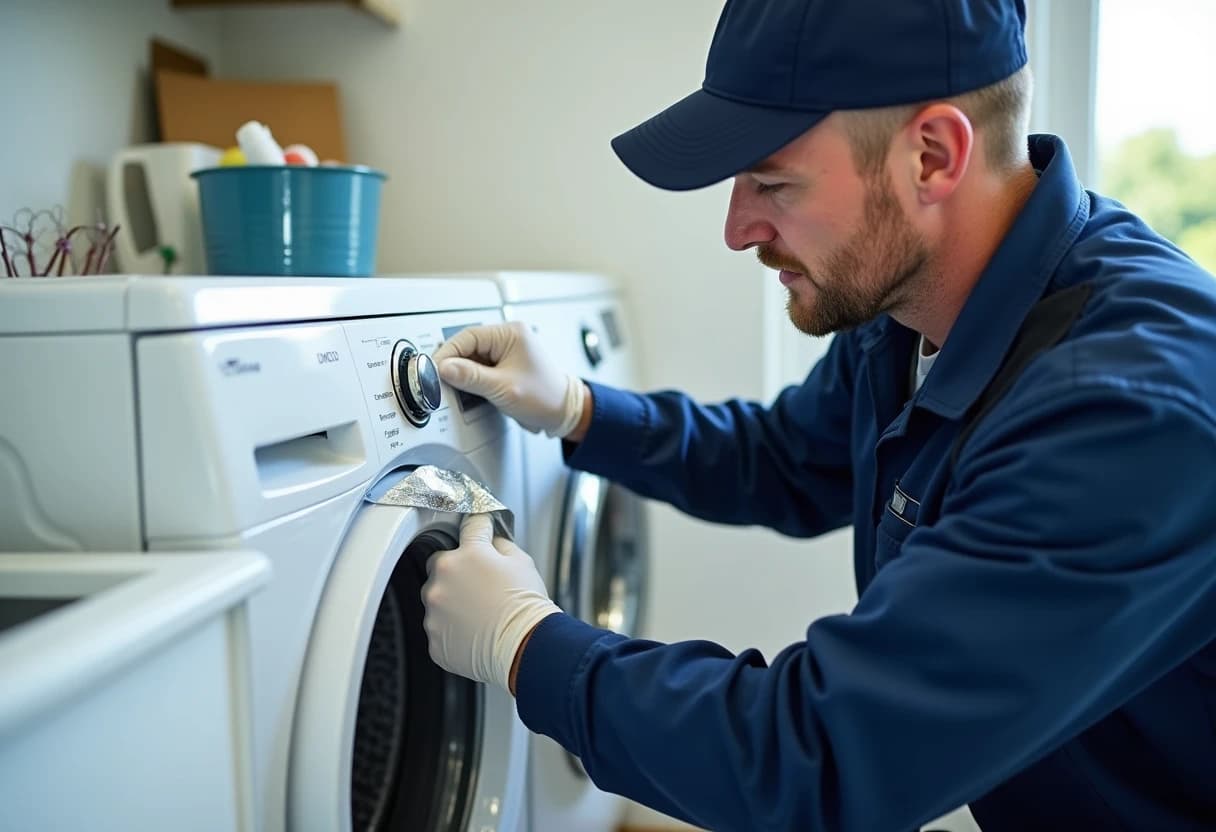
Homeowners in Wakefield usually discover a broken dryer vent through a symptom that seems unrelated: a water stain on the ceiling under the laundry, lint appearing in the basement, a mildew smell in one wall, or an energy bill that crept up as the dryer strained. Our repair service finds the failure and fixes it for good — with 4-inch smooth rigid metal duct, joints fitted and clamped without airstream-piercing screws, seams sealed with UL-listed foil tape, and a new exterior hood where the old damper has failed. We are local, insured, and we photograph every repair so you can see exactly what was wrong and exactly what made it right.
Why Dryer Vent Repair Matters for Wakefield Homes
Condensation problems deserve their own diagnosis, because they mimic other failures and defeat simple cleaning. The physics: dryer exhaust leaves the drum warm and nearly saturated with moisture. If the duct passes through a cold basement, garage, crawlspace or attic — as most retrofitted Massachusetts laundry runs do — the exhaust cools below its dew point and water condenses inside the duct. The consequences cascade: condensate soaks passing lint into heavy mats that block the line; pooled water corrodes galvanized duct from the inside until pinholes leak onto ceilings; water drains backward through joints and drips behind the dryer; and in the worst winter cases, condensate freezes at the termination and seals the vent entirely. The repairs are specific and effective: restore continuous slope so water drains outward, seal the joints it has been escaping through, insulate the cold duct sections, shorten or reroute runs where the design is hopeless, and replace corroded segments. Guessing at it wastes money; our inspection identifies which combination your vent actually needs.
Winters around Wakefield are hard on dryer vents in ways warmer regions never see. Homes near Lake Quannapowitt and Crystal Lake sit in a noticeably damp microclimate, and we frequently find condensation and musty odors in basement duct runs on the lake side of town. Wakefield's older housing also hides a lot of century-old framing cavities used as makeshift return paths, which pull attic and wall dust straight into the airstream. Exhaust moisture condenses and freezes in duct sections crossing cold basements and exterior walls, dampers ice shut, and snow buries grade-level hoods. Wakefield's blocks around Lake Quannapowitt and the Upper Common are lined with Queen Anne Victorians and roomy 1900s-1920s colonials, while Greenwood and Montrose fill in with capes, bungalows and postwar ranches. Many of the older homes began life with steam or hot-water heat and have since gained forced-air or ducted AC threaded through tight balloon-framed walls. Those homes often route vents through the coldest parts of the structure, which is why our Wakefield condensation repairs so often involve insulating and re-sloping duct in unheated space. We fix the winter failure and the design weakness behind it, so the same problem does not return with the next cold snap.
Our Dryer Vent Repair Process in Wakefield
1Diagnose the Full Exhaust Path
We treat symptoms as evidence: lint in the basement points to a specific joint; a ceiling stain maps to a specific duct section; condensation drips tell us where the run crosses cold space. Correlating symptoms with the physical path usually pinpoints the failure within minutes — and rules out the failures you do not have.
2Protect the Area & Open Access
Before repair work, we protect floors and finishes along the work path, move the dryer out carefully on sliders, and set up at the failure points. Where a concealed joint requires access, we discuss options first — many repairs can be made from existing openings, and when cutting is unavoidable we keep openings minimal and tell you exactly what restoration will involve.
3Reconnect & Properly Fasten Separated Joints
Where lint and moisture have escaped into a cavity through a long-standing disconnection, we vacuum accessible accumulation with HEPA equipment and document conditions with photos. Removing that hidden fuel load matters as much as the reconnection itself — and the photos give you a record for insurance or future renovation planning.
4Replace Crushed, Corroded or Non-Compliant Sections
Duct that is crushed, kinked, rusted through or made of prohibited material gets replaced, not patched. We install 4-inch smooth-interior rigid metal duct — the material the IRC's dryer exhaust rules specify — cut to fit, joined without airstream-piercing fasteners, and supported so it cannot sag into water-pooling bellies.
5Cure Condensation: Slope, Seal & Insulate
Condensation repairs follow the water. We restore continuous slope toward the termination so condensate drains out instead of pooling; seal the joints it has been leaking through with foil tape rated for the duty; and insulate duct sections crossing unheated basements, garages, attics and exterior wall bays so exhaust stays above its dew point until it exits.
6Repair or Replace the Exterior Hood & Damper
Failed terminations get quality metal replacements: a hood sized to the 4-inch duct with a free-swinging damper that opens fully under airflow and closes tight against weather and pests. Screened hoods — a code violation on dryer vents because mesh mats over with lint — are replaced with proper damper-and-guard designs made for dryer exhaust.
7Replace the Transition Duct & Reset the Dryer
The appliance connection is rebuilt to spec: a UL-listed semi-rigid aluminum transition duct, as short and straight as the layout allows, secured with clamps at both ends. We position the dryer so the connector keeps its full diameter — not crushed against the wall — and mark the safe distance so future pushes do not recreate the old kink.
8Verify Airflow & Document the Repair
The proof is at the hood: with the dryer running, the damper should stand fully open under a strong, steady exhaust stream. We verify it together, compare against the pre-repair condition, and confirm no leakage remains at any repaired joint. Then the work area is cleaned, the dryer set, and the laundry room returned to service.
Benefits of Professional Dryer Vent Repair in Wakefield
A Serious Fire Hazard, Eliminated
Code-compliant materials are themselves a safety upgrade: smooth rigid metal resists lint accumulation, clamped joints hold under heat and vibration, and a proper termination keeps nesting animals from plugging the line. A repaired vent is not just fixed — it is a fundamentally lower-risk system than what it replaces.
Restored Drying Performance
A crushed or separated duct throttles airflow just like a lint clog, and no amount of cleaning fixes it. Repair restores the full 4-inch path, and drying performance returns immediately — one-cycle loads, accurate sensor-dry behavior, and a machine that stops straining against backpressure it was never designed to fight.
Moisture Out of Your Walls and Ceilings
Condensation repairs — slope, sealing, insulation — end the drip-and-pool cycle that rusts ducts from the inside and stains ceilings from above. Laundry areas dry out, winter window condensation eases, and the musty smell that clung to the wall behind the dryer leaves with the moisture feeding it.
Lower Energy and Repair Bills
Blocked and breached vents are behind a large share of dryer service calls: blown thermal fuses, burned heating elements, failed high-limit switches. Each is a $150 to $400 appliance visit that recurs until the vent is fixed. One proper duct repair typically costs less than two of those visits and ends the cycle.
Pest Entry Points Closed
We remove existing nesting material as part of termination repair and clean the affected duct section, because a nest is both a blockage and a sanitation issue in an airstream that passes your clothing. The new hood's pest protection is chosen to exclude animals without the lint-trapping mesh that code prohibits.
Code Compliance & Inspection-Ready Documentation
Compliance is not paperwork for its own sake; each code provision encodes a failure the industry learned about the hard way. Smooth interiors resist lint. Clamped joints survive heat. Unscreened dampers do not mat over. A to-code vent is simply a vent engineered not to fail the common ways.
Signs Your Wakefield Home Needs Dryer Vent Repair
Lint Appearing Where It Shouldn't
Lint drifting from a basement ceiling, gathering on joists, puffing from a wall register or collecting behind the dryer means exhaust is escaping the duct before the termination. Lint marks the leak like dye in water — follow it and you find the separated joint or breach. This is a repair call, not a cleaning call, and it should not wait.
Exterior Damper Broken, Stuck or Missing
Look at the hood outside: a damper flap hanging loose, rusted stiff, cracked off, painted shut or missing entirely is a failed termination. Stuck open, it drains heat and admits pests all winter; stuck shut, it blocks the vent completely. Either way the fix is a proper replacement hood — one of the fastest, most cost-effective repairs on our list.
Musty or Mildew Smell in the Laundry Area
A persistent damp smell around the laundry — or in one adjacent wall or ceiling — often means exhaust moisture has been feeding hidden mildew via a leak or chronic condensation. The odor is the nose's report on a moisture problem the eyes cannot see. A vent-path inspection locates the escape point, and repair dries up its food supply.
Water Stains, Drips or Peeling Paint Near the Vent Path
Rust streaks on duct exteriors, corroded clamps and white mineral tracks at joints are the slow-motion version of the same evidence: repeated internal condensation escaping over months. Left alone it rusts through the duct wall; caught early, the fix is sealing and insulation rather than replacement.
Slow Drying That Cleaning Didn't Fix
A dryer that dries poorly immediately after being moved, after appliance delivery, or after renovation work near the laundry almost certainly has a crushed transition or a disturbed joint — the timing is the clue. These are among the quickest, least expensive repairs we make, often at the bottom of the $150 to $450 range.
Visibly Damaged, Kinked or Sagging Duct
Trust your eyes: a transition hose flattened behind the dryer, a dented or crushed section in the basement, duct sagging between supports into a low belly, or a run held together with fabric duct tape are all failures in progress. Each restricts airflow, collects lint and moisture, and worsens with time. Photograph what you see and call — the quote is quick.
Dryer Vent Repair Cost in Wakefield, MA
Compare the repair cost against what the failure costs to keep. A leaking vent delivers roughly a gallon of water per load into your building assemblies — and chronic wall moisture matures into mold remediation and drywall work that starts around $1,500 and climbs steeply. A crushed or blocked duct overworks the dryer into $150 to $400 appliance repairs (thermal fuses, elements, switches) that recur until the vent is fixed, while adding $10 to $20 a month in energy waste. A failed damper leaks heated air all winter and invites nest blockages every spring. And every one of these failures raises fire risk in a system that already accounts for about 2,900 US home fires a year. Against that ledger, $150 to $450 for a permanent, code-compliant repair is one of the clearest-value maintenance purchases in the home. Most customers who see the diagnostic photos do not need convincing; the duct makes the argument itself.
Want the full pricing picture? See our complete Boston-area cost guide or call (617) 390-7145 for an exact flat quote for your Wakefield home.
Local Knowledge: Wakefield, Middlesex County
What makes Wakefield different? Wakefield's blocks around Lake Quannapowitt and the Upper Common are lined with Queen Anne Victorians and roomy 1900s-1920s colonials, while Greenwood and Montrose fill in with capes, bungalows and postwar ranches. Many of the older homes began life with steam or hot-water heat and have since gained forced-air or ducted AC threaded through tight balloon-framed walls. Homes near Lake Quannapowitt and Crystal Lake sit in a noticeably damp microclimate, and we frequently find condensation and musty odors in basement duct runs on the lake side of town. Wakefield's older housing also hides a lot of century-old framing cavities used as makeshift return paths, which pull attic and wall dust straight into the airstream. For duct and dryer vent systems, those local factors translate into specific, predictable problems — and predictable problems are the ones we solve fastest. Call (617) 390-7145, tell us your street and home style, and we will quote the job accurately the first time, usually in under five minutes.
The Best Time of Year in Wakefield
Spring is nesting season, and a dryer vent with a compromised damper is prime real estate: warm, dry, sheltered, and lined with soft lint. Birds, squirrels and mice move in between March and June, and by summer the nest has become a full blockage — often discovered when drying times collapse or a burning smell appears. The seasonal logic favors acting early: repair a failing damper in late winter and the nest never happens; wait, and the spring repair includes nest removal, duct cleaning and sanitizing on top of the hood replacement. If you heard scratching or chirping near the laundry last spring, put the termination inspection on this year's calendar before the wildlife does.
Why Choose Boston Air Duct Cleaners
As a West Newton-based company, we treat Wakefield like the neighborhood it is — because for us, it is. Our reputation lives or dies on local referrals, so every job gets the full process: complete system cleaning under negative pressure, mechanical agitation of every run, blower compartment service, and a documented walkthrough before we leave. We are licensed and insured, our estimates are free and flat, and our schedule holds same-day slots for urgent calls. One visit and you will understand why neighbors keep our magnet on the fridge.
Serving Wakefield and Surrounding Communities
Wakefield sits in the heart of our service area, and neighboring Stoneham, Melrose, Reading, Lynnfield, Saugus, North Reading appointments share the same routes. That density is why our response times in this part of Middlesex County are among our fastest — and why you will see our trucks in the area week after week.