
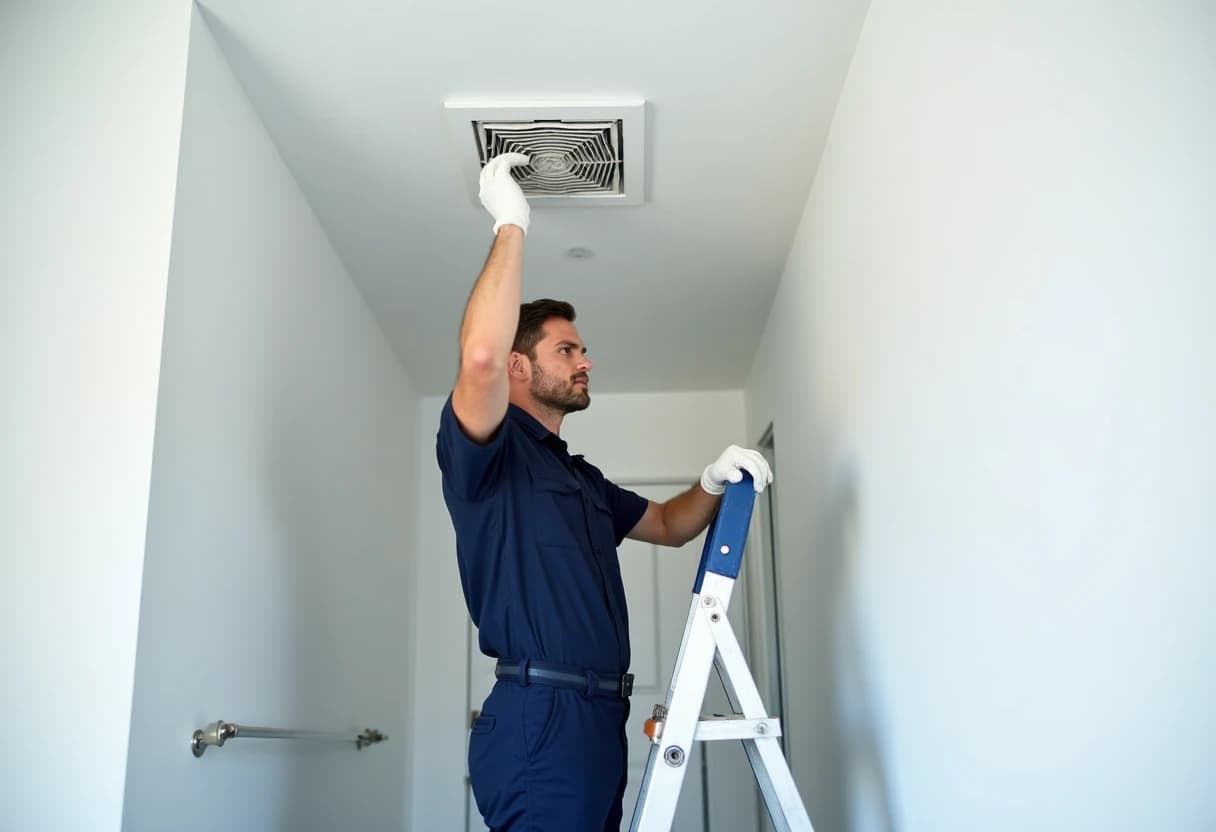
Mold in a bathroom is rarely a cleaning-product problem — it is an airflow problem. Every shower releases moisture that must leave the room through one small duct, and when that duct and its fan are choked with years of dust, the moisture stays: fogging mirrors long after the shower ends, feeding the black speckling on ceilings and grout, and condensing inside walls where you cannot see it. Our Back Bay technicians clean the complete system — grille, blades, motor housing, and the full duct run to its exterior termination — then verify the restored airflow. EPA guidance on mold control starts with ventilation for a reason: fix the airflow and the bathroom finally dries the way it was designed to.
Why Bathroom Exhaust Fan Cleaning Matters for Back Bay Homes
The grille test tells the story: pull the cover off any bathroom fan that has run for a few years without service and you will find the blades wearing fur coats and the housing packed with damp gray felt. That accumulation does three kinds of damage. It blocks airflow, so moisture stays in the room and feeds mold on every surface it touches. It loads and unbalances the motor, which is why neglected fans hum, rattle and grind — and why their motors burn out years early, often seizing in a way that presents a genuine overheating hazard in an appliance mounted against attic framing. And it makes the fan itself a contamination source: a dust-caked fan in a moist room grows its own microbial load, then blows it around the bathroom every time it runs. Cleaning reverses all three at once. It is dramatically cheaper than the alternatives people end up paying for instead — repeated mold remediation of the same ceiling, premature fan replacement, or repainting a bathroom every other year because the paint keeps failing from trapped humidity.
The moisture math is unforgiving in Back Bay winters. The high-velocity small-duct systems common in Back Bay brownstones clog faster than conventional ductwork because the two-inch flexible tubing has so little tolerance for buildup. Add in landmark-district window restrictions that limit natural ventilation and dryer vents that exit through rear alley walls after long horizontal runs, and Back Bay units benefit from cleaning more often than almost anywhere we serve. Every shower sends a surge of humid air at a duct that must carry it through freezing attic or wall space before it condenses — and a dirty, restricted run loses that race daily from November through April. Back Bay is a nearly unbroken grid of Victorian brownstones built on filled land between the 1860s and 1890s, most long since divided into condos, alongside luxury towers near the Prudential and Copley Place. Original coal-and-radiator buildings have been retrofitted over and over - high-velocity mini-duct systems, ceiling-cassette air handlers, and full forced-air conversions threaded through plaster walls and marble-trimmed stairwells. Those retrofit runs are narrow, joint-heavy and notoriously dusty. That is why local bathroom complaints cluster in winter: brown rings around fans, speckled ceilings, window condensation, paint that fails within a year of repainting. Cleaning the exhaust path is the fix that addresses the cause. We serve Back Bay alongside Beacon Hill and South End, so route slots open weekly and bundled visits with our other services are easy to schedule.
Our Bathroom Exhaust Fan Cleaning Process in Back Bay
1Airflow Test & System Assessment
First, a diagnosis: the fan runs while we check draw at the grille and note the sound signature — a healthy hum versus the rattle of caked blades or the groan of a straining motor. We locate where the duct goes and where it terminates, because the fix must cover the full path, not just the visible fixture.
2Protect the Bathroom & Drop the Grille
We lay protection over the vanity, tub and floor before touching anything overhead. The grille is released — gently, since aging plastic clips grow brittle — and taken down for degreasing and washing. A grille that strains humid air daily accumulates a felt that must be soaked off, not dusted off.
3Clean the Fan Blades, Motor & Housing
The fan assembly gets detailed by hand: every blade surface cleared, the motor housing cleaned so the motor stops running hot under its dust blanket, and the interior of the unit HEPA-vacuumed. Where the assembly is designed to drop out, we remove it for a more thorough bench cleaning at the site.
4Clean the Full Duct Run
The duct gets cleaned end to end, not just where it meets the fan. In attic runs we follow the duct physically where access allows, correcting sags that trap condensation and verifying every joint is still connected — a surprising number are not, and a disconnected bathroom duct is quietly raining moisture into the insulation.
5Check the Roof or Soffit Termination
Every bathroom duct ends somewhere — a roof cap, a soffit vent, a wall hood — and that termination is a common failure point. We verify the damper opens freely and closes fully, clear any matted screen or debris, and confirm exhaust actually exits the building rather than dead-ending in the attic.
6Verify Airflow & Reassemble
The final test is the point of the whole visit: does the fan now clear the room? We verify strong draw at the grille, confirm smooth and quiet operation, and reinstall the cleaned grille. If measured airflow remains weak after a full cleaning, the cause is mechanical or structural — and we tell you exactly what and what it would cost, rather than declaring victory.
7Report, Recommendations & Maintenance Notes
Documentation comes standard because bathroom fans intersect with real decisions: condo compliance requests, mold remediation follow-ups, pre-sale punch lists. Our summary — findings, photos, airflow figures — slots into all of them. And if we spotted anything beyond our scope, like active mold in the surrounding drywall, you will hear it straight, with referral guidance rather than an upsell.
Benefits of Professional Bathroom Exhaust Fan Cleaning in Back Bay
Mold Prevention at the Source
Bathroom mold is a moisture symptom, and moisture is an airflow symptom. A cleaned, verified exhaust system removes shower humidity before it can condense on ceilings, grout and window frames — cutting off the water supply mold depends on. It is the fix that makes the scrubbing finally stick.
Protection for the Attic & Structure
A bathroom fan venting into the attic is one of the most damaging small defects a house can have, and one of the most common in older Massachusetts homes. Because we clean the duct to its termination rather than stopping at the fan, that defect cannot hide from our visit.
Lower Whole-Home Humidity
Dust mites and mold throughout the house track indoor humidity, and indoor humidity tracks bathroom ventilation more than most owners realize. Fixing the exhaust path is one of the cheapest whole-home humidity interventions available — a fraction of the purchase and running cost of the dehumidifier it often replaces.
Fresher Air & Odor Control
Guest bathrooms, powder rooms, rental units: anywhere odors and freshness matter to people beyond the household, a properly exhausting fan is the difference between a bathroom that resets itself and one that broadcasts its history. Landlords bundle this service across units for exactly that reason.
A Quieter, Longer-Lived Fan
Fan motors die early for one main reason: heat trapped by the dust packed around them, working against blades made heavy and unbalanced by the same dust. Cleaning removes both stressors, routinely adding years to a motor's life and deferring the cost and ceiling-patching of a full replacement.
Cheap Insurance Bundled Conveniently
At $99–$199 per bathroom — less when bundled with air duct or dryer vent service — this is among the least expensive preventive services in home maintenance, weighed against what chronic bathroom moisture costs: remediation, repainting, regrouting, fan replacement, attic repairs. The economics are not close.
Signs Your Back Bay Home Needs Bathroom Exhaust Fan Cleaning
The Fan Has Grown Loud, Rattly or Labored
Fans do not naturally get louder with age — they get louder with dirt. Dust bonds unevenly to blades, unbalancing the wheel; buildup around the motor makes it labor. The rattle, hum or grind you have learned to ignore is the sound of a system asking to be cleaned.
Mold Keeps Returning on Ceiling or Grout
Check where the mold concentrates. Growth ringing the fan grille itself is the strongest clue of all: the fixture meant to remove humidity has become the dampest, dirtiest spot in the room. That fan is overdue for a full-system cleaning, not another wipe-down.
Musty Smells When the Fan Runs
A fan that makes the bathroom smell worse is contaminating rather than ventilating: the damp felt on its blades and housing hosts microbial growth, and running the fan aerosolizes it. Cleaning removes the growth medium — the smell leaves with the dirt.
Ceiling Stains or Winter Drips Around the Fan
Actual dripping from the fan on cold mornings is the same condensation cycle at full strength, and it deserves prompt attention: the water is also soaking the duct's low spots and the ceiling cavity. Cleaning plus correcting duct sags typically resolves it in one visit.
Mirrors Stay Fogged Long After Showers
A working exhaust fan should clear mirror fog within minutes of shower's end. Fog that lingers a half hour is humidity with nowhere to go — the fan is running but not exhausting, which is the signature of a blocked duct or a dust-choked fan assembly.
Visible Dust Fur on the Grille
The grille is the system's tell: gray fuzz on the louvers means the fan has been straining humid air through accumulating dust for years, and the buildup you can see continues into the blades, housing and duct you cannot. A furred grille has never once meant a clean duct behind it.
Bathroom Exhaust Fan Cleaning Cost in Back Bay, MA
It is worth pricing this service against what it prevents, because the prevention math is lopsided. Recurring bathroom mold that finally spreads into drywall means remediation billed in the thousands; chronic humidity peels paint and blackens grout on a repeating cycle of four-figure refinishing; a fan motor cooked by years of dust-blanket operation means replacement — the unit, the electrician, the ceiling patching — at several times the cost of the cleaning that would have prevented it. The hidden failures are costlier still: a duct quietly venting into the attic wets insulation and sheathing for years before discovery, and the repair bill reflects every one of those years. Against that list, $99–$199 per fan every two to three years is one of the cheapest insurance policies in home maintenance. The bathrooms where it matters most are exactly the ones where the service is most neglected: rentals, guest baths, and the hardworking family bathroom that runs four showers a day against a duct that has not been touched since installation.
Want the full pricing picture? See our complete Boston-area cost guide or call (617) 390-7145 for an exact flat quote for your Back Bay home.
Local Knowledge: Back Bay, Suffolk County
Serving Back Bay means knowing Back Bay. Back Bay is a nearly unbroken grid of Victorian brownstones built on filled land between the 1860s and 1890s, most long since divided into condos, alongside luxury towers near the Prudential and Copley Place. Original coal-and-radiator buildings have been retrofitted over and over - high-velocity mini-duct systems, ceiling-cassette air handlers, and full forced-air conversions threaded through plaster walls and marble-trimmed stairwells. Those retrofit runs are narrow, joint-heavy and notoriously dusty. The high-velocity small-duct systems common in Back Bay brownstones clog faster than conventional ductwork because the two-inch flexible tubing has so little tolerance for buildup. Add in landmark-district window restrictions that limit natural ventilation and dryer vents that exit through rear alley walls after long horizontal runs, and Back Bay units benefit from cleaning more often than almost anywhere we serve. Those conditions shape how we work here: which brush heads come off the truck, how we protect finishes in older interiors, and what we expect to find when the camera goes into a 02116 duct system. Our crews are in and around Back Bay nearly every week — often for neighbors of past customers — so scheduling is fast and our arrival windows hold.
The Best Time of Year in Back Bay
New England's old housing stock writes its history into its bathroom ventilation. In the region's Victorians, triple-deckers and pre-war capes, bathroom fans are almost always retrofits — added decades after construction, ducted along whatever path an installer could find, terminated wherever the outside was reachable. Those improvised runs age poorly: flex duct sags into condensation traps, joints pull apart as old framing moves seasonally, and terminations disappear under subsequent roofing and siding projects. Layer the region's long heating season and humid summers over that infrastructure and the case for periodic cleaning-plus-inspection makes itself. Our visits treat the duct path as seriously as the fan because in this housing stock, the path is usually the problem — and every season leaves its mark on it.
Why Choose Boston Air Duct Cleaners
We built this company around the jobs other duct cleaners do badly: the 130-year-old Victorian with panned-joist returns, the Back Bay condo with a 60-foot dryer run to the roof, the post-renovation house full of drywall dust. Our crews see Greater Boston's hardest systems every week, and the experience shows in the details — floor protection on the way in, sealed registers during the work, HEPA-vacuumed work areas on the way out, and imagery that proves the ducts are actually clean. Call (617) 390-7145 and judge the difference from the first conversation.
Serving Back Bay and Surrounding Communities
Beyond Back Bay, our crews cover the surrounding communities daily — including Beacon Hill, South End, Boston, Brookline, Seaport District, Allston. Because routes cluster geographically, booking alongside a neighboring appointment often unlocks same-day service and combined-visit savings. Wherever you are in Suffolk County, the same flat-rate pricing, insured technicians and photo-documented process applies.