
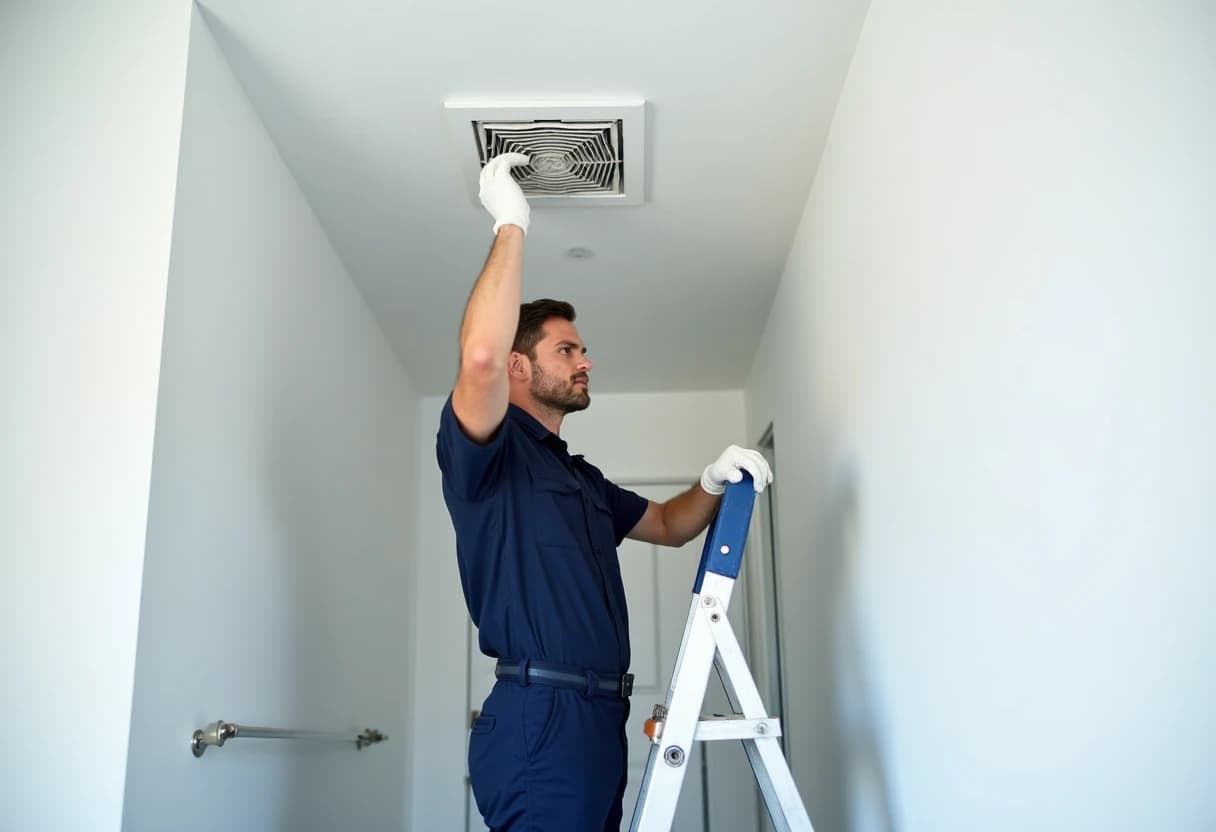
Your bathroom exhaust fan has one job: move moist air out of the house before it condenses into mold, peeling paint and rotting trim. Most fans in Boston homes have not been able to do that job properly in years — the grille is furred with dust, the blades are caked, the motor is straining, and the duct to the roof or soffit is narrowed with lint-like buildup. Our cleaning service restores the whole system: grille degreased and washed, fan blades and motor housing cleaned, the complete duct run cleaned to its termination, and airflow verified before we leave. Most bathrooms take under an hour, and the difference — in noise, in mirror fog, in how fast the room dries — is immediate.
Why Bathroom Exhaust Fan Cleaning Matters for Boston Homes
Skeptics ask whether a fan this small justifies professional service, and the honest answer comes from what the service actually covers. Vacuuming a grille is a five-minute homeowner job we happily encourage. What homeowners cannot practically do is the rest: dismantle and degrease the fan assembly without damaging brittle plastic and aging wiring, clean a duct run they cannot reach or see, verify the roof or soffit termination is intact and its damper free, catch the disconnected joint quietly venting into the attic, and measure airflow to confirm the system actually works when reassembled. That full scope is the difference between a fan that looks clean and a fan that performs. Our visits routinely uncover issues beyond dirt — crushed ducts, backwards-installed dampers, terminations painted over during exterior work — that explain years of bathroom moisture problems in a single inspection. And because the service is quick, we bundle it: most customers add bathroom fans to an air duct or dryer vent appointment for a reduced per-fan rate, handling every exhaust system in the house in one visit.
Condo and multi-family living makes bathroom exhaust a shared concern in Boston. Boston's housing runs the full spectrum of American urban building: 1800s brownstones and brick rowhouses in Back Bay, Beacon Hill and the South End, wood-frame triple-deckers across Dorchester and the streetcar neighborhoods, mid-rise brick apartment blocks near the universities, and glass condo towers downtown and along the harbor. Countless older buildings have been carved into condos with each unit given its own furnace or heat pump, so ductwork is often squeezed through 19th-century joist bays, chases and dropped ceilings never designed for it. The result is a city full of long, tight, hard-to-reach duct runs that trap decades of dust. In stacked buildings, one unit's failed fan raises humidity that neighbors feel, and duct runs to roof terminations often cross common attics or chases the unit owner has never seen. We work in Boston every week, from rowhouse condos on gas-fired forced air to triple-decker units with attic air handlers. City-specific issues come up constantly: shared-wall dust migration in rowhouse blocks, renovation debris left in ducts after condo conversions, and dryer vent runs that snake thirty-plus feet to reach an outside wall - a genuine fire risk we flag on nearly every Boston visit. Associations across Suffolk County increasingly ask owners to verify their exhaust fans are actually functional, and our service answers that request completely: full cleaning, duct-path inspection, termination check and an airflow reading, documented per unit. Boards booking whole buildings get block scheduling and per-unit pricing that makes compliance genuinely affordable.
Our Bathroom Exhaust Fan Cleaning Process in Boston
1Airflow Test & System Assessment
First, a diagnosis: the fan runs while we check draw at the grille and note the sound signature — a healthy hum versus the rattle of caked blades or the groan of a straining motor. We locate where the duct goes and where it terminates, because the fix must cover the full path, not just the visible fixture.
2Protect the Bathroom & Drop the Grille
We lay protection over the vanity, tub and floor before touching anything overhead. The grille is released — gently, since aging plastic clips grow brittle — and taken down for degreasing and washing. A grille that strains humid air daily accumulates a felt that must be soaked off, not dusted off.
3Clean the Fan Blades, Motor & Housing
This step returns the fan to its rated performance. Dust on blades changes their shape and steals capacity; dust packed around motors traps heat and shortens their lives. We clean both thoroughly, check that the wheel spins free and true, and inspect wiring and mounts while the housing is open — problems get photographed and flagged.
4Clean the Full Duct Run
The duct gets cleaned end to end, not just where it meets the fan. In attic runs we follow the duct physically where access allows, correcting sags that trap condensation and verifying every joint is still connected — a surprising number are not, and a disconnected bathroom duct is quietly raining moisture into the insulation.
5Check the Roof or Soffit Termination
Every bathroom duct ends somewhere — a roof cap, a soffit vent, a wall hood — and that termination is a common failure point. We verify the damper opens freely and closes fully, clear any matted screen or debris, and confirm exhaust actually exits the building rather than dead-ending in the attic.
6Verify Airflow & Reassemble
The final test is the point of the whole visit: does the fan now clear the room? We verify strong draw at the grille, confirm smooth and quiet operation, and reinstall the cleaned grille. If measured airflow remains weak after a full cleaning, the cause is mechanical or structural — and we tell you exactly what and what it would cost, rather than declaring victory.
7Report, Recommendations & Maintenance Notes
The visit closes with a walkthrough: what the duct looked like, what the termination needed, how the numbers changed. We note the fan's make and condition for your records, recommend a realistic recleaning interval based on household use, and leave grille-vacuuming tips that stretch the interval further.
Benefits of Professional Bathroom Exhaust Fan Cleaning in Boston
Cheap Insurance Bundled Conveniently
Most customers add bathroom fans to an existing appointment: the crew is already in the house, the equipment is on the truck, and the per-fan price drops accordingly. One visit covers every exhaust system you own — HVAC ducts, dryer vent, bathroom fans — which is how whole-house air maintenance should work.
A Bathroom That Actually Dries
Paint, caulk, grout and trim all fail early in chronically damp bathrooms — peeling, cracking, blackening on a schedule set by humidity. Fixing the exhaust extends the life of every finished surface in the room, which is why a $99–$199 cleaning routinely postpones a four-figure repaint or regrout.
Mold Prevention at the Source
Bathroom mold is a moisture symptom, and moisture is an airflow symptom. A cleaned, verified exhaust system removes shower humidity before it can condense on ceilings, grout and window frames — cutting off the water supply mold depends on. It is the fix that makes the scrubbing finally stick.
Lower Whole-Home Humidity
Bathrooms are the largest humidity source in most homes, and a failed fan shares that humidity with every adjacent room. Restoring exhaust performance measurably lowers whole-home moisture — less window condensation in winter, less summer mugginess, less work for dehumidifiers and air conditioners alike.
Protection for the Attic & Structure
Ceiling stains around bathroom fans are usually condensation dripping back from cold, dirty ducts — not roof leaks. Cleaning restores the airflow that outruns condensation, and our inspection of the run corrects the sags and gaps that let water collect. The stain stops growing because its source is gone.
A Quieter, Longer-Lived Fan
A straining fan is also a small but real safety concern — seized, overheating exhaust fan motors mounted against framing are a documented ignition source. A cleaned fan runs cool, balanced and free, which is better for the motor, the electric bill and your peace of mind.
Signs Your Boston Home Needs Bathroom Exhaust Fan Cleaning
Visible Dust Fur on the Grille
The grille is the system's tell: gray fuzz on the louvers means the fan has been straining humid air through accumulating dust for years, and the buildup you can see continues into the blades, housing and duct you cannot. A furred grille has never once meant a clean duct behind it.
Musty Smells When the Fan Runs
In winter, an intermittent sour smell from the fan often means condensate is collecting in the cold duct and wetting years of accumulated dust. That damp mass blocks airflow, breeds odor and drips back toward the ceiling — three symptoms, one cause, one cleaning.
The Fan Has Grown Loud, Rattly or Labored
If the household habit is leaving the fan off because it is annoying, the noise problem has become a moisture problem: an unused fan protects nothing. Restoring quiet operation is often what actually restores ventilation, because a fan people tolerate is a fan people run.
Ceiling Stains or Winter Drips Around the Fan
If stains reappear after every repaint, stop repainting and check the exhaust path. Paint hides the symptom for a season; airflow removes the cause permanently. We photograph the duct conditions behind chronic stains, so you finally see what the ceiling has been protesting about.
Mirrors Stay Fogged Long After Showers
Fog time is a free airflow meter. Note how long your mirror takes to clear with the fan running: under five minutes is healthy; over fifteen means the room is holding the moisture that should have left through the duct, and everything porous in the bathroom is absorbing the difference.
The Tissue Test Fails
Try the test in every bathroom; the comparison is telling. Households often find one fan holds the tissue firmly while another drops it instantly — same house, same habits, different duct conditions. The failing one is not older or worse; it is dirtier, and cleaning restores it.
Bathroom Exhaust Fan Cleaning Cost in Boston, MA
Three factors set your exact price. First, termination type: soffit and wall terminations are quick to access and verify; roof caps require ladder or roof work that adds cost, especially on steep New England rooflines. Second, duct length and material: a four-foot rigid run cleans quickly, while twenty feet of aging flex duct across an attic takes time and care — flexible duct tears if cleaned aggressively, so it is slower by necessity. Third, fan condition: a unit serviced within recent memory cleans faster than one untouched since installation, where bonded buildup needs soaking and hand work. What does not change the price: surprises we find along the way. Discovered problems — disconnected joints, failed dampers, fans venting into the attic — get photographed and quoted separately as flat-rate repairs, never folded into the cleaning bill or performed without approval. And if a fan proves to be at genuine end of life, we say so plainly; charging full cleaning price for a motor with months to live helps nobody, and we would rather quote the replacement honestly.
Want the full pricing picture? See our complete Boston-area cost guide or call (617) 390-7145 for an exact flat quote for your Boston home.
Local Knowledge: Boston, Suffolk County
What makes Boston different? Boston's housing runs the full spectrum of American urban building: 1800s brownstones and brick rowhouses in Back Bay, Beacon Hill and the South End, wood-frame triple-deckers across Dorchester and the streetcar neighborhoods, mid-rise brick apartment blocks near the universities, and glass condo towers downtown and along the harbor. Countless older buildings have been carved into condos with each unit given its own furnace or heat pump, so ductwork is often squeezed through 19th-century joist bays, chases and dropped ceilings never designed for it. The result is a city full of long, tight, hard-to-reach duct runs that trap decades of dust. We work in Boston every week, from rowhouse condos on gas-fired forced air to triple-decker units with attic air handlers. City-specific issues come up constantly: shared-wall dust migration in rowhouse blocks, renovation debris left in ducts after condo conversions, and dryer vent runs that snake thirty-plus feet to reach an outside wall - a genuine fire risk we flag on nearly every Boston visit. For duct and dryer vent systems, those local factors translate into specific, predictable problems — and predictable problems are the ones we solve fastest. Call (617) 390-7145, tell us your street and home style, and we will quote the job accurately the first time, usually in under five minutes.
The Best Time of Year in Boston
Humid Boston summers give bathroom fans a different job and expose a different weakness. With July dew points regularly in the mid-60s and above, the bathroom starts each day damp before anyone showers, and a weak fan cannot clear moisture the ambient air continuously replaces. The result is the summer complaint pattern: mildew smell that builds through August, towels that never fully dry, mold appearing in bathrooms that were fine all winter. Coastal and near-coastal homes add salt air, which corrodes damper hinges and fan components faster than inland exposure. Summer is also our lightest booking season, which makes it the practical choice for multi-fan homes and landlord portfolios — easy scheduling, bundle-friendly, and the whole system ready before fall closes the windows.
Why Choose Boston Air Duct Cleaners
Homeowners across Suffolk County choose Boston Air Duct Cleaners for three reasons. First, honesty: our inspection camera tells you whether your system actually needs cleaning — and sometimes the answer is no. Second, capability: truck-grade negative-air machines, rotary brush systems and HEPA filtration handle everything from antique gravity-furnace conversions to brand-new high-velocity systems. Third, accountability: flat quoted pricing, before-and-after photos, insured technicians, and a real local office you can call at (617) 390-7145. That combination is rarer in this industry than it should be.
Serving Boston and Surrounding Communities
We serve every community around Boston as well: Back Bay, South End, Cambridge, Brookline, Somerville, Dorchester all fall inside our regular service routes. If you have a second property, a rental, or family nearby, ask about multi-home scheduling — grouped appointments on the same route are our most requested discount.