
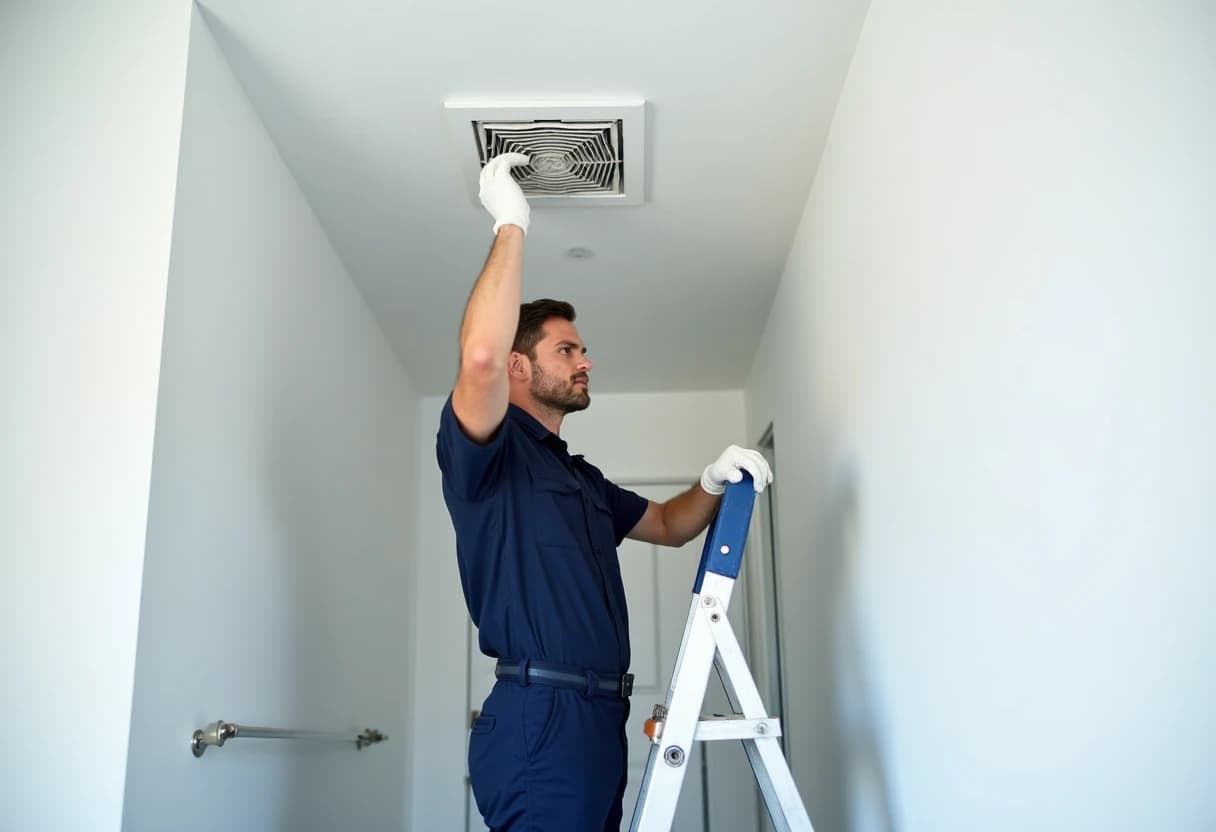
Hold a square of toilet paper up to your running bathroom fan. If the fan cannot pin it against the grille, it is not moving enough air to protect the room — and in our experience across Seaport District, most fans fail that test. The cause is almost always accumulation: dust bonds to moist surfaces inside the fan and duct, layer by layer, until a fan rated to clear the room in minutes can barely stir it. Our service is a true deep clean of the entire exhaust path, from the grille you can see to the roof or soffit termination you cannot, finishing with an airflow check that proves the fix. It is one of the least expensive, highest-impact moisture-control services a homeowner can buy.
Why Bathroom Exhaust Fan Cleaning Matters for Seaport District Homes
Winter is when weak bathroom exhaust does its most expensive damage in Massachusetts. Through the long heating season, every duct run passing through a cold attic becomes a condensation trap: humid shower air enters the duct, cools below its dew point before reaching the termination, and the resulting water either drips back through the fan onto the ceiling — those mysterious brown rings around bathroom fans — or pools in flex-duct sags where it soaks accumulated dust into a blocking sludge. A clean, smooth, well-flowing duct moves air fast enough to clear before condensing; a dirty, restricted one guarantees the condensation cycle repeats with every shower from November to April. This is why bathroom ceiling stains and recurring winter mold are overwhelmingly ventilation problems rather than roof leaks, and why cleaning the exhaust path — often paired with correcting duct sags and stuck dampers found along the way — fixes bathrooms that repainting never could. If your bathroom grows spots every winter and recovers every summer, the fan system is telling you exactly what it needs.
Ask anyone renovating near Harborwalk what they found when the bathroom ceiling came down: the fan duct tells the story of the house. The Seaport is Boston's newest neighborhood, dominated by glass luxury high-rises built almost entirely since 2010, with the Fort Point fringe adding century-old brick-and-beam warehouse lofts converted to condos. The towers run sophisticated central systems - vertical risers, unit-level fan coils and heat pumps, and shared corridor ventilation - where individual condo ductwork is compact but works hard year-round. Fort Point lofts feature long exposed spiral duct runs strung across timber ceilings. We regularly find original fans wired decades ago, ducts of every improvised material, and terminations that stopped functioning years back — all still running daily against total blockage. New construction is no guarantee of clean ducts: Seaport units routinely carry construction debris from their own build-out, and the towers' sealed windows mean residents breathe only what the mechanical systems deliver. Harbor humidity and salt air are hard on rooftop equipment and vent terminations, and in-unit washer-dryer setups with long concealed vent runs to the building exterior are a lint problem we service throughout the district. A cleaning visit is the inexpensive way to learn what your own bathroom is hiding: we open the system, clean it end to end, photograph anything that needs attention, and restore the airflow that keeps Seaport District bathrooms dry through the heating season. Most visits finish inside an hour per fan.
Our Bathroom Exhaust Fan Cleaning Process in Seaport District
1Airflow Test & System Assessment
We start by measuring what the fan actually moves — the tissue test at minimum, an anemometer reading when precision helps — and by asking about symptoms: fog that lingers, ceiling spots, noise, odors. The before-reading gives us a baseline, and your answers usually predict what the duct will show.
2Protect the Bathroom & Drop the Grille
Bathrooms are finished spaces, so we treat them that way: drop cloth below the fan, fixtures covered, careful hands on grilles that may not have moved in decades. The grille comes down for a full wash — soaking and scrubbing away the bonded dust fur that no in-place vacuuming can remove.
3Clean the Fan Blades, Motor & Housing
The fan assembly gets detailed by hand: every blade surface cleared, the motor housing cleaned so the motor stops running hot under its dust blanket, and the interior of the unit HEPA-vacuumed. Where the assembly is designed to drop out, we remove it for a more thorough bench cleaning at the site.
4Clean the Full Duct Run
From the fan housing, we clean the duct itself — brush and vacuum for rigid runs, gentler methods for flexible duct that tears easily — working toward the termination. This is where most of the lost airflow lives: years of humid-air dust lining every inch of a duct only a few inches across.
5Check the Roof or Soffit Termination
Every bathroom duct ends somewhere — a roof cap, a soffit vent, a wall hood — and that termination is a common failure point. We verify the damper opens freely and closes fully, clear any matted screen or debris, and confirm exhaust actually exits the building rather than dead-ending in the attic.
6Verify Airflow & Reassemble
The final test is the point of the whole visit: does the fan now clear the room? We verify strong draw at the grille, confirm smooth and quiet operation, and reinstall the cleaned grille. If measured airflow remains weak after a full cleaning, the cause is mechanical or structural — and we tell you exactly what and what it would cost, rather than declaring victory.
7Report, Recommendations & Maintenance Notes
Documentation comes standard because bathroom fans intersect with real decisions: condo compliance requests, mold remediation follow-ups, pre-sale punch lists. Our summary — findings, photos, airflow figures — slots into all of them. And if we spotted anything beyond our scope, like active mold in the surrounding drywall, you will hear it straight, with referral guidance rather than an upsell.
Benefits of Professional Bathroom Exhaust Fan Cleaning in Seaport District
Mold Prevention at the Source
EPA mold guidance is blunt: control the moisture and you control the mold. In a bathroom, the exhaust fan is the moisture control, and cleaning is what keeps it working. Customers who fought recurring ceiling spots for years consistently report the spots simply stop returning once real airflow is restored.
Cheap Insurance Bundled Conveniently
Most customers add bathroom fans to an existing appointment: the crew is already in the house, the equipment is on the truck, and the per-fan price drops accordingly. One visit covers every exhaust system you own — HVAC ducts, dryer vent, bathroom fans — which is how whole-house air maintenance should work.
Fresher Air & Odor Control
Odor removal is the fan's second job, and a choked fan fails at it just as thoroughly. Restored airflow clears the room in minutes instead of lingering half the morning — a small daily quality-of-life upgrade every member of the household notices immediately.
Lower Whole-Home Humidity
Bathrooms are the largest humidity source in most homes, and a failed fan shares that humidity with every adjacent room. Restoring exhaust performance measurably lowers whole-home moisture — less window condensation in winter, less summer mugginess, less work for dehumidifiers and air conditioners alike.
A Bathroom That Actually Dries
Weak exhaust makes a bathroom feel older than it is: perpetually damp air, sticky surfaces, fog that outlasts the shower by an hour. Restored airflow reverses the feel of the room the first day. Many customers tell us it is the most noticeable result of any service we offer, per dollar spent.
A Quieter, Longer-Lived Fan
Fan motors die early for one main reason: heat trapped by the dust packed around them, working against blades made heavy and unbalanced by the same dust. Cleaning removes both stressors, routinely adding years to a motor's life and deferring the cost and ceiling-patching of a full replacement.
Signs Your Seaport District Home Needs Bathroom Exhaust Fan Cleaning
The Tissue Test Fails
Try the test in every bathroom; the comparison is telling. Households often find one fan holds the tissue firmly while another drops it instantly — same house, same habits, different duct conditions. The failing one is not older or worse; it is dirtier, and cleaning restores it.
Ceiling Stains or Winter Drips Around the Fan
Brown rings around a bathroom fan are usually condensation, not roof leaks: humid air cooling in a dirty, restricted duct condenses and drips back through the housing. Restoring brisk airflow lets exhaust clear the duct before condensing — which is why cleaning, not roofing, fixes most of these stains.
Mirrors Stay Fogged Long After Showers
A working exhaust fan should clear mirror fog within minutes of shower's end. Fog that lingers a half hour is humidity with nowhere to go — the fan is running but not exhausting, which is the signature of a blocked duct or a dust-choked fan assembly.
The Fan Has Grown Loud, Rattly or Labored
A change in sound is a change in condition. Grinding suggests a failing bearing running hot under its dust blanket; rhythmic ticking suggests debris contacting the wheel; a strained drone suggests a motor fighting resistance. Cleaning resolves most of these — and identifies the fans genuinely near end of life.
Mold Keeps Returning on Ceiling or Grout
Scrub-recur, scrub-recur: when the same speckling returns to the same spots every few weeks, the bathroom's moisture budget is broken, and the fan system is almost always why. Cleaning restores the airflow that keeps surfaces below the moisture threshold mold needs.
Musty Smells When the Fan Runs
Musty odor from the grille can also signal trouble upstream: condensation pooling in a sagging duct run, or moisture problems at a failed termination. Either way the nose knows before the eyes do, and a full-path cleaning with duct inspection identifies which problem you have.
Bathroom Exhaust Fan Cleaning Cost in Seaport District, MA
Landlords, condo associations and property managers get building pricing that changes the math substantially. Per-unit rates for multi-fan and multi-unit bookings step down with volume: a triple-decker's three bathrooms booked together cost far less than three separate visits, and a full condo building scheduled in a block brings per-fan pricing well below the single-visit range. Each unit still receives the complete scope — cleaning, duct path, termination check, airflow verification — plus per-unit documentation formatted for board files and management records, which matters because exhaust fan verification is appearing in more Massachusetts association maintenance requirements every year. For owner-occupants, the equivalent savings come from bundling: bathroom fans added to an air duct cleaning or dryer vent appointment are priced as add-ons rather than standalone visits. However you book it, the quote is flat and confirmed before work begins, the scope is itemized, and the airflow numbers at the end demonstrate what you paid for.
Want the full pricing picture? See our complete Boston-area cost guide or call (617) 390-7145 for an exact flat quote for your Seaport District home.
Local Knowledge: Seaport District, Suffolk County
What makes Seaport District different? The Seaport is Boston's newest neighborhood, dominated by glass luxury high-rises built almost entirely since 2010, with the Fort Point fringe adding century-old brick-and-beam warehouse lofts converted to condos. The towers run sophisticated central systems - vertical risers, unit-level fan coils and heat pumps, and shared corridor ventilation - where individual condo ductwork is compact but works hard year-round. Fort Point lofts feature long exposed spiral duct runs strung across timber ceilings. New construction is no guarantee of clean ducts: Seaport units routinely carry construction debris from their own build-out, and the towers' sealed windows mean residents breathe only what the mechanical systems deliver. Harbor humidity and salt air are hard on rooftop equipment and vent terminations, and in-unit washer-dryer setups with long concealed vent runs to the building exterior are a lint problem we service throughout the district. For duct and dryer vent systems, those local factors translate into specific, predictable problems — and predictable problems are the ones we solve fastest. Call (617) 390-7145, tell us your street and home style, and we will quote the job accurately the first time, usually in under five minutes.
The Best Time of Year in Seaport District
Spring earns its place on the bathroom fan calendar as inspection season. Winter is hard on the hidden parts of the system: freeze-thaw cycles loosen duct joints as framing moves, ice and snow stress roof caps and dampers, and months of condensation may have soaked accumulated dust into blocking mats at the duct's low points. A spring visit cleans out winter's damp accumulation and verifies the system survived intact — joints connected, damper swinging free, termination undamaged. It also positions the bathroom for summer, when the challenge flips from condensation to ambient humidity and a strong fan becomes the difference between a bathroom that resets after each shower and one that stays muggy all season.
Why Choose Boston Air Duct Cleaners
What separates us from the coupon crowd is simple: we do the whole job, we prove it, and we charge what we quoted. Our technicians clean supplies, returns, trunks and blower compartments on every visit — never a cosmetic vent wipe. Photo documentation comes standard, pricing is flat and confirmed up front, and our trucks carry true commercial vacuum equipment, not rented shop-vacs. Based in West Newton and serving Seaport District year-round, we answer our own phone at (617) 390-7145 and stand behind every cleaning with a satisfaction guarantee.
Serving Seaport District and Surrounding Communities
We serve every community around Seaport District as well: South Boston, Boston, Back Bay, South End, East Boston, Dorchester all fall inside our regular service routes. If you have a second property, a rental, or family nearby, ask about multi-home scheduling — grouped appointments on the same route are our most requested discount.