
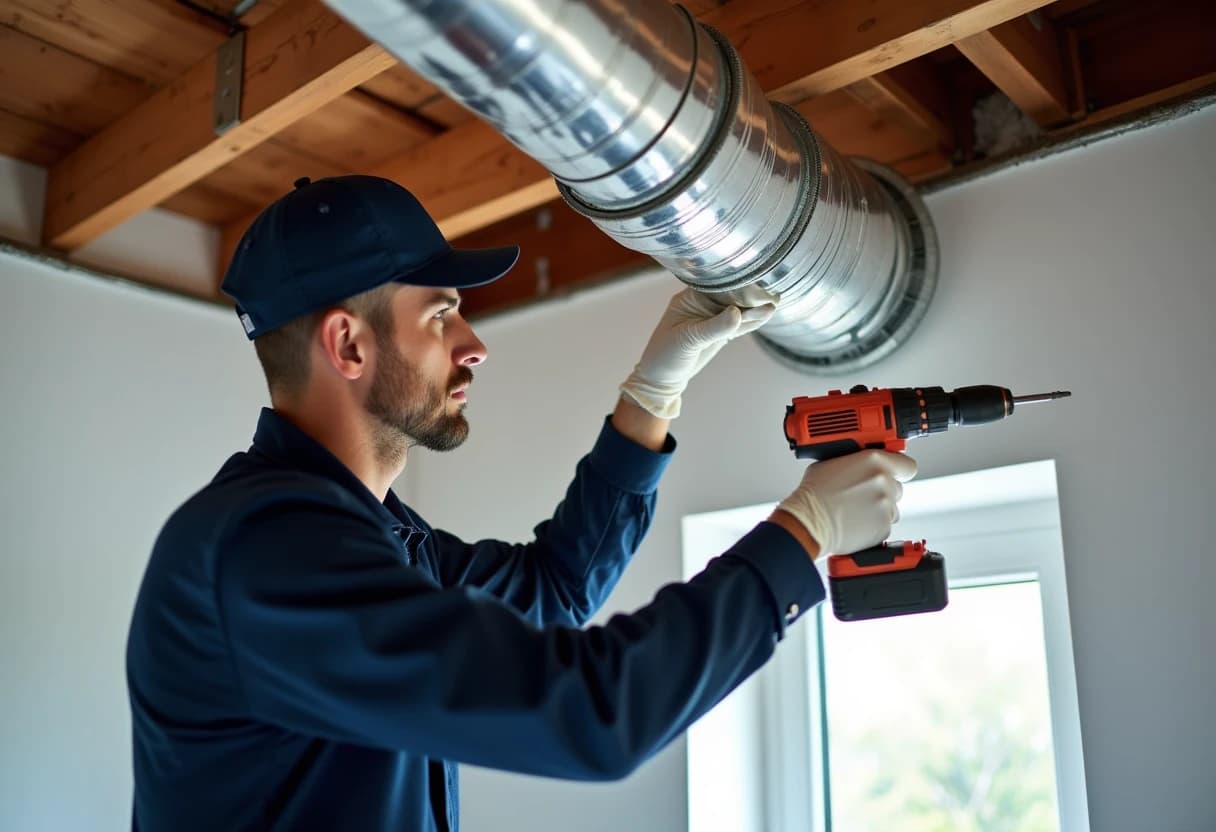
Some dryer vents cannot be cleaned or repaired into safety — they were never right to begin with. Runs assembled from vinyl or foil flex duct, routes that wander fifty feet through a basement, dryers venting into crawlspaces or garages, laundry areas with no vent at all: these call for installation, not maintenance. Our Dracut crews design and build code-compliant dryer exhaust systems from scratch — 4-inch smooth rigid metal duct, the shortest practical route to outdoors, joints without airstream-piercing screws, and a proper damper-equipped termination through the side wall, roof or rim joist. Priced flat from $300 to $900, finished in a day, and built to outlast the dryer itself.
Why Dryer Vent Installation & Rerouting Matters for Dracut Homes
Materials are the second decision that determines everything after. Vinyl accordion hose — still present behind thousands of local dryers — is a fire hazard the industry disowned decades ago: it melts, kinks and packs with lint. Foil flex crushes at a touch and corrugates the airflow into turbulence that drops fibers at every ridge. Even where flex is tolerated, it is only as a short transition at the appliance, never concealed, never as the run. Smooth-interior rigid metal duct is the code's answer and ours: lint slides across it instead of catching, rotary cleaning brushes glide through it at full effectiveness, it cannot kink or sag into condensation bellies when properly supported, and it is noncombustible. Joints matter equally — fitted in the direction of airflow, secured with clamps or external fasteners and sealed with UL-listed foil tape, because a screw tip inside the duct becomes a lint anchor that seeds the next blockage. Full flex-to-rigid replacement is among our most common installations, and its effects are permanent: slower lint accumulation, faster cleanings, better drying, lower risk.
Basement laundries dominate Dracut's housing stock, and they are where thoughtful venting matters most. Dracut evolved from a farm-and-mill town into a busy commuter suburb, so its streets mix old farmhouses and Collinsville mill housing with big tracts of 1970s-1990s ranches, splits and gambrels, plus newer subdivisions still going in on former farmland. Much of the later stock was built with forced hot air from day one, leaving thirty-to-fifty-year-old duct systems due for a first-ever cleaning. A below-grade dryer must exhaust up and out — through the rim joist above the foundation, most often — and every foot of that run crosses cold space where moist exhaust wants to condense. Active farm operations like Beaver Brook and the open fields of East Dracut send field dust and pollen drifting through nearby neighborhoods every growing season. Cottages-turned-year-round-homes around Lake Mascuppic bring us frequent moisture and musty-duct calls as well. Our basement installations handle both problems by design: the shortest legal route to a rim-joist or high-wall termination, continuous slope so any condensate drains outward, and insulation on duct crossing unheated space. The result is a basement laundry that stays dry, and a vent that stays clear between annual cleanings.
Our Dryer Vent Installation & Rerouting Process in Dracut
1Site Assessment & Route Planning
Planning is where installations succeed or fail, so we do it deliberately: equivalent-length math on paper, termination clearances checked against grade, snow line, openings and property conditions, and the penetration point chosen for both duct efficiency and envelope integrity. For renovations, we are glad to plan while walls are open — the cheapest routing decisions are made before drywall.
2Demolition of Non-Compliant Venting
Where the old route will be reused, we strip it to sound structure; where it is abandoned, we seal the redundant penetrations properly — foam and blocking inside, patched and flashed outside — so the old path does not remain as an air leak or pest entry. Clean removal is part of the installation, not an extra.
3Cut & Flash the Exterior Penetration
Roof terminations get roofing-grade treatment: shingles lifted and re-laid over proper flashing, a cap rated for dryer exhaust with a working damper, and sealant appropriate to the roofing material. We schedule roof penetrations for dry weather and verify water-tightness before leaving — a roof leak is not an acceptable side effect of a laundry upgrade.
4Install Rigid Metal Duct on the Planned Route
Where the route crosses unheated space — a cold basement, garage bay, attic run — we insulate the duct so exhaust stays above its dew point until it exits, which is the difference between a dry duct and a condensation problem in a Massachusetts winter. Concealed sections are completed and verified before any finishes close them in.
5Mount the Termination Hood & Damper
The termination is a quality metal hood matched to the 4-inch duct, with a backdraft damper that swings fully open under airflow and closes tight against weather, drafts and pests — and no screen, which the code prohibits on dryer terminations because mesh mats over with lint. It is fastened to the cladding, sealed at the perimeter, and tested by hand before the first cycle.
6Connect the Appliance & Seal the System
System sealing is completed end to end: every joint taped with UL-listed foil tape, the wall penetration sealed inside and out, and the transition clamped tight. A dryer vent is a pressure system; leaks anywhere cost airflow at the termination and push lint and moisture into places they do not belong. Sealed means sealed everywhere.
7Test, Verify & Document the Installation
Before we leave: work areas vacuumed with HEPA equipment, penetration debris removed, the dryer set and leveled, and a walkthrough of the finished system — where it runs, how the damper should look during a cycle, and when the first annual cleaning is due. A correctly built vent needs almost nothing from you; we make sure you know the little it does.
Benefits of Professional Dryer Vent Installation & Rerouting in Dracut
Permanently Lower Energy Costs
Sealed rigid duct also stops the hidden energy leaks of bad systems: conditioned air escaping through gapped joints, winter infiltration through failed dampers, and the heating-season cost of a laundry room with a permanent 4-inch draft. A tight system with a tight damper closes all of it.
Code Compliance That Closes Every Question
Compliance has practical teeth in transactions: dryer venting is among the most commonly flagged items in Massachusetts home inspections, and an improvised system becomes a negotiation item or a closing repair. A documented compliant installation converts that liability into a selling point — visible evidence of a well-maintained house.
Fire-Safe by Design, Not by Vigilance
A code-compliant installation attacks fire risk structurally: smooth rigid metal that lint slides across instead of catching on, a run short enough that exhaust velocity carries fibers all the way out, joints without screw tips to snag them, and a termination that cannot mat over. The system accumulates fuel slowly by design — safety that does not depend on anyone remembering anything.
Decades of Service From a One-Day Job
Because we also clean and repair dryer vents across Greater Boston, we install with the next twenty years of maintenance in mind — routes our own brushes can traverse, access preserved where it matters, baselines recorded for future verification. We build systems we expect to service ourselves, and it shows in the choices.
A Laundry Located Where You Actually Want It
Relocation also fixes inherited mistakes: many Dracut-area laundries sit where a previous owner could most easily improvise a vent, not where the household actually wants to do laundry. Once the exhaust is treated as a designed system, the laundry can finally move to where life happens.
Dramatically Faster Drying
Every elbow removed and every foot shortened is resistance the dryer no longer fights on every load, forever. The performance gain is not subtle on bad systems — 30 to 50 percent cycle-time reductions are common when we replace overlong flex runs — and unlike an appliance upgrade, it benefits every dryer the laundry will ever have.
Signs Your Dracut Home Needs Dryer Vent Installation & Rerouting
Chronic Condensation the Route Guarantees
Watch the laundry itself: loads that come out damp-smelling, a duct that drips after cycles, rust tracks under joints. Chronic internal moisture is rotting the system from the inside while it feeds blockages. The permanent fix is a route engineered for New England winters, not another season of drip trays and patches.
Blockages and Repairs Keep Recurring
The tell is the fade: a fresh cleaning helps for a few weeks, then performance sags again as lint resettles in the same flex ridges and dead-air corners. Well-designed systems hold their cleaning for a full year. If yours cannot, stop paying to maintain the flaw and price the fix.
Your Vent Is Flexible Plastic or Foil Duct
A quick self-check: press gently on the visible duct. Rigid metal does not give; flex crumples. If any concealed portion of your run is flex, assume the hidden sections are in worse shape than the visible ones — they always are — and price the replacement before the blockage schedule prices it for you.
Inspection, Insurance or Association Requirements
Massachusetts home inspections flag improvised dryer venting constantly — flex runs, screened hoods, indoor terminations, overlong routes — and the flag follows the transaction: buyers demand fixes, sellers concede credits. A documented compliant installation clears the item permanently, whether you are listing this spring or just retiring a known liability.
The Run Is Overlong or Elbow-Heavy
Basement laundries venting to a far wall are the classic offenders — installed where the first hole was easiest, not where the route was shortest. Our assessment often finds a rim-joist or near-wall exit that cuts the run by half or more. Ask for the measurement; the equivalent-length math takes ten minutes and settles the question.
A New Laundry Location Needs Its First Vent
Renovation is the moment of maximum leverage: we consult with homeowners and contractors while framing is open, position the laundry within the length budget, and rough in the run for pennies on the retrofit dollar. If your project touches the laundry's walls or ceiling, call before drywall — future you will be grateful.
Dryer Vent Installation & Rerouting Cost in Dracut, MA
Dryer vent installation in Greater Boston typically runs $300 to $900, and the price is mostly the route. At the low end, $300 to $450: a straightforward side-wall or rim-joist installation with a short run — dryer near an exterior wall, one clean penetration, minimal duct. Mid-range, $450 to $650: longer routes with several elbows, full flex-to-rigid replacement along an existing path, insulation over unheated space, or masonry penetrations through brick or block foundation. The top of the range, $650 to $900: reroutes through finished space with access openings, roof terminations with proper flashing, relocations that move the laundry's exhaust across the floor plan, and multi-story routes in triple-deckers and condos. Every quote is flat and follows a site assessment — we measure the route, do the equivalent-length math, and price the specific design you approve. Materials are included: rigid metal duct, listed transition connector, clamps and foil tape, insulation where needed, and a quality damper-equipped termination hood.
Want the full pricing picture? See our complete Boston-area cost guide or call (617) 390-7145 for an exact flat quote for your Dracut home.
Local Knowledge: Dracut, Middlesex County
Every town's ductwork tells the story of its housing. Dracut evolved from a farm-and-mill town into a busy commuter suburb, so its streets mix old farmhouses and Collinsville mill housing with big tracts of 1970s-1990s ranches, splits and gambrels, plus newer subdivisions still going in on former farmland. Much of the later stock was built with forced hot air from day one, leaving thirty-to-fifty-year-old duct systems due for a first-ever cleaning. Active farm operations like Beaver Brook and the open fields of East Dracut send field dust and pollen drifting through nearby neighborhoods every growing season. Cottages-turned-year-round-homes around Lake Mascuppic bring us frequent moisture and musty-duct calls as well. We plan Dracut jobs around those realities, from equipment selection to time on site, and it shows in the results. If you live near Lake Mascuppic or anywhere across Dracut's 01826 area, we have almost certainly cleaned a system like yours before — and we can tell you exactly what to expect before we arrive.
The Best Time of Year in Dracut
Renovation season drives our installation rhythm as much as weather does. Greater Boston remodels from spring through fall — basements finished, laundries moved upstairs, triple-deckers converted to condos — and every one of those projects needs dryer exhaust designed rather than improvised. The economics of timing are stark: venting planned at framing stage routes shorter, conceals cleaner and costs $200 to $400 less than the same run retrofitted after drywall. We take planning calls from homeowners and contractors all season, often walking a route in fifteen minutes that saves the project real money and the homeowner a decade of compromise. If your project touches the laundry — or could move it somewhere better — the cheapest vent you will ever build is the one designed before the walls close.
Why Choose Boston Air Duct Cleaners
As a West Newton-based company, we treat Dracut like the neighborhood it is — because for us, it is. Our reputation lives or dies on local referrals, so every job gets the full process: complete system cleaning under negative pressure, mechanical agitation of every run, blower compartment service, and a documented walkthrough before we leave. We are licensed and insured, our estimates are free and flat, and our schedule holds same-day slots for urgent calls. One visit and you will understand why neighbors keep our magnet on the fridge.
Serving Dracut and Surrounding Communities
Dracut sits in the heart of our service area, and neighboring Lowell, Methuen, Chelmsford, Tewksbury, Andover, Billerica appointments share the same routes. That density is why our response times in this part of Middlesex County are among our fastest — and why you will see our trucks in the area week after week.