
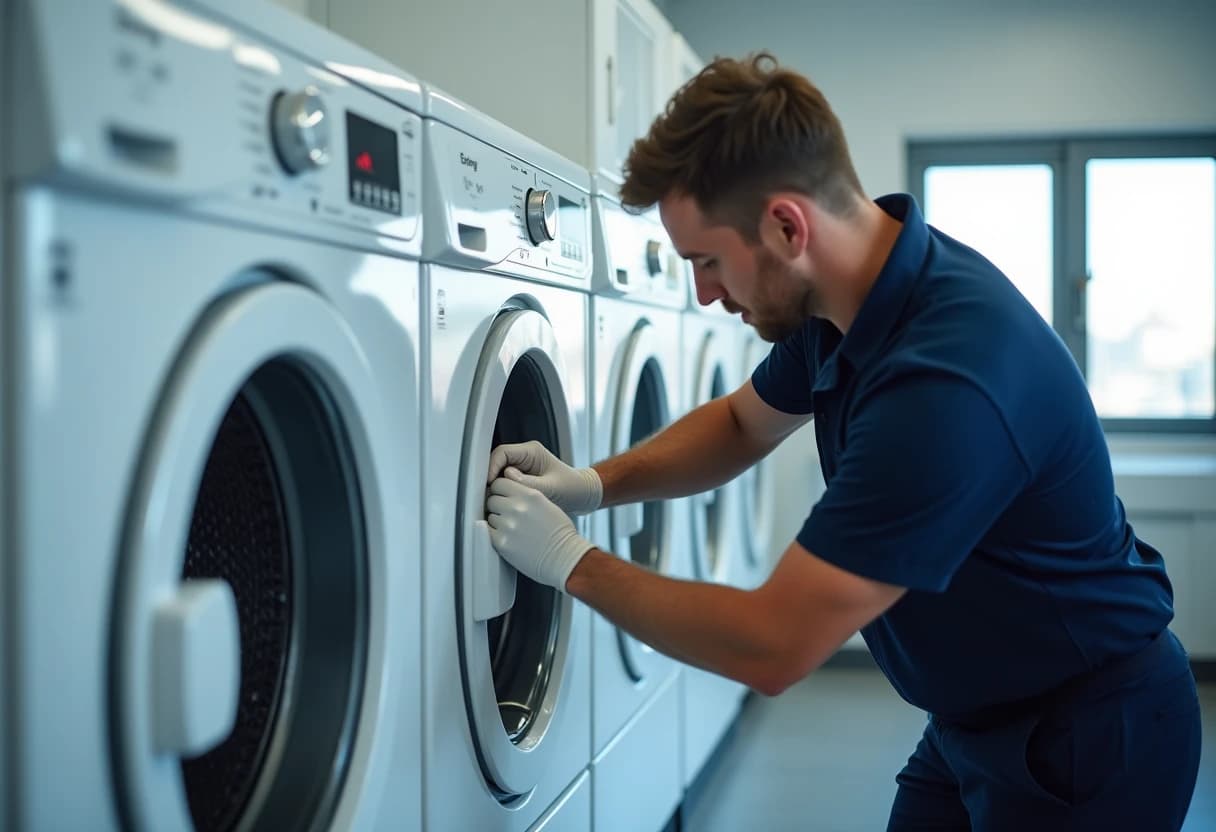
Lint is the most flammable substance most buildings produce daily, and dryer vents concentrate it precisely where heat lives. The National Fire Protection Association's data is blunt: failure to clean is the leading factor in home clothes dryer fires, and multi-family buildings carry the compounded exposure of many dryers behind one set of walls. Our Hamilton commercial program serves condominiums, apartment buildings, townhome HOAs, senior housing and laundromats with full-building vent cleaning: every run brushed and vacuumed end to end, terminations and dampers cleared and checked, hazardous transition ducts flagged, and airflow measured after cleaning. Boards get one flat proposal, residents get minimal disruption, and everyone gets the report that proves it happened.
Why Commercial & Multi-Unit Dryer Vent Cleaning Matters for Hamilton Homes
Residents cannot solve this problem individually, which is why it belongs to the building. A tenant or condo owner can clear their lint screen and perhaps the first few feet of transition hose — but the duct in the wall, the vertical riser shared with three neighbors, the forty-foot ceiling run to the far wall, and the termination flap four stories up are all beyond any resident's reach, tools and authority. Meanwhile every load every household dries adds lint to those shared paths. This is the classic common-element maintenance problem: individually invisible, collectively dangerous, and cheap to fix at building scale. A coordinated whole-building cleaning turns dozens of separate impossibilities into one efficient project — our coordinator handles notices and access scheduling, crews clear multiple units per hour once mobilized, no-access units are documented and revisited, and the building ends the week with every run verified clear. Boards that institutionalize it annually spend a modest per-door amount; buildings that leave it to residents are, in practice, leaving it to no one.
Fire safety in Hamilton multi-unit housing is a shared-wall problem: one clogged vent endangers every neighbor. Between Appleton Farms, Myopia's fields and the town's working stables, Hamilton's air carries more hay dust, pollen and equestrian-related particulates than a typical suburb, and it shows in the return ducts we open here. Rural properties on well water and wooded lots also see heavier seasonal organic debris in their systems. Hamilton is classic North Shore horse country: rambling antique farmhouses and estate homes on large acreage, mixed with modest mid-century capes and ranches in the South Hamilton village near the commuter rail. The estate properties often run multiple heating zones with long, complex duct networks, while the older farmhouses carry retrofit forced-air systems squeezed through 18th- and 19th-century framing. Those conditions are precisely why FEMA's dryer-fire statistics — about 2,900 a year nationally, led by failure to clean — should read as a maintenance schedule rather than trivia. Our crews serve Hamilton buildings with the same program associations in Wenham and Ipswich rely on: whole-building mechanical cleaning, shared riser service, hazard flagging, airflow verification, and per-unit compliance documentation delivered to the board within days of completion.
Our Commercial & Multi-Unit Dryer Vent Cleaning Process in Hamilton
1Building Walkthrough & Per-Unit Proposal
First we learn your building's venting anatomy, because no two multi-unit buildings vent alike. Stacked risers, basement manifolds, improvised renovation-era runs and individual wall vents each demand different equipment and time. The walkthrough maps it, a camera check of representative runs establishes condition honestly, and your written proposal reflects the actual building — not a per-vent teaser that grows on site.
2Resident Coordination & Scheduling
Access is the hard part of multi-unit work, and we manage it for you. Our coordinator provides notice templates for management to distribute, builds a unit-by-unit schedule in efficient sequences, confirms time windows, and tracks completions and no-access units in real time. Buildings typically complete in one to three days, and residents are in their homes for minutes, not hours.
3Dryer-Side Service: Transition Duct & Connection
Each unit visit starts at the machine: lint screen housing vacuumed, dryer pulled and the fire-load of lint behind it removed, transition duct inspected against IRC M1502 requirements — smooth interior, proper material, no screws projecting into the airstream, no excessive length or crushing. Deficiencies are photographed for the unit's report line, and simple corrections are completed during the same visit with owner approval.
4Mechanical Cleaning of the Full Vent Run
The in-wall duct is cleaned end to end with rotary brush systems driven through the full run while a high-powered vacuum captures dislodged lint — the same agitation-plus-extraction principle as NADCA duct cleaning, sized for 4-inch dryer duct. Long runs and multiple elbows get repeat passes; the pass is complete when the brush returns clean and airflow verifies.
5Shared Risers, Common Trunks & Booster Fans
High-rise and mid-rise venting is a system, not a bundle of individual runs. Our crews clean shared risers top-down from roof terminations with weighted rotary lines, verify each unit's takeoff where it joins the common duct, and confirm draft through the full stack afterward. Central exhaust fans and pressure-relief dampers serving laundry stacks are cleaned and checked in the same mobilization.
6Termination Service & Exterior Verification
Exterior work is where multi-unit projects earn their price: terminations three stories up that no resident has ever seen, roof caps buried under winter ice damage, wall hoods behind shrubs. Each one is cleared of lint and debris, checked for damper function so it seals when idle and opens fully under flow, and photographed for the report. Damaged or non-compliant caps are flagged with replacement pricing.
7Airflow Verification & Building Compliance Report
Verification is what separates a maintenance program from a receipt. We confirm restored airflow run by run, re-photograph representative ducts against their before images, and compile the compliance report: every unit's status, every exception explained, every hazard located and pictured, every recommendation priced separately for board action. Associations on our annual program receive the same format each cycle, so year-over-year condition is genuinely comparable.
Benefits of Professional Commercial & Multi-Unit Dryer Vent Cleaning in Hamilton
Hazard Discovery Before It Costs You
Cleaning puts trained eyes and cameras into duct paths nobody has seen in years, and the discoveries matter: prohibited foil accordion transitions, disconnected runs dumping humid lint-laden air into wall cavities, vents terminating in attics or soffits, screens trapping lint at caps. Each is photographed, located and priced for correction — found on your schedule instead of an incident report's.
Longer Dryer Life & Fewer Appliance Failures
Dryers venting against a clogged duct cook themselves: heating elements cycle against trapped heat, thermostats and thermal fuses trip and fail, motors run hot and die early. Clear venting is the cheapest appliance-life extension available — a point every appliance manufacturer's manual makes, and every burned-out element invoice repeats.
Shorter Dry Times & Lower Utility Costs
Every minute of extra runtime is heat pushed against a clogged duct: wasted energy, elevated temperatures, and accelerated wear. Post-cleaning, residents notice loads finishing in one cycle again — the most tangible everyday benefit of the program and the one that quiets the steady trickle of 'my dryer is broken' maintenance tickets.
A Program, Not a Project
Buildings on our maintenance program stop managing this risk and start merely reviewing it: we track the interval, propose dates, coordinate residents, execute, and deliver the report to the same folder every cycle. For management companies, the program scales across portfolios with standardized reporting — one decision covering every property's most preventable hazard.
Insurance & Liability Documentation That Holds Up
Documentation converts maintenance into protection. The same cleaning, undocumented, protects the building physically but leaves the association exposed on paper. Our reports close that gap: scope, method, dates, per-unit outcomes and photographic evidence, delivered in a format managers file once and retrieve in minutes when the renewal questionnaire arrives.
Volume Pricing That Beats Unit-by-Unit Service
Left to individual residents, vent cleaning happens rarely, unevenly and at retail prices — and the shared ducts never get cleaned at all. Building-wide service inverts every part of that: complete coverage, common elements included, standardized quality, one invoice, and a per-unit rate that makes the line item easy to defend at budget time.
Signs Your Hamilton Home Needs Commercial & Multi-Unit Dryer Vent Cleaning
Dryers Taking Two or More Cycles Per Load
Extended dry times are the classic first symptom of vent restriction: moist air cannot exit, so clothes tumble in humidity until the machine times out. When this complaint appears across multiple units in a building, the shared venting is implicated — and every affected dryer is running hotter and longer than its design intends.
Lint Visible at Terminations or on the Building Exterior
Walk the building perimeter and look at every vent hood: visible lint at the flap, caps that no longer close, vegetation fuzzy with fibers below the outlet. These external tells are free inspection data, and they reliably indicate runs overdue for mechanical cleaning — plus terminations that need damper service while the crew is there.
Insurance Questionnaires or Post-Incident Requirements
Post-incident requirements are the hard version of the sign: a fire or near-miss anywhere in the building, an adjuster's inquiry, or a fire-department visit that noted lint at terminations. At that point documentation is being demanded rather than recommended. The same program that would have prevented the scrutiny now becomes its resolution — start it either way.
Foil Accordion Ducts or Improvised Vent Runs in Units
If your association has never inspected what connects residents' dryers to the walls, assume nonconformance: transition duct is resident-installed, unregulated in practice, and frequently the worst link in the chain. Our unit visits document and correct these connections — the cheap fix that removes the most flammable segment of the entire vent path.
No One Can Say When Vents Were Last Cleaned
Buildings inherit their venting history blind: previous owners' renovations, decades of resident turnover, and zero records. FEMA's dryer-fire data — about 2,900 a year, led by failure to clean — describes exactly this population of never-serviced vents. A documented first cleaning moves your building out of that statistic's denominator.
High-Duty Operations: Laundromats & Common Laundry Rooms
Shared laundry rooms in apartment and condo buildings combine commercial duty with residential oversight — machines run all day, but no one owns the maintenance. Booster fans cake with lint and stall, common trunks load up, and the room runs hot. If your building's laundry room fits that description, it is the building's single most overdue vent.
Commercial & Multi-Unit Dryer Vent Cleaning Cost in Hamilton, MA
Multi-unit dryer vent cleaning in Greater Boston is priced per building, and the per-unit economics are the story: while a single-home service runs $150–$250, coordinated building projects typically price between $40 and $90 per unit depending on scale and complexity, with whole-building totals commonly landing between $300 for a small multi-family and $3,000 or more for larger properties. The honest drivers are unit count (bigger buildings earn lower per-unit rates), vent configuration (short individual wall runs price lowest; long improvised runs and shared vertical risers add equipment and time), termination access (ground-floor wall caps versus roof work or lift access), and machine handling (pulling and resetting each dryer versus laundry-room fleets). Shared risers, common trunks and booster fans are itemized separately as common-element service. Every proposal is flat and written after a walkthrough — the board approves a number, not an estimate.
Want the full pricing picture? See our complete Boston-area cost guide or call (617) 390-7145 for an exact flat quote for your Hamilton home.
Local Knowledge: Hamilton, Essex County
Serving Hamilton means knowing Hamilton. Hamilton is classic North Shore horse country: rambling antique farmhouses and estate homes on large acreage, mixed with modest mid-century capes and ranches in the South Hamilton village near the commuter rail. The estate properties often run multiple heating zones with long, complex duct networks, while the older farmhouses carry retrofit forced-air systems squeezed through 18th- and 19th-century framing. Between Appleton Farms, Myopia's fields and the town's working stables, Hamilton's air carries more hay dust, pollen and equestrian-related particulates than a typical suburb, and it shows in the return ducts we open here. Rural properties on well water and wooded lots also see heavier seasonal organic debris in their systems. Those conditions shape how we work here: which brush heads come off the truck, how we protect finishes in older interiors, and what we expect to find when the camera goes into a 01982 duct system. Our crews are in and around Hamilton nearly every week — often for neighbors of past customers — so scheduling is fast and our arrival windows hold.
The Best Time of Year in Hamilton
The regional housing stock shapes the work itself. Triple-deckers and converted multi-families across Greater Boston were built before household dryers existed, so every vent is a retrofit: runs improvised through basements and chases, terminations punched wherever a wall was reachable, and successive renovations layering flex duct, elbows and prohibited materials into paths that flout the modern code intent of 35 feet equivalent length. Post-war garden complexes add long ceiling runs; newer stacked construction adds shared risers with their own maintenance logic. Seasonal stress finds every weakness — winter freeze at bad terminations, summer humidity in leaky runs, ice-dam moisture in the cavities ducts traverse. It is why our building walkthroughs map each property individually, and why Essex County associations with pre-war stock are our most consistent annual-program clients.
Why Choose Boston Air Duct Cleaners
We built this company around the jobs other duct cleaners do badly: the 130-year-old Victorian with panned-joist returns, the Hamilton condo with a 60-foot dryer run to the roof, the post-renovation house full of drywall dust. Our crews see Greater Boston's hardest systems every week, and the experience shows in the details — floor protection on the way in, sealed registers during the work, HEPA-vacuumed work areas on the way out, and imagery that proves the ducts are actually clean. Call (617) 390-7145 and judge the difference from the first conversation.
Serving Hamilton and Surrounding Communities
We serve every community around Hamilton as well: Wenham, Ipswich, Essex, Topsfield, Manchester-by-the-Sea, Beverly all fall inside our regular service routes. If you have a second property, a rental, or family nearby, ask about multi-home scheduling — grouped appointments on the same route are our most requested discount.