
Every dryer in your building is a small fire waiting on maintenance. FEMA attributes roughly 2,900 clothes dryer fires a year in US homes to exactly the failure this service prevents — lint accumulation in vents and ducts, the leading ignition factor. For condo associations, HOAs, apartment owners and property managers in Ipswich, that risk multiplies by the unit count: dozens of dryers, dozens of vent runs, and in many buildings shared risers where one resident's lint becomes everyone's hazard. Our multi-unit dryer vent cleaning program handles the whole building in one coordinated visit — every unit's vent mechanically cleaned end to end, airflow verified, exceptions documented — and closes with a per-unit compliance report your board, manager and insurance carrier can file.
Why Commercial & Multi-Unit Dryer Vent Cleaning Matters for Ipswich Homes
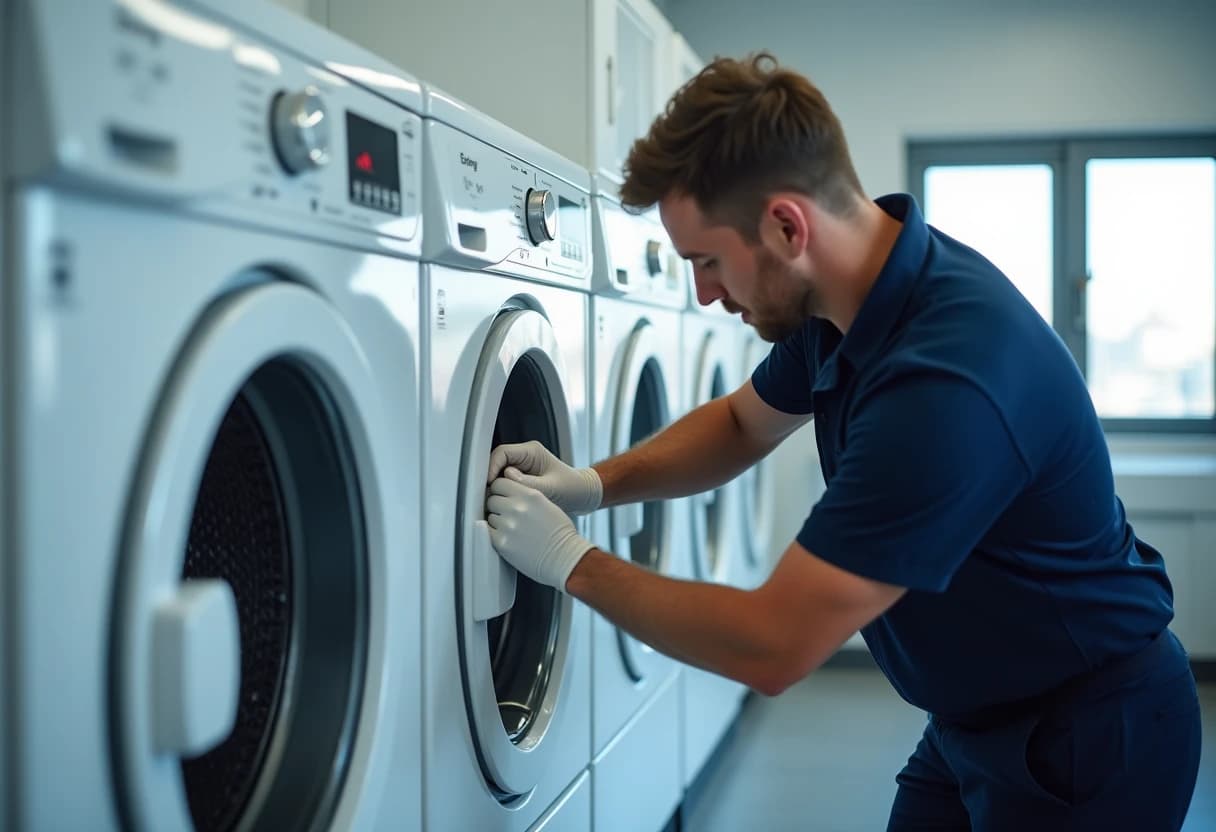
Laundromats and high-duty commercial laundry face the same physics at industrial intensity. A commercial dryer cycling ten hours a day produces more lint in a week than a household machine does in a year, and that lint loads into manifolded duct systems that were often sized optimistically to begin with. The operational symptoms arrive before the fire risk peaks: dry times stretch, customers complain and leave, gas consumption climbs, high-limit switches trip, and machines cook their own components in the trapped heat. NFPA 211 and equipment manufacturers alike call for regular exhaust cleaning at commercial duty cycles — quarterly or better in busy stores, not the annual rhythm of a home. Our commercial program matches the interval to your throughput: full mechanical cleaning of each machine's run and every common trunk, termination and damper service, booster fan cleaning where installed, and airflow verification numbers before and after so you can see the recovery. Most operators find the service pays for itself in gas savings and machine uptime before the fire-safety benefit is even counted.
Ipswich property managers call us for three reasons more than any other: an insurance renewal questionnaire asking about vent maintenance, a resident complaint about two-cycle dry times, or a neighboring building's fire making the local news. Ipswich holds more surviving First Period houses than any other community in America, and its downtown streets are lined with 17th- and 18th-century homes where any forced-air system is by definition a careful retrofit through hand-hewn framing. Beyond the historic core, seasonal cottage colonies on Great Neck and Little Neck have largely converted to year-round living, alongside mid-century and newer homes out the Linebrook corridor. Between the tidal Ipswich River, the salt marshes and Crane Beach, humidity and salt air press on this town from three sides, keeping duct interiors and crawlspaces damp deep into fall. In the First Period homes downtown, retrofit duct runs snake through centuries-old cavities that accumulate dust from plaster, timber and long-settled chimneys. All three end the same way — a coordinated building-wide cleaning with per-unit documentation. We handle resident scheduling and notices, clean every run with rotary brush and vacuum extraction, service the shared risers individual residents cannot reach, and deliver the report that closes the file. Most Ipswich buildings complete in a single visit of one to three days.
Our Commercial & Multi-Unit Dryer Vent Cleaning Process in Ipswich
1Building Walkthrough & Per-Unit Proposal
Every building project starts with a walkthrough: we identify how each unit vents — individual wall runs, shared vertical risers, common trunk lines — locate terminations on walls and roofs, note access requirements, and inspect representative runs. The proposal that follows prices the building flat, per unit, with riser and common-duct service itemized, so boards approve a known number.
2Resident Coordination & Scheduling
Access is the hard part of multi-unit work, and we manage it for you. Our coordinator provides notice templates for management to distribute, builds a unit-by-unit schedule in efficient sequences, confirms time windows, and tracks completions and no-access units in real time. Buildings typically complete in one to three days, and residents are in their homes for minutes, not hours.
3Dryer-Side Service: Transition Duct & Connection
Each unit visit starts at the machine: lint screen housing vacuumed, dryer pulled and the fire-load of lint behind it removed, transition duct inspected against IRC M1502 requirements — smooth interior, proper material, no screws projecting into the airstream, no excessive length or crushing. Deficiencies are photographed for the unit's report line, and simple corrections are completed during the same visit with owner approval.
4Mechanical Cleaning of the Full Vent Run
The in-wall duct is cleaned end to end with rotary brush systems driven through the full run while a high-powered vacuum captures dislodged lint — the same agitation-plus-extraction principle as NADCA duct cleaning, sized for 4-inch dryer duct. Long runs and multiple elbows get repeat passes; the pass is complete when the brush returns clean and airflow verifies.
5Shared Risers, Common Trunks & Booster Fans
Common-element ducts get common-element treatment: documented condition before and after, cleaning with equipment sized for vertical and long-trunk work, and function checks on the mechanical components — booster fans, backdraft dampers, rooftop exhaust terminations — that keep a shared system moving air. For associations, this is the portion of the project that most clearly discharges the board's maintenance duty, and we document it accordingly.
6Termination Service & Exterior Verification
Exterior work is where multi-unit projects earn their price: terminations three stories up that no resident has ever seen, roof caps buried under winter ice damage, wall hoods behind shrubs. Each one is cleared of lint and debris, checked for damper function so it seals when idle and opens fully under flow, and photographed for the report. Damaged or non-compliant caps are flagged with replacement pricing.
7Airflow Verification & Building Compliance Report
Verification is what separates a maintenance program from a receipt. We confirm restored airflow run by run, re-photograph representative ducts against their before images, and compile the compliance report: every unit's status, every exception explained, every hazard located and pictured, every recommendation priced separately for board action. Associations on our annual program receive the same format each cycle, so year-over-year condition is genuinely comparable.
Benefits of Professional Commercial & Multi-Unit Dryer Vent Cleaning in Ipswich
A Program, Not a Project
Buildings on our maintenance program stop managing this risk and start merely reviewing it: we track the interval, propose dates, coordinate residents, execute, and deliver the report to the same folder every cycle. For management companies, the program scales across portfolios with standardized reporting — one decision covering every property's most preventable hazard.
Volume Pricing That Beats Unit-by-Unit Service
Left to individual residents, vent cleaning happens rarely, unevenly and at retail prices — and the shared ducts never get cleaned at all. Building-wide service inverts every part of that: complete coverage, common elements included, standardized quality, one invoice, and a per-unit rate that makes the line item easy to defend at budget time.
Shorter Dry Times & Lower Utility Costs
Utility waste from restricted venting is invisible but continuous, accruing on every load in every unit. Cleaning removes the restriction building-wide at once, which is why managers of buildings with house-paid gas or electric can often see the program's effect in the utility data — a rare maintenance item with a measurable meter-level return.
Hazard Discovery Before It Costs You
The inspection value of a building-wide project rivals the cleaning value. Our unit-by-unit documentation regularly surfaces conditions associations did not know they had — moisture damage from leaking ducts, code violations from old renovations, pest entry at damaged terminations — while they are still inexpensive line items rather than insurance claims.
Insurance & Liability Documentation That Holds Up
Boards carry a duty to maintain common elements, and in most governing documents the vent path beyond the unit wall qualifies. A dated, unit-by-unit report demonstrates that duty discharged — and the annual repetition of it demonstrates a program, which is what diligence actually looks like to a carrier or a court.
Directly Reduced Fire Risk, Building-Wide
Lint-clogged venting is the leading factor in the roughly 2,900 US dryer fires FEMA counts each year, and multi-unit buildings multiply the exposure by their unit count. Whole-building cleaning removes the fuel and restores the airflow that keeps duct temperatures in design range — addressing the top cause of a genuinely common fire, in every unit at once.
Signs Your Ipswich Home Needs Commercial & Multi-Unit Dryer Vent Cleaning
Burning Smells, Hot Laundry Areas or Tripped Thermal Fuses
A hot, linty smell during dryer operation is the machine overheating against restricted exhaust — the exact precondition of a lint fire. Treat it as urgent in any building: the affected unit's run needs immediate inspection, and one unit's condition in a shared-riser building is a reasonable proxy for its neighbors'.
Dryers Taking Two or More Cycles Per Load
Extended dry times are the classic first symptom of vent restriction: moist air cannot exit, so clothes tumble in humidity until the machine times out. When this complaint appears across multiple units in a building, the shared venting is implicated — and every affected dryer is running hotter and longer than its design intends.
High-Duty Operations: Laundromats & Common Laundry Rooms
Commercial duty cycles compress the maintenance calendar: a laundromat dryer produces in weeks the lint a household machine makes in a year, loading manifolded ducts continuously. If your store has never set a cleaning interval matched to throughput, the venting is overdue by definition — quarterly service is typical for busy operations.
No One Can Say When Vents Were Last Cleaned
New management contracts and board turnovers routinely surface this gap: dryer vents appear in no budget, no vendor list and no maintenance log. It is among the first items worth correcting, because it combines genuine fire risk with an insurer-facing documentation hole — and because the first cleaning doubles as a building-wide inspection.
Insurance Questionnaires or Post-Incident Requirements
When the master-policy renewal asks 'When were dryer vents last professionally cleaned?', the underwriting message is explicit: this risk is on their radar, and undocumented buildings price accordingly. A completed building-wide cleaning with per-unit reporting answers the question directly — and answering it before renewal season is markedly cheaper than answering it after a nonrenewal notice.
Lint Visible at Terminations or on the Building Exterior
Walk the building perimeter and look at every vent hood: visible lint at the flap, caps that no longer close, vegetation fuzzy with fibers below the outlet. These external tells are free inspection data, and they reliably indicate runs overdue for mechanical cleaning — plus terminations that need damper service while the crew is there.
Commercial & Multi-Unit Dryer Vent Cleaning Cost in Ipswich, MA
Comparison shopping this service is worth doing carefully, because scope games hide in the details. A low per-unit bid that services only the in-wall duct — no dryer pull, no transition duct, no termination, no riser work — leaves the most fire-prone segments untouched and the association's documentation incomplete. A defensible Eastern Massachusetts multi-unit proposal includes, per unit: machine pulled and area cleaned, transition duct serviced and inspected against code (foil accordion flagged), full run mechanically brushed and vacuum-extracted, termination cleared and damper verified, and a completion line in the building report. Common risers, trunk lines and boosters appear as their own itemized scope. Priced that way, expect $40–$90 per unit at building volume and $300–$3,000 typical project totals. Our proposals arrive itemized to exactly this standard so competing bids can be lined up scope-for-scope — and the gaps in the cheap ones become visible before you hire them.
Want the full pricing picture? See our complete Boston-area cost guide or call (617) 390-7145 for an exact flat quote for your Ipswich home.
Local Knowledge: Ipswich, Essex County
Every town's ductwork tells the story of its housing. Ipswich holds more surviving First Period houses than any other community in America, and its downtown streets are lined with 17th- and 18th-century homes where any forced-air system is by definition a careful retrofit through hand-hewn framing. Beyond the historic core, seasonal cottage colonies on Great Neck and Little Neck have largely converted to year-round living, alongside mid-century and newer homes out the Linebrook corridor. Between the tidal Ipswich River, the salt marshes and Crane Beach, humidity and salt air press on this town from three sides, keeping duct interiors and crawlspaces damp deep into fall. In the First Period homes downtown, retrofit duct runs snake through centuries-old cavities that accumulate dust from plaster, timber and long-settled chimneys. We plan Ipswich jobs around those realities, from equipment selection to time on site, and it shows in the results. If you live near Choate Bridge or anywhere across Ipswich's 01938 area, we have almost certainly cleaned a system like yours before — and we can tell you exactly what to expect before we arrive.
The Best Time of Year in Ipswich
Termination freeze-up is the distinctly New England failure mode. Dryer exhaust is warm and humid; when it meets a February termination, moisture condenses and freezes on the flap and hood, and a cap already propped partway open by lint accumulation becomes an ice-and-lint blockage that can seal a vent entirely. Residents notice two-cycle drying; the duct experiences trapped heat. Buildings with north-facing terminations, roof caps and long uninsulated runs through cold cavities are most vulnerable — and long cold runs also condense moisture internally, matting lint into dense plugs that only mechanical brushing removes. A pre-winter cleaning and damper service is the prevention; mid-winter, we triage frozen-vent calls across Essex County weekly, and the buildings calling are overwhelmingly the ones without a fall program.
Why Choose Boston Air Duct Cleaners
Choosing a duct cleaner is really a trust decision — you are letting a crew work inside the system that feeds air to your family. We make that decision easy: a local West Newton company with insured, uniformed technicians, transparent flat-rate quotes, NADCA-standard equipment and methods, and photographic proof of the finished work. No door-to-door sales, no bait-and-switch coupons, no invented 'mold emergencies.' Just honest mechanical cleaning done properly the first time, backed by a written guarantee.
Serving Ipswich and Surrounding Communities
We serve every community around Ipswich as well: Rowley, Hamilton, Essex, Topsfield, Georgetown, Gloucester all fall inside our regular service routes. If you have a second property, a rental, or family nearby, ask about multi-home scheduling — grouped appointments on the same route are our most requested discount.