
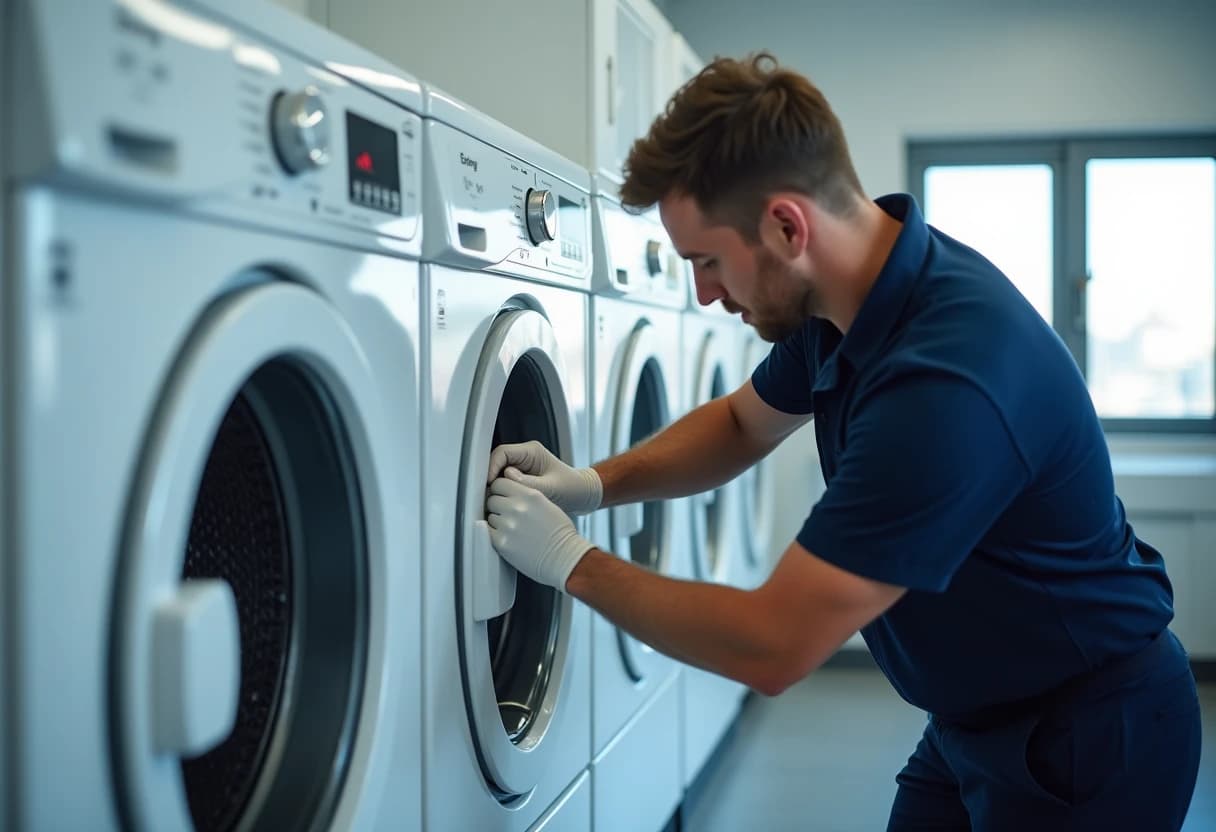
If you manage or sit on the board of a multi-unit building in Topsfield, dryer vents are one of the few line items where deferred maintenance converts directly into fire risk and liability. Building codes cap dryer duct runs for a reason — the IRC allows a maximum equivalent length of 35 feet with deductions for every elbow — yet many Massachusetts buildings run longer, older, or shared configurations that clog years faster than a textbook run. Our whole-building service cleans every vent with mechanical agitation and vacuum extraction, addresses stacked and shared risers common in mid-rise and high-rise construction, documents code and safety exceptions unit by unit, and prices the work on a per-unit volume scale that makes annual programs genuinely affordable.
Why Commercial & Multi-Unit Dryer Vent Cleaning Matters for Topsfield Homes
Residents cannot solve this problem individually, which is why it belongs to the building. A tenant or condo owner can clear their lint screen and perhaps the first few feet of transition hose — but the duct in the wall, the vertical riser shared with three neighbors, the forty-foot ceiling run to the far wall, and the termination flap four stories up are all beyond any resident's reach, tools and authority. Meanwhile every load every household dries adds lint to those shared paths. This is the classic common-element maintenance problem: individually invisible, collectively dangerous, and cheap to fix at building scale. A coordinated whole-building cleaning turns dozens of separate impossibilities into one efficient project — our coordinator handles notices and access scheduling, crews clear multiple units per hour once mobilized, no-access units are documented and revisited, and the building ends the week with every run verified clear. Boards that institutionalize it annually spend a modest per-door amount; buildings that leave it to residents are, in practice, leaving it to no one.
Whether it is a triple-decker near Ipswich River Wildlife Sanctuary, a mid-rise condominium off Topsfield Fairgrounds, or garden apartments elsewhere in Topsfield, the venting problems rhyme: lint-loaded runs, blocked or screened terminations, transition ducts that should have been replaced years ago. Topsfield surrounds one of New England's finest town commons with First Period and Federal homes, including the 1683 Parson Capen House, while its outer roads carry gentleman-farm properties and 1960s-1990s colonials on generous wooded lots. The antique center-village homes demand sensitive HVAC retrofits around original timber frames, and the larger modern colonials run full multi-zone duct systems. Home of America's oldest agricultural fair, Topsfield keeps a genuinely rural character, and the hay, livestock and field dust of fair season and working farms show up in the duct systems of nearby homes. Properties along the Ipswich River and its wetlands also deal with persistent ground moisture that encourages musty odors in basement duct runs. As a local company based 28 miles away in West Newton, we have cleaned building-wide across Essex County for associations, HOAs and management portfolios — with volume pricing per unit, crews that respect residents' homes, and reporting standardized so multi-building managers can compare properties at a glance.
Our Commercial & Multi-Unit Dryer Vent Cleaning Process in Topsfield
1Building Walkthrough & Per-Unit Proposal
Every building project starts with a walkthrough: we identify how each unit vents — individual wall runs, shared vertical risers, common trunk lines — locate terminations on walls and roofs, note access requirements, and inspect representative runs. The proposal that follows prices the building flat, per unit, with riser and common-duct service itemized, so boards approve a known number.
2Resident Coordination & Scheduling
We treat resident experience as part of the deliverable: clear advance notices, tight arrival windows, uniformed technicians who protect floors and finish each unit in roughly 20 to 40 minutes, and a same-day completion log to management. Units we cannot access are documented — not silently skipped — and a make-up window is scheduled so the building report ends with every unit accounted for.
3Dryer-Side Service: Transition Duct & Connection
Each unit visit starts at the machine: lint screen housing vacuumed, dryer pulled and the fire-load of lint behind it removed, transition duct inspected against IRC M1502 requirements — smooth interior, proper material, no screws projecting into the airstream, no excessive length or crushing. Deficiencies are photographed for the unit's report line, and simple corrections are completed during the same visit with owner approval.
4Mechanical Cleaning of the Full Vent Run
Compressed-air whips and rotary brushes work the duct from the unit connection toward the termination, mechanically stripping the lint mat that blowers and leaf-blower shortcuts merely compact. Every elbow — each one worth 5 feet of equivalent length under code math, and each one a lint trap in practice — gets deliberate attention. Extracted lint is bagged per unit, which residents find quietly persuasive.
5Shared Risers, Common Trunks & Booster Fans
Common-element ducts get common-element treatment: documented condition before and after, cleaning with equipment sized for vertical and long-trunk work, and function checks on the mechanical components — booster fans, backdraft dampers, rooftop exhaust terminations — that keep a shared system moving air. For associations, this is the portion of the project that most clearly discharges the board's maintenance duty, and we document it accordingly.
6Termination Service & Exterior Verification
We finish each run where the air does: at the outside wall or roof. The termination is cleaned, its flap or damper exercised and verified, screens and nests removed, and the exhaust confirmed to discharge outdoors — not into an attic, soffit or crawlspace, a dangerous and surprisingly common Massachusetts finding. Interior-terminating vents are documented as the priority hazards they are.
7Airflow Verification & Building Compliance Report
Each cleaned run gets a functional verification — airflow at the termination with the dryer running, or anemometer readings where equipment access allows — so the report records outcomes, not just activity. The building deliverable lists every unit: cleaned and verified, no-access, or exception, with photos of hazards and itemized repair recommendations. Boards file it; insurers accept it; renewals cite it.
Benefits of Professional Commercial & Multi-Unit Dryer Vent Cleaning in Topsfield
Longer Dryer Life & Fewer Appliance Failures
Dryers venting against a clogged duct cook themselves: heating elements cycle against trapped heat, thermostats and thermal fuses trip and fail, motors run hot and die early. Clear venting is the cheapest appliance-life extension available — a point every appliance manufacturer's manual makes, and every burned-out element invoice repeats.
Hazard Discovery Before It Costs You
Every exception we flag is a future incident pre-empted: the crushed run behind a renovated wall, the riser takeoff installed backwards, the termination flap frozen shut that made one unit's dryer exhaust into the building. Boards receive these findings prioritized and priced, converting unknown risks into a manageable repair list.
Directly Reduced Fire Risk, Building-Wide
Fire prevention in shared-wall housing is collective by nature: one blocked vent endangers the neighbors, and no resident can clean the common risers. A coordinated cleaning is the only mechanism that actually resets the whole building's risk — every run, every riser, every termination verified clear on the same dated report.
Insurance & Liability Documentation That Holds Up
Master-policy renewals increasingly ask when dryer vents were last professionally cleaned, and after any fire, maintenance records become the story. Our per-unit compliance report — cleaned, verified, exceptions documented, hazards flagged in writing — is formatted for exactly those readers: underwriters at renewal, adjusters after a claim, and counsel if it ever comes to that.
Volume Pricing That Beats Unit-by-Unit Service
Left to individual residents, vent cleaning happens rarely, unevenly and at retail prices — and the shared ducts never get cleaned at all. Building-wide service inverts every part of that: complete coverage, common elements included, standardized quality, one invoice, and a per-unit rate that makes the line item easy to defend at budget time.
Shorter Dry Times & Lower Utility Costs
Every minute of extra runtime is heat pushed against a clogged duct: wasted energy, elevated temperatures, and accelerated wear. Post-cleaning, residents notice loads finishing in one cycle again — the most tangible everyday benefit of the program and the one that quiets the steady trickle of 'my dryer is broken' maintenance tickets.
Signs Your Topsfield Home Needs Commercial & Multi-Unit Dryer Vent Cleaning
Foil Accordion Ducts or Improvised Vent Runs in Units
Walk any older building's units and you will find them: shiny foil accordion transitions sagging behind dryers, trapping lint in every corrugation. Manufacturers prohibit them and the IRC's requirements for smooth-interior duct exist because they burn. Each one found is a unit-level hazard flag — and a building-wide survey usually finds many.
High-Duty Operations: Laundromats & Common Laundry Rooms
Shared laundry rooms in apartment and condo buildings combine commercial duty with residential oversight — machines run all day, but no one owns the maintenance. Booster fans cake with lint and stall, common trunks load up, and the room runs hot. If your building's laundry room fits that description, it is the building's single most overdue vent.
Burning Smells, Hot Laundry Areas or Tripped Thermal Fuses
Laundry rooms that run noticeably hot and humid indicate exhaust air staying in the building — restricted ducts, failed boosters or leaking joints. Beyond discomfort, that moisture feeds mold in shared spaces and the heat stresses every machine in the room. Both symptoms resolve when the common venting actually moves its design airflow.
Insurance Questionnaires or Post-Incident Requirements
Carriers writing habitational risk in Massachusetts have tightened on dryer venting because loss data justifies it. Boards seeing new questionnaire language, inspection requirements or premium credits tied to vent maintenance should read the market signal: this is now standard due diligence for multi-unit buildings, and the documented program is what compliance looks like.
Dryers Taking Two or More Cycles Per Load
Residents report it as an appliance problem — 'the dryer is getting old' — but two-cycle drying is a venting symptom far more often than a machine failure. Before replacing dryers or fielding another season of complaints, verify the exhaust path; in multi-unit buildings a pattern of slow-dry complaints maps reliably onto clogged runs and risers.
Lint Visible at Terminations or on the Building Exterior
Lint beards on wall caps, gray fuzz on the siding below terminations, or lint scatter on the roof around stack outlets mean the ducts are so loaded they are extruding their contents. What escapes outside is the overflow; the accumulation inside the run is worse, and the affected units are drying against serious restriction.
Commercial & Multi-Unit Dryer Vent Cleaning Cost in Topsfield, MA
Annual program pricing is where the economics get genuinely favorable. Buildings on our recurring schedule receive locked per-unit rates, priority booking in the spring and fall rush, and lighter-touch renewal cleanings — because a vent cleaned twelve months ago needs maintenance, not excavation, and we price the difference honestly. Most associations find the steady-state annual cost per door runs 20–30% below their first catch-up cleaning, which had years of accumulation to remove. Laundromats and common laundry rooms price by machine count and duty cycle rather than by unit: figure roughly $30–$60 per machine per visit at quarterly intervals for busy stores, with common manifolds and booster fans included in scope. Operators should weigh that against the other side of the ledger — gas waste from restricted exhaust, machine downtime, and element and fuse replacements — which for high-throughput stores routinely exceeds the cleaning cost on its own.
Want the full pricing picture? See our complete Boston-area cost guide or call (617) 390-7145 for an exact flat quote for your Topsfield home.
Local Knowledge: Topsfield, Essex County
Serving Topsfield means knowing Topsfield. Topsfield surrounds one of New England's finest town commons with First Period and Federal homes, including the 1683 Parson Capen House, while its outer roads carry gentleman-farm properties and 1960s-1990s colonials on generous wooded lots. The antique center-village homes demand sensitive HVAC retrofits around original timber frames, and the larger modern colonials run full multi-zone duct systems. Home of America's oldest agricultural fair, Topsfield keeps a genuinely rural character, and the hay, livestock and field dust of fair season and working farms show up in the duct systems of nearby homes. Properties along the Ipswich River and its wetlands also deal with persistent ground moisture that encourages musty odors in basement duct runs. Those conditions shape how we work here: which brush heads come off the truck, how we protect finishes in older interiors, and what we expect to find when the camera goes into a 01983 duct system. Our crews are in and around Topsfield nearly every week — often for neighbors of past customers — so scheduling is fast and our arrival windows hold.
The Best Time of Year in Topsfield
Winter is dryer-fire season in New England, and the mechanics are seasonal in every direction. Cold months mean heavier laundry — flannels, fleeces, blankets — that sheds more lint per load; closed-up buildings mean any exhaust leak or interior-terminating vent dumps moisture where it condenses; and frozen or lint-jammed termination flaps restrict airflow exactly when dryers work hardest. Fire departments nationally see dryer-fire incidence peak in winter, and Massachusetts buildings fit the pattern. Fall is therefore the smart season for building-wide cleaning: every run cleared and every damper verified before the heavy-laundry months, and the project completed while roof and ladder access is still comfortable. Associations that anchor their annual cycle to September and October get the protection when it matters most — and beat the scheduling rush.
Why Choose Boston Air Duct Cleaners
Homeowners across Essex County choose Boston Air Duct Cleaners for three reasons. First, honesty: our inspection camera tells you whether your system actually needs cleaning — and sometimes the answer is no. Second, capability: truck-grade negative-air machines, rotary brush systems and HEPA filtration handle everything from antique gravity-furnace conversions to brand-new high-velocity systems. Third, accountability: flat quoted pricing, before-and-after photos, insured technicians, and a real local office you can call at (617) 390-7145. That combination is rarer in this industry than it should be.
Serving Topsfield and Surrounding Communities
Topsfield sits in the heart of our service area, and neighboring Middleton, Danvers, Ipswich, Hamilton, Rowley, Wenham appointments share the same routes. That density is why our response times in this part of Essex County are among our fastest — and why you will see our trucks in the area week after week.