
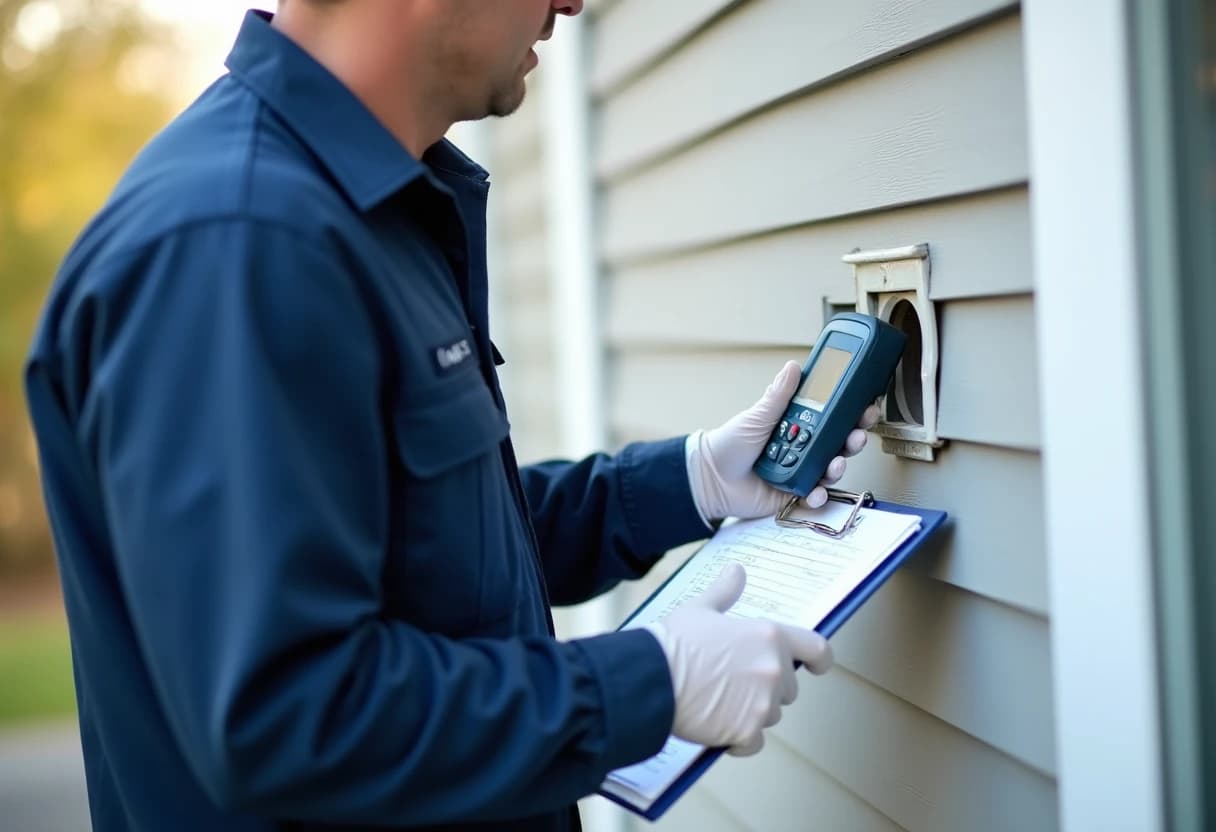
A dryer vent inspection is the fastest, cheapest way to answer a question every homeowner should be able to answer: is my dryer exhaust safe? Our Milford technicians measure airflow at the termination with a calibrated anemometer, run an inspection camera the full length of the duct, examine the exterior hood and damper, assess the lint load inside the run, and check the installation against the residential code rules that govern dryer ducts. You leave with a written safety report — photos, measurements and a clear verdict — instead of a guess. If the vent is clean and compliant, we tell you so and you are done for the year. If it needs work, you will know exactly what and why before spending a dollar on cleaning or repairs.
Why Dryer Vent Inspection & Safety Check Matters for Milford Homes
Homeowners reliably maintain what they can see and neglect what they cannot, and the dryer duct is the definition of cannot-see: it disappears behind the dryer into a wall and emerges somewhere outside, sometimes two or three stories up. Between those points, anything may be happening — lint packing at a crushed elbow, a joint pulled apart inside a ceiling and quietly venting moist air into the framing, a bird nest behind the hood, a plastic flex duct a previous owner installed decades before it was understood to be a fire hazard. An inspection replaces assumption with evidence. Our process is instrument-first: an anemometer reading at the termination establishes whether the system moves the volume of air a dryer needs, and the camera pass explains any shortfall. The findings frequently surprise owners — long-time residents discover terminations that have been painted shut, and new buyers discover the sellers' 'recently cleaned' vent was never touched. Either way, you finally know.
Buying or selling in Milford? The dryer vent is the gap in almost every home inspection. Milford's downtown blocks are filled with two-family homes and workers' cottages from the town's pink-granite quarrying era, many built between 1870 and 1930, while the outer neighborhoods added split-levels, raised ranches and subdivision Colonials from the 1960s onward. The older multifamilies were built for coal and steam heat, so their forced-air systems are retrofits with ducts squeezed through balloon-framed walls. Newer condo developments near the Upper Charles Trail run compact, builder-grade duct systems. General inspectors note the dryer's presence and move on; they do not camera the duct, measure the exhaust, or verify the hidden run complies with code — yet vent condition is a genuine safety and cost item, especially in older properties near Upper Charles Trail where laundry was retrofitted long after construction. Milford's granite-era two-families often share tight basements where the furnace, laundry and storage compete for space, and we frequently find lint-choked dryer runs and crushed flex duct in them. The town's steady conversion of older homes into rentals means many systems change hands without ever having been cleaned. We provide pre-listing and pre-purchase dryer vent inspections across Worcester County with fast written reports that slot straight into a disclosure package or an inspection-response negotiation. Sellers use them to remove doubt; buyers use them to avoid inheriting someone else's fire risk.
Our Dryer Vent Inspection & Safety Check Process in Milford
1Interview & Visual Assessment
First, context: your answers about drying performance and service history frame the inspection, and a walk of the laundry area frames the system. We identify the duct material, count visible elbows, locate where the run enters the structure, and note anything — crushing, kinks, tape-only joints — that already tells part of the story.
2Airflow Measurement at the Termination
With the dryer running on air-only, we measure exhaust velocity at the exterior termination using a calibrated anemometer and convert it to airflow volume. A healthy vent typically delivers strong, steady flow; a weak reading quantifies restriction before we ever look inside. This number anchors the whole report — objective, repeatable and comparable year over year.
3Full-Length Camera Inspection
An inspection camera travels the entire duct run from the dryer connection to the termination, recording as it goes. We are looking for lint accumulation and where it concentrates, separated or leaking joints, crushed or kinked sections, screws protruding into the airstream, moisture staining, and any nesting material — the full biography of a duct you cannot otherwise see.
4Termination Hood & Damper Check
The exterior hood gets a hands-on inspection — flap movement, spring tension, seal condition, evidence of pest entry, and clearance from grade and snow lines. New England weather is hard on terminations; corroded hinges and stuck dampers are among our most common findings, and both restrict airflow as effectively as a clogged duct.
5Lint-Load Assessment & Fire-Risk Scoring
Combining the camera footage and airflow numbers, we score the system's lint load: how much fuel the duct is carrying and how fast it is accumulating based on household laundry volume. This converts raw findings into a clear risk statement — fine for now, clean this season, or clean immediately — with the evidence attached.
6Code-Compliance Review
We review the installation against the residential mechanical code for dryer exhaust: smooth rigid metal duct (not foil or plastic flex in concealed runs), a maximum of 35 feet equivalent length with deductions for each elbow, no screws penetrating the airstream, proper termination with a backdraft damper and no screen. Violations are photographed and explained.
7Written Safety Report & Recommendations
Everything we measured and saw goes into a written safety report delivered the same day. Pass or fail, you have proof of the vent's condition — the document buyers ask for, insurers accept and associations require. If work is warranted, the report doubles as a precise scope, so any quote you gather is comparing the same job.
Benefits of Professional Dryer Vent Inspection & Safety Check in Milford
A Written Report You Can Actually Use
The report is the product: dated, photographed, measured. Homeowners file it with insurance records, sellers attach it to disclosures, landlords and condo boards accept it as compliance documentation, and buyers use it to negotiate or verify. A verbal 'looks fine' from a handyman does none of those jobs.
Lower Drying Costs & Longer Appliance Life
The economics are simple: restricted airflow taxes every single load, and the tax grows as the restriction does. Measurement catches the problem when it is small. Customers consistently report faster drying and lower utility bills after acting on inspection findings — savings that repeat weekly, every laundry day.
Real-Estate & Insurance Documentation
Buyers increasingly ask about dryer vents because their inspectors increasingly flag them. A pre-listing inspection removes the issue from the table before it appears; a pre-purchase inspection prices it before you own it. Agents across Greater Boston refer us for exactly this reason.
No Unnecessary Cleanings
Fear sells a lot of dryer vent cleanings that ducts did not need. Our answer is evidence: your own duct on camera, your own airflow in numbers. When the data says clean, we quote it flat; when it says pass, you keep your money and gain a report. Either way you decide from facts.
Protection From Moisture & Carbon Monoxide
A leaking or restricted dryer duct pushes warm, saturated air into wall cavities and framing — a slow moisture problem that shows up later as mold, peeling paint or rot. For gas dryers, exhaust integrity also governs the removal of combustion byproducts, including carbon monoxide. Inspection verifies both.
Fire Risk Caught Before It Matters
You insure your house against fire for thousands a year; an inspection actively prevents the most preventable category of fire for a fraction of one premium payment. The camera and anemometer find what smoke detectors only react to — the hazard itself, while it is still just lint in a duct.
Signs Your Milford Home Needs Dryer Vent Inspection & Safety Check
Burning or Musty Smells During Operation
A hot, singed odor while the dryer runs can mean lint is contacting the heating element or accumulating somewhere hot — the most urgent warning sign a vent can give. Stop using the dryer and book an inspection immediately; this is the symptom that precedes actual ignition events.
Recent Renovation, New Dryer or New Home
Just bought the house? Your home inspector almost certainly did not camera the dryer duct or measure its airflow — general inspections do not include it. Given that lint fires are among the most common preventable house fires, a dedicated vent inspection belongs on every new-owner checklist.
The Dryer or Laundry Room Feels Hot
A dryer cabinet that is hot to the touch, or a laundry room that turns into a sauna mid-cycle, means exhaust heat is staying in the house instead of leaving through the duct. That trapped heat is the same heat that ignites lint. It warrants a measurement promptly.
Clothes Take More Than One Cycle
Drying time is the vent's report card. Loads that once took 45 minutes now taking 80 means delivered airflow has fallen substantially — and every extra minute is money and heat stress. If your laundry routine has quietly stretched over the past year, the duct is asking for an inspection.
You Cannot Remember the Last Service
Dryer vents fail on a schedule set by laundry volume, duct length and installation quality — variables you cannot assess from the laundry room. Annual inspection is the standing recommendation of fire-safety agencies precisely because no visible cue reliably announces when a vent crosses from fine to dangerous.
Insurance, Condo or Sale Requirements
If your carrier, condo board or property manager has asked for proof of dryer vent maintenance, that is the sign — the requirement itself. Our written report is built to satisfy exactly these requests: dated, photographed, measured and signed, delivered after a single visit.
Dryer Vent Inspection & Safety Check Cost in Milford, MA
Three honest questions set your price. Where does the vent terminate — ground-level wall, second story, or roof? How long and complicated is the run — a straight 8-foot shot or 30 feet with four elbows through two floors? And is this a single home or a multi-unit building? Simple answers put you at $79; complex ones at $149; buildings get per-unit rates that drop with unit count. Two pricing notes worth knowing. First, our inspection fee is credited in full toward any cleaning we perform at the same visit, so the diagnostic never costs extra when work follows it. Second, beware of free inspections from cleaning companies — an inspection whose only revenue comes from selling you a cleaning is a sales call with a camera. Ours is priced as a standalone professional service precisely so the verdict can honestly be 'your vent is fine,' which it is roughly a third of the time.
Want the full pricing picture? See our complete Boston-area cost guide or call (617) 390-7145 for an exact flat quote for your Milford home.
Local Knowledge: Milford, Worcester County
Serving Milford means knowing Milford. Milford's downtown blocks are filled with two-family homes and workers' cottages from the town's pink-granite quarrying era, many built between 1870 and 1930, while the outer neighborhoods added split-levels, raised ranches and subdivision Colonials from the 1960s onward. The older multifamilies were built for coal and steam heat, so their forced-air systems are retrofits with ducts squeezed through balloon-framed walls. Newer condo developments near the Upper Charles Trail run compact, builder-grade duct systems. Milford's granite-era two-families often share tight basements where the furnace, laundry and storage compete for space, and we frequently find lint-choked dryer runs and crushed flex duct in them. The town's steady conversion of older homes into rentals means many systems change hands without ever having been cleaned. Those conditions shape how we work here: which brush heads come off the truck, how we protect finishes in older interiors, and what we expect to find when the camera goes into a 01757 duct system. Our crews are in and around Milford nearly every week — often for neighbors of past customers — so scheduling is fast and our arrival windows hold.
The Best Time of Year in Milford
Spring earns its own place on the inspection calendar because of what moves into vents between March and June: nesting birds. Starlings and house sparrows treat an uncapped or damaged dryer termination as prime real estate, and a nest turns a healthy vent into a near-total blockage within days. Our spring inspections put extra attention on the termination — damper integrity, hood condition, evidence of nesting activity — and catch bird problems before eggs complicate a humane removal. Spring is also when winter's damage surfaces: hoods cracked by ice, dampers stiffened by corrosion, joints loosened by months of freeze-thaw movement in the structure.
Why Choose Boston Air Duct Cleaners
We built this company around the jobs other duct cleaners do badly: the 130-year-old Victorian with panned-joist returns, the Milford condo with a 60-foot dryer run to the roof, the post-renovation house full of drywall dust. Our crews see Greater Boston's hardest systems every week, and the experience shows in the details — floor protection on the way in, sealed registers during the work, HEPA-vacuumed work areas on the way out, and imagery that proves the ducts are actually clean. Call (617) 390-7145 and judge the difference from the first conversation.
Serving Milford and Surrounding Communities
We serve every community around Milford as well: Hopkinton, Holliston, Mendon, Bellingham, Medway, Upton all fall inside our regular service routes. If you have a second property, a rental, or family nearby, ask about multi-home scheduling — grouped appointments on the same route are our most requested discount.