
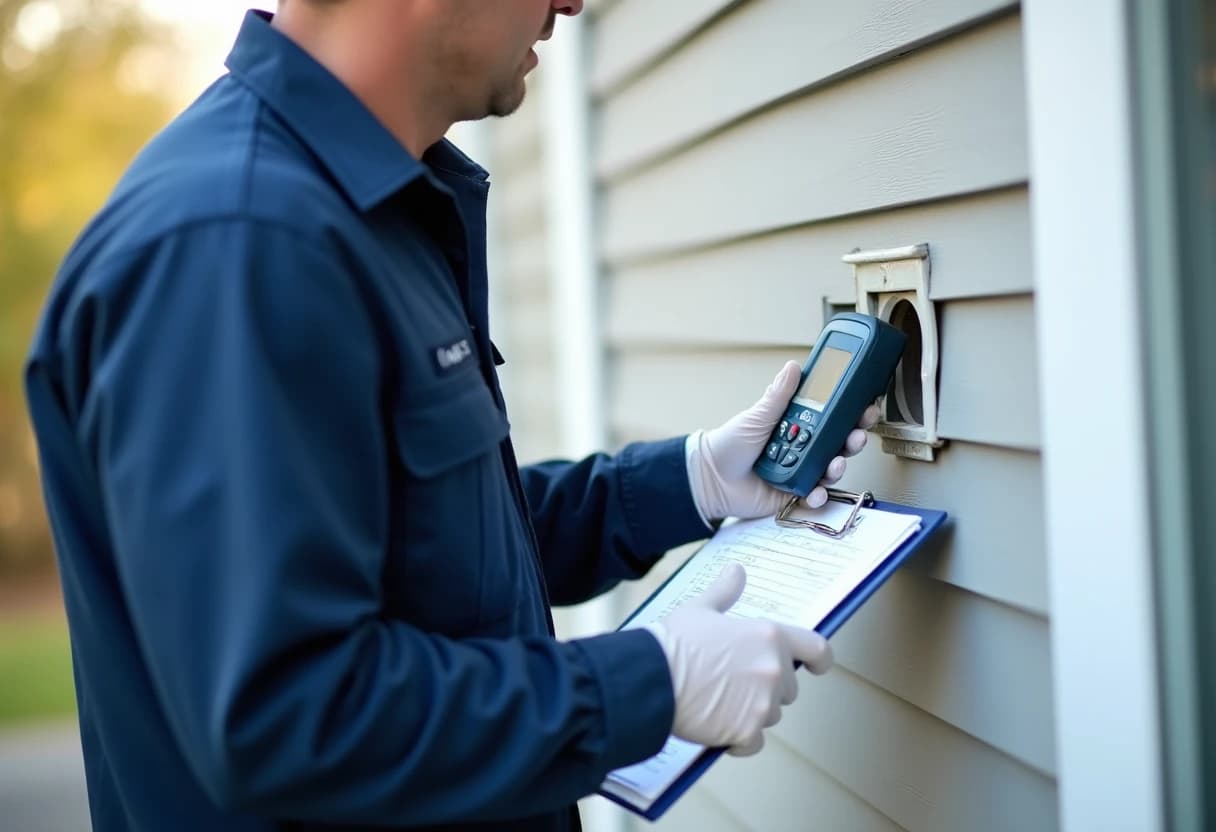
Think of a dryer vent inspection as an annual physical for the hardest-working exhaust duct in your house. In one visit, our South Boston technician verifies four things: that air is actually moving at the volume a dryer requires, that the duct interior is not accumulating a dangerous lint load, that the exterior hood and damper open freely and seal properly, and that the installation follows the code rules written to prevent dryer fires — smooth metal duct, legal length, proper joints. Most inspections take under an hour. Many end with good news; the rest catch a developing hazard years before it becomes a house-fire statistic or a dead heating element.
Why Dryer Vent Inspection & Safety Check Matters for South Boston Homes
Homeowners reliably maintain what they can see and neglect what they cannot, and the dryer duct is the definition of cannot-see: it disappears behind the dryer into a wall and emerges somewhere outside, sometimes two or three stories up. Between those points, anything may be happening — lint packing at a crushed elbow, a joint pulled apart inside a ceiling and quietly venting moist air into the framing, a bird nest behind the hood, a plastic flex duct a previous owner installed decades before it was understood to be a fire hazard. An inspection replaces assumption with evidence. Our process is instrument-first: an anemometer reading at the termination establishes whether the system moves the volume of air a dryer needs, and the camera pass explains any shortfall. The findings frequently surprise owners — long-time residents discover terminations that have been painted shut, and new buyers discover the sellers' 'recently cleaned' vent was never touched. Either way, you finally know.
The South Boston climate is quietly hard on dryer terminations. Southie juts into Boston Harbor, and homes near Castle Island and the beaches live with genuine coastal conditions - salt air that corrodes vent hoods and dampness that finds any duct run passing through an unconditioned space. The neighborhood's condo conversion boom also left a generation of systems installed fast during renovations, and we regularly pull construction debris from ducts in units sold as brand new. Wind-driven rain, coastal air and freeze-thaw cycles corrode hoods and stiffen damper flaps, and by late winter we routinely find South Boston terminations that no longer open fully — or no longer close, inviting drafts and pests. South Boston's grid is filled with 19th-century brick rowhouses and wood-frame triple-deckers, a huge share of which have been gut-renovated into upscale condos over the past two decades, with new mid-rise buildings rising along West Broadway and the Dorchester Avenue corridor. Those gut rehabs almost always added central air and new ductwork, but tight rowhouse footprints force ducts through soffits and party-wall chases with plenty of bends. Roof decks and penthouse additions frequently put condensers and air handlers in salt-exposed locations. An annual inspection catches termination problems along with everything else: our checklist covers the hood, damper, exterior seal, duct interior, airflow volume, lint load and code compliance in one visit. Neighbors in Seaport District and Dorchester book us for the same annual check, which keeps our trucks in the area and appointment windows short.
Our Dryer Vent Inspection & Safety Check Process in South Boston
1Interview & Visual Assessment
First, context: your answers about drying performance and service history frame the inspection, and a walk of the laundry area frames the system. We identify the duct material, count visible elbows, locate where the run enters the structure, and note anything — crushing, kinks, tape-only joints — that already tells part of the story.
2Airflow Measurement at the Termination
The single most telling test takes two minutes: dryer on, anemometer at the hood. Exhaust volume tells us how much of the dryer's rated airflow actually survives the trip through the duct. We record the reading in your report so future inspections can track the trend — a slow year-over-year decline is the earliest possible warning of developing blockage.
3Full-Length Camera Inspection
The camera answers the question the airflow number raises. We feed it the full length of the duct, documenting interior condition foot by foot: where lint is packing, whether joints have pulled apart inside the wall, whether a previous installer used screws or materials the code prohibits. Nothing in the run stays hidden or hypothetical.
4Termination Hood & Damper Check
Outside, we evaluate the termination: does the damper open fully under dryer airflow and close cleanly at rest? Is the hood intact, sealed to the wall, and free of lint beards, paint-overs or screening that traps lint? A surprising share of vent failures live entirely at this last twelve inches of the system.
5Lint-Load Assessment & Fire-Risk Scoring
Not all lint findings are equal. A light, even film is normal; wet, matted accumulation at a low point signals condensation problems; heavy packing at elbows signals a duct working beyond its geometry. We grade what the camera found against how your household uses the dryer, so the recommendation matches your actual risk.
6Code-Compliance Review
We review the installation against the residential mechanical code for dryer exhaust: smooth rigid metal duct (not foil or plastic flex in concealed runs), a maximum of 35 feet equivalent length with deductions for each elbow, no screws penetrating the airstream, proper termination with a backdraft damper and no screen. Violations are photographed and explained.
7Written Safety Report & Recommendations
Everything we measured and saw goes into a written safety report delivered the same day. Pass or fail, you have proof of the vent's condition — the document buyers ask for, insurers accept and associations require. If work is warranted, the report doubles as a precise scope, so any quote you gather is comparing the same job.
Benefits of Professional Dryer Vent Inspection & Safety Check in South Boston
Protection From Moisture & Carbon Monoxide
A leaking or restricted dryer duct pushes warm, saturated air into wall cavities and framing — a slow moisture problem that shows up later as mold, peeling paint or rot. For gas dryers, exhaust integrity also governs the removal of combustion byproducts, including carbon monoxide. Inspection verifies both.
A Written Report You Can Actually Use
Every inspection creates a baseline. Next year's airflow number is compared against this year's, which turns a single snapshot into a trend line — and trend lines catch developing problems that any single visit might reasonably pass. It is the difference between a photo and a medical history.
No Unnecessary Cleanings
Fear sells a lot of dryer vent cleanings that ducts did not need. Our answer is evidence: your own duct on camera, your own airflow in numbers. When the data says clean, we quote it flat; when it says pass, you keep your money and gain a report. Either way you decide from facts.
Hidden Code Violations Exposed
Code review matters most at transactions. A non-compliant vent discovered by a buyer's inspector becomes a negotiation weapon; the same finding surfaced by your own inspection becomes a controlled, competitively priced repair. Knowing first is worth far more than the inspection fee.
Real-Estate & Insurance Documentation
Condo associations and landlords in Massachusetts are steadily adding dryer vent verification to their maintenance requirements after well-publicized multi-family lint fires. Our per-unit reports satisfy property managers and boards in one visit, with scheduling built for buildings — multiple units, one appointment block, individual documentation.
Fire Risk Caught Before It Matters
The roughly 2,900 dryer fires U.S. homes suffer each year share a common history: a restriction that built silently for years. Annual inspection breaks that pattern by catching declining airflow and accumulating lint at the measurement stage — years before the ignition stage. It is the cheapest intervention in fire prevention.
Signs Your South Boston Home Needs Dryer Vent Inspection & Safety Check
You Cannot Remember the Last Service
New homeowners inherit the previous owners' laundry habits inside their duct. Unless the sellers produced a dated inspection report, the vent's condition is unknown — and unknown is exactly the wrong state for the home's most fire-prone duct. A move-in inspection resolves it for under $150.
Recent Renovation, New Dryer or New Home
Just bought the house? Your home inspector almost certainly did not camera the dryer duct or measure its airflow — general inspections do not include it. Given that lint fires are among the most common preventable house fires, a dedicated vent inspection belongs on every new-owner checklist.
Insurance, Condo or Sale Requirements
If your carrier, condo board or property manager has asked for proof of dryer vent maintenance, that is the sign — the requirement itself. Our written report is built to satisfy exactly these requests: dated, photographed, measured and signed, delivered after a single visit.
Burning or Musty Smells During Operation
Musty smells on 'clean' laundry point to moisture lingering in the duct — often a low spot where condensation pools and lint mats into a damp plug. Beyond the odor, wet lint accumulations restrict flow badly and hide mold. The camera finds the low spot; the fix follows from there.
No Visible Exhaust at the Outside Hood
Step outside while the dryer runs: you should see the damper held open by strong airflow and feel a confident stream of warm air. A flap barely moving — or not moving at all — means severe restriction or a stuck damper, and the system needs professional attention.
The Dryer or Laundry Room Feels Hot
A dryer cabinet that is hot to the touch, or a laundry room that turns into a sauna mid-cycle, means exhaust heat is staying in the house instead of leaving through the duct. That trapped heat is the same heat that ignites lint. It warrants a measurement promptly.
Dryer Vent Inspection & Safety Check Cost in South Boston, MA
A standalone dryer vent inspection in Greater Boston runs $79 to $149, with most single-family homes landing near the middle. The variables are access and complexity: a first-floor laundry with a short run to a reachable exterior hood sits at the low end, while roof terminations, multi-story runs, stacked or hard-to-move appliances, and long concealed ducts requiring extended camera work move the price up. Multi-unit buildings are quoted per unit with volume discounts for associations and property managers booking a full building. What the fee always includes: anemometer airflow measurement, full-length camera inspection, exterior hood and damper evaluation, lint-load scoring, code-compliance review, and the written photographic report. What it never includes: pressure to buy anything. If cleaning or repair is warranted, you receive a flat-rate quote alongside the findings — and if we perform the cleaning during the same visit, the inspection fee is credited toward it, which is how most customers who need work choose to proceed.
Want the full pricing picture? See our complete Boston-area cost guide or call (617) 390-7145 for an exact flat quote for your South Boston home.
Local Knowledge: South Boston, Suffolk County
Every town's ductwork tells the story of its housing. South Boston's grid is filled with 19th-century brick rowhouses and wood-frame triple-deckers, a huge share of which have been gut-renovated into upscale condos over the past two decades, with new mid-rise buildings rising along West Broadway and the Dorchester Avenue corridor. Those gut rehabs almost always added central air and new ductwork, but tight rowhouse footprints force ducts through soffits and party-wall chases with plenty of bends. Roof decks and penthouse additions frequently put condensers and air handlers in salt-exposed locations. Southie juts into Boston Harbor, and homes near Castle Island and the beaches live with genuine coastal conditions - salt air that corrodes vent hoods and dampness that finds any duct run passing through an unconditioned space. The neighborhood's condo conversion boom also left a generation of systems installed fast during renovations, and we regularly pull construction debris from ducts in units sold as brand new. We plan South Boston jobs around those realities, from equipment selection to time on site, and it shows in the results. If you live near Dorchester Heights Monument or anywhere across South Boston's 02127 area, we have almost certainly cleaned a system like yours before — and we can tell you exactly what to expect before we arrive.
The Best Time of Year in South Boston
Humid Boston summers change what we find inside dryer ducts. Moisture-laden ambient air combines with exhaust condensation in long or cool runs — basement ducts especially — and lint that would stay loose and fluffy in dry conditions mats into dense, damp accumulations that restrict flow and occasionally host mold. Coastal and near-coastal homes add salt air to the equation, which corrodes hoods, hinge pins and damper springs measurably faster than inland exposure. A summer inspection catches both patterns, and it is also the easiest season to schedule: our calendar is lightest between June and August, which makes it the smart pick for annual-plan customers.
Why Choose Boston Air Duct Cleaners
What separates us from the coupon crowd is simple: we do the whole job, we prove it, and we charge what we quoted. Our technicians clean supplies, returns, trunks and blower compartments on every visit — never a cosmetic vent wipe. Photo documentation comes standard, pricing is flat and confirmed up front, and our trucks carry true commercial vacuum equipment, not rented shop-vacs. Based in West Newton and serving South Boston year-round, we answer our own phone at (617) 390-7145 and stand behind every cleaning with a satisfaction guarantee.
Serving South Boston and Surrounding Communities
South Boston sits in the heart of our service area, and neighboring Seaport District, Dorchester, South End, Boston, Back Bay, Quincy appointments share the same routes. That density is why our response times in this part of Suffolk County are among our fastest — and why you will see our trucks in the area week after week.