
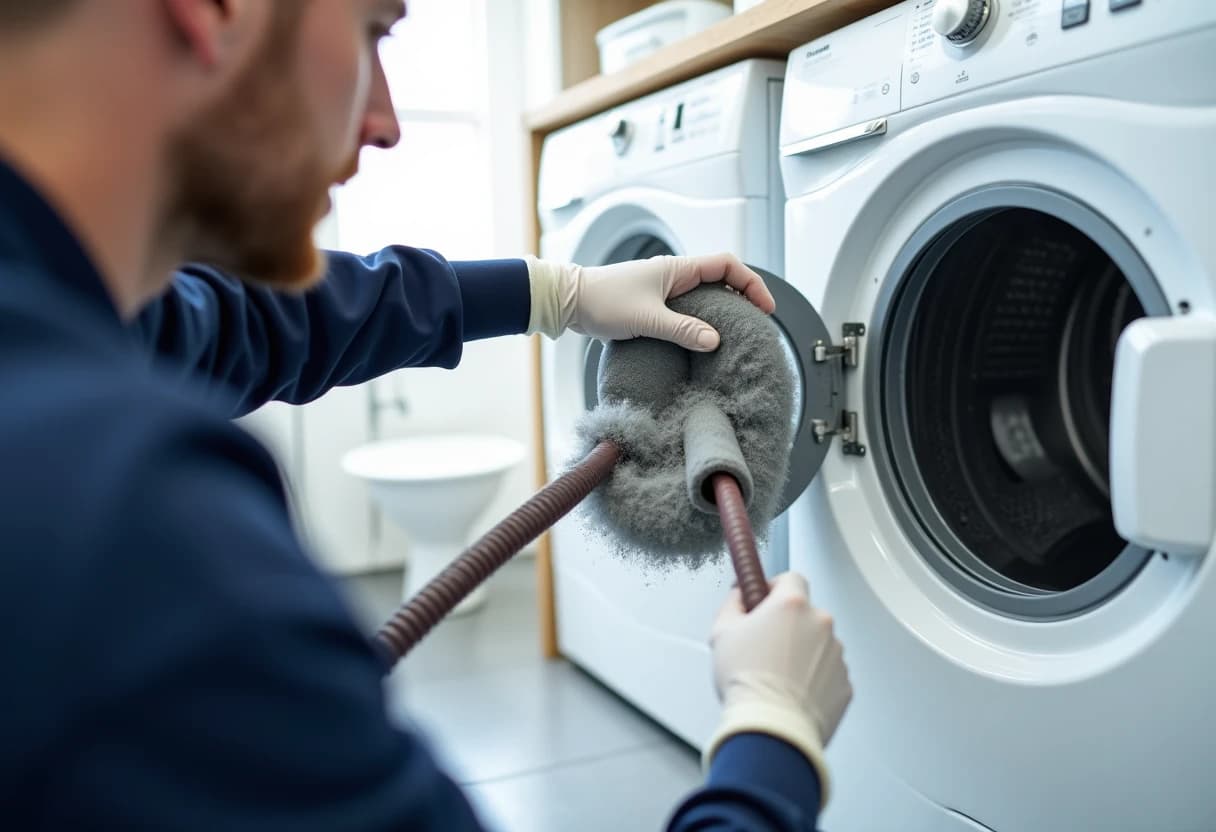
Most homeowners clean the lint screen every load and assume the job is done. But dryer manufacturers, the NFPA and the US Fire Administration all say the same thing: the vent duct itself needs professional cleaning at least once a year. Lint bypasses the screen constantly, and in Greater Boston homes — where vents commonly run twenty feet or more through basements, up wall cavities and across roofs — the accumulation happens out of sight. Our Melrose technicians use full-length rotary brushes driven through the entire run while a HEPA vacuum collects everything, then verify airflow at the termination before we leave.
Why Dryer Vent Cleaning Matters for Melrose Homes
Dryer vents fail invisibly. The duct runs through wall cavities, basement ceilings, soffits and attics — places no one looks — and lint accumulation is gradual enough that homeowners adapt to the symptoms without noticing. Loads take a little longer each year. The laundry room gets a little more humid. The exterior flap opens a little less. By the time a vent is fully blocked, it has usually been dangerously restricted for two or three years. This is why the NFPA and dryer manufacturers recommend professional cleaning at least annually rather than waiting for symptoms: the schedule catches restriction before it becomes blockage, and blockage before it becomes ignition. Greater Boston's housing stock compounds the problem — long vent runs from basement laundry rooms, multiple elbows navigating old framing, and terminations high on walls or roofs that homeowners cannot inspect. A yearly cleaning with airflow verification is the only way to actually know the state of a duct you cannot see.
In Melrose's older housing stock, we regularly find dryer vents that violate every modern guideline — vinyl flex duct sagging through a basement, screws catching lint at every joint, runs far past the 35-foot code maximum. Melrose is a showcase of intact Victorian architecture - Queen Annes, mansard-roofed Second Empires and shingled four-squares built for early rail commuters - along with two-families near the Wyoming and Cedar Park stations. Most were built for steam or gravity heat, so today's forced-air and central-AC systems are retrofits squeezed through closets and attics with narrow, high-static duct runs. These systems clog two or three times faster than a code-compliant rigid duct, which makes annual cleaning genuinely important rather than merely advisable. Melrose homeowners restore their Victorians constantly, and sanding, plaster repair and attic insulation projects leave fine renovation dust that recirculates through retrofit duct systems for years. Homes tucked against the Fells also pull in outsized loads of spring tree pollen from the reservation's forest. We clean what is there, document what we find with photos, and tell you honestly whether the duct itself needs repair or replacement — a judgment call our crews make in Melrose homes every week.
Our Dryer Vent Cleaning Process in Melrose
1Inspect the Dryer, Transition Duct & Vent Path
Every job opens with a walkthrough of the complete exhaust path. The technician checks the lint screen housing, inspects the transition hose behind the dryer, locates every accessible section of duct, and finds the termination — wall hood, soffit outlet or roof cap. Photos document the starting condition so you can compare against the finished result.
2Protect the Laundry Area & Disconnect the Dryer
Before cleaning starts, we lay floor protection, carefully slide the dryer out without scarring floors, and disconnect the transition duct. Gas dryers are handled with proper care around the flexible gas connector — we never strain it. With the duct open at the appliance end, we have the access needed to clean the entire run.
3Rotary Brush the Full Length of the Duct
We feed flexible rotary rods through the duct, adding sections until the brush has traveled the complete run from the dryer connection to the exterior hood. The rotating head dislodges packed lint, bird nesting material and debris from every interior surface, including the elbow throats where lint mats form first. Nothing is bypassed; the brush touches every foot of the line.
4Capture Everything With HEPA Vacuum Extraction
Extraction runs continuously during brushing so debris moves in one controlled direction. On long or heavily blocked runs we alternate: brush a section, extract, advance. This staged approach clears even fully plugged ducts — the ones where the exterior damper has not opened in years — without compacting the blockage deeper.
5Clean From the Exterior Termination Inward
The exterior hood gets hands-on service: damper flap cleaned and checked for free movement, cage or screen cleared (or removal recommended — screens on dryer terminations trap lint and violate most codes), and the visible duct section brushed. A damper that cannot close invites drafts and pests; one that cannot open blocks the entire system.
6Service the Transition Duct & Reconnect
The short duct connecting dryer to wall does more harm than its length suggests — crushed, kinked or made of plastic, it can choke an otherwise clean system. We clean it, or if it is damaged or made of hazardous foil or vinyl accordion material, we recommend replacement with a semi-rigid aluminum connector, usually installed on the spot for a small parts charge.
7Verify Airflow & Walk You Through the Results
We run the dryer and inspect the termination together — you should see the damper flap standing open under confident airflow, something many homeowners have literally never observed on their own vent. Your technician reviews photos, flags any code or condition issues for future attention, and records your service date for an annual reminder.
Benefits of Professional Dryer Vent Cleaning in Melrose
Less Moisture, Mildew & Musty Odor
Each load exhausts about a gallon of water as vapor. When the vent is blocked, that moisture backs into the laundry room and the duct itself — condensing on walls, peeling paint, and feeding mildew. A clear vent sends the humidity outside, drying out the laundry area and eliminating the damp, musty smell that clings to blocked systems.
Lower Energy Bills
Energy waste from blocked dryer vents is invisible on any single bill but substantial over a year — hundreds of extra kilowatt-hours or therms for a heavy-laundry household. Cleaning converts that waste back into performance. It is one of the few home services with a direct, same-month payback mechanism.
Longer Dryer Lifespan & Fewer Repairs
New dryers deserve clean vents from day one — manufacturers require adequate exhaust airflow for warranty coverage, and delivery crews almost never clean the existing duct. If you have recently replaced your dryer and skipped the vent, you have connected a new engine to a clogged tailpipe.
Documentation for Insurance, Condos & Peace of Mind
Every cleaning ends with a written record: date, scope, before-and-after photos, airflow verification and condition notes. Condo associations increasingly require proof of dryer vent maintenance, some insurers ask after claims, and home buyers appreciate the paper trail. One visit satisfies all three — and tells you exactly when the next service is due.
Safer Operation for Gas Dryers
Gas dryer exhaust carries combustion byproducts, including carbon monoxide, and the vent is the only path designed to remove them. A blocked line can force those gases back into living space. Cleaning restores the engineered exhaust path — a meaningful safety margin for any home with a gas appliance and a real necessity for homes with bedrooms near the laundry.
Dramatically Reduced Fire Risk
After cleaning, your dryer's exhaust runs cool and free, its high-temperature safety switches stop cycling, and the duct holds no fuel load waiting for a spark. For households that run daily laundry — big families, home businesses, multi-generational homes — that risk reduction compounds with every load.
Signs Your Melrose Home Needs Dryer Vent Cleaning
Lint Building Up Behind or Inside the Dryer
Lint accumulating behind the machine, around the transition hose or under the dryer means the exhaust path is leaking or backing up — lint should travel out, not settle in. It is both a symptom of restriction and a hazard in itself, since this lint sits nearest the heat source. A cleaning addresses the cause and clears the accumulation.
The Exterior Vent Flap Barely Opens
Many Melrose-area vents terminate on roofs or high walls where owners never look — which is exactly why blockages there grow uninterrupted for years. If you cannot see your termination or have never checked it, assume it needs inspection. We check and clean terminations, roof-mounted included, on every visit.
Laundry Room Gets Hot and Humid
In winter, backed-up dryer moisture migrates to the coldest nearby surfaces — window frames, exterior-wall corners, basement sills — and condenses there, feeding mold New England homes already fight. If winter condensation spikes on laundry days, your vent is contributing and a cleaning will subtract it.
Burning Smell During a Cycle
Never normalize a burning odor from a dryer. Investigators repeatedly find that households smelled scorching lint for weeks before an ignition. A cleaning visit resolves the source in about an hour and includes vacuuming the dryer's internal lint paths near the element — where the smell most often starts.
Dryer or Clothes Are Hot to the Touch
A dryer cabinet too hot to rest a hand on, or clothes that come out scorching, means exhaust heat is not leaving the machine. That heat is being absorbed by the dryer's components — and by the lint in the duct. This is the pre-ignition condition fire investigators describe; treat it as urgent, not cosmetic.
Clothes Take More Than One Cycle to Dry
Modern sensor-dry machines mask the problem by simply running longer, so watch total time rather than dampness. A sensor cycle that used to finish in 45 minutes and now runs 75 is reporting a restricted vent the only way it can. Believe it before the thermal fuse makes the point more expensively.
Dryer Vent Cleaning Cost in Melrose, MA
For budgeting across property types: single-family homes run $149 to $299 as described; condos are usually $149 to $199 unless the unit vents to the roof; and multi-family buildings get per-unit rates that drop meaningfully when we clean all units in one visit — the arrangement most triple-decker owners and condo associations choose, both for cost and for the single insurance-ready service record covering the building. Commercial laundry and shared-venting systems are quoted after a walkthrough. Frequency matters to lifetime cost too: an annual cleaning is quick and inexpensive because accumulation is light, while a vent neglected for five years often needs blockage-level work at the top of the range, and sometimes reveals damage requiring repair. The cheapest way to own a dryer vent, year over year, is to clean it on schedule — which is why we log your service date and send a reminder when the next one is due.
Want the full pricing picture? See our complete Boston-area cost guide or call (617) 390-7145 for an exact flat quote for your Melrose home.
Local Knowledge: Melrose, Middlesex County
What makes Melrose different? Melrose is a showcase of intact Victorian architecture - Queen Annes, mansard-roofed Second Empires and shingled four-squares built for early rail commuters - along with two-families near the Wyoming and Cedar Park stations. Most were built for steam or gravity heat, so today's forced-air and central-AC systems are retrofits squeezed through closets and attics with narrow, high-static duct runs. Melrose homeowners restore their Victorians constantly, and sanding, plaster repair and attic insulation projects leave fine renovation dust that recirculates through retrofit duct systems for years. Homes tucked against the Fells also pull in outsized loads of spring tree pollen from the reservation's forest. For duct and dryer vent systems, those local factors translate into specific, predictable problems — and predictable problems are the ones we solve fastest. Call (617) 390-7145, tell us your street and home style, and we will quote the job accurately the first time, usually in under five minutes.
The Best Time of Year in Melrose
Fall is the strategic season for dryer vent cleaning in Massachusetts, and not only because winter laundry is coming. Fall is when heating systems seal the house — windows shut, mechanical ventilation doing all the work — which raises the stakes on any appliance that exhausts into, rather than out of, the building envelope. A restricted or leaking dryer vent in a closed-up house pushes moisture and, for gas dryers, combustion byproducts into air that will not be refreshed until April. An October cleaning means the vent enters the closed-window months verified clear, the damper moves freely before the first freeze, and holiday-season laundry marathons run on full airflow.
Why Choose Boston Air Duct Cleaners
What separates us from the coupon crowd is simple: we do the whole job, we prove it, and we charge what we quoted. Our technicians clean supplies, returns, trunks and blower compartments on every visit — never a cosmetic vent wipe. Photo documentation comes standard, pricing is flat and confirmed up front, and our trucks carry true commercial vacuum equipment, not rented shop-vacs. Based in West Newton and serving Melrose year-round, we answer our own phone at (617) 390-7145 and stand behind every cleaning with a satisfaction guarantee.
Serving Melrose and Surrounding Communities
We serve every community around Melrose as well: Malden, Stoneham, Wakefield, Saugus, Medford, Reading all fall inside our regular service routes. If you have a second property, a rental, or family nearby, ask about multi-home scheduling — grouped appointments on the same route are our most requested discount.