
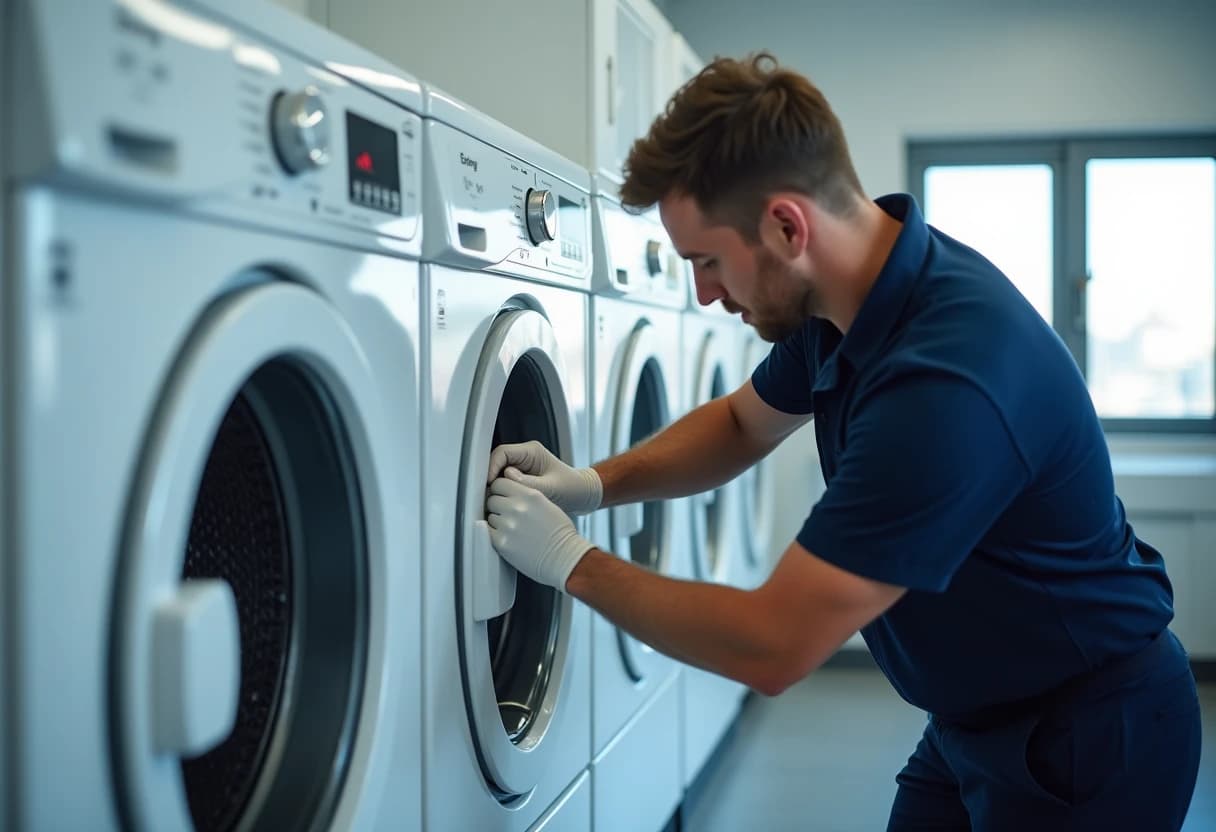
Laundromats and shared laundry rooms push dryer venting harder than any residential setting: commercial dryers cycling all day, multiple machines manifolded into common ducts, and lint production measured in pounds per week. A clogged vent in this environment does not just risk fire — it lengthens dry times, drives up gas and electric costs, trips high-limit switches and burns out machines. Our commercial dryer vent service covers Natick laundromats, coin-op rooms in apartment buildings, salons, gyms and any business that dries in volume: full mechanical cleaning of each duct run and common manifold, termination and damper service, before-and-after airflow verification, and maintenance intervals matched to your machine duty cycle rather than a generic calendar.
Why Commercial & Multi-Unit Dryer Vent Cleaning Matters for Natick Homes
Laundromats and high-duty commercial laundry face the same physics at industrial intensity. A commercial dryer cycling ten hours a day produces more lint in a week than a household machine does in a year, and that lint loads into manifolded duct systems that were often sized optimistically to begin with. The operational symptoms arrive before the fire risk peaks: dry times stretch, customers complain and leave, gas consumption climbs, high-limit switches trip, and machines cook their own components in the trapped heat. NFPA 211 and equipment manufacturers alike call for regular exhaust cleaning at commercial duty cycles — quarterly or better in busy stores, not the annual rhythm of a home. Our commercial program matches the interval to your throughput: full mechanical cleaning of each machine's run and every common trunk, termination and damper service, booster fan cleaning where installed, and airflow verification numbers before and after so you can see the recovery. Most operators find the service pays for itself in gas savings and machine uptime before the fire-safety benefit is even counted.
Multi-unit housing defines Natick, and its dryer venting shows the accumulated improvisation of decades. Natick spans everything from South Natick's antique Colonials along the Charles to dense postwar capes and ranches built for returning GIs, plus a fast-growing crop of luxury condos and apartments around the mall and West Natick commuter rail. The postwar neighborhoods are heavily retrofitted with central air riding on original 1950s ductwork, while the new multifamily buildings run compact fan-coil and shared-riser systems. Teardown-rebuild activity keeps construction dust circulating through whole streets. In buildings like these, vents were often added long after construction — routed through basements, snaked to whatever wall was nearest, extended during renovations — and many have never been professionally cleaned since installation. Natick's teardown wave means many homes sit next to active construction for months, and we constantly clear drywall and silica dust from systems near rebuild sites. Homes around Lake Cochituate also deal with elevated humidity and summer algae-season odors that get pulled into ductwork through basement returns. Our crews work Natick buildings regularly and carry what its stock demands: rotary systems for long improvised runs, ladder and roof access for upper-floor terminations, and the patience for buildings where every unit's vent tells a different story. Boards get one proposal, one project, one per-unit report.
Our Commercial & Multi-Unit Dryer Vent Cleaning Process in Natick
1Building Walkthrough & Per-Unit Proposal
We scope before we quote: unit count and layout, vent configurations and lengths, termination locations and access (ladder, lift or roof), laundry room and common-area equipment, and any known problem units. Associations receive a fixed proposal with volume per-unit pricing, a project schedule with resident notice templates, and the reporting format agreed in advance so the board knows exactly what deliverable closes the project.
2Resident Coordination & Scheduling
We treat resident experience as part of the deliverable: clear advance notices, tight arrival windows, uniformed technicians who protect floors and finish each unit in roughly 20 to 40 minutes, and a same-day completion log to management. Units we cannot access are documented — not silently skipped — and a make-up window is scheduled so the building report ends with every unit accounted for.
3Dryer-Side Service: Transition Duct & Connection
In each unit we pull the dryer, clean behind and beneath it — a major hidden lint reservoir — and service the transition duct between machine and wall. Foil accordion transitions, which manufacturers prohibit and which trap lint in every corrugation, are flagged and can be replaced on the spot with code-appropriate material. The connection is reseated and secured without airstream-penetrating screws, per code.
4Mechanical Cleaning of the Full Vent Run
Compressed-air whips and rotary brushes work the duct from the unit connection toward the termination, mechanically stripping the lint mat that blowers and leaf-blower shortcuts merely compact. Every elbow — each one worth 5 feet of equivalent length under code math, and each one a lint trap in practice — gets deliberate attention. Extracted lint is bagged per unit, which residents find quietly persuasive.
5Shared Risers, Common Trunks & Booster Fans
Stacked buildings route multiple dryers into shared vertical risers, and these common elements are where multi-unit lint risk concentrates — no resident can clean them, and every household loads them. We service risers from terminations and access points with vertical-run equipment, clean common horizontal trunks and basement manifolds, and service inline booster fans, whose blades cake with lint and quietly fail.
6Termination Service & Exterior Verification
Exterior work is where multi-unit projects earn their price: terminations three stories up that no resident has ever seen, roof caps buried under winter ice damage, wall hoods behind shrubs. Each one is cleared of lint and debris, checked for damper function so it seals when idle and opens fully under flow, and photographed for the report. Damaged or non-compliant caps are flagged with replacement pricing.
7Airflow Verification & Building Compliance Report
Each cleaned run gets a functional verification — airflow at the termination with the dryer running, or anemometer readings where equipment access allows — so the report records outcomes, not just activity. The building deliverable lists every unit: cleaned and verified, no-access, or exception, with photos of hazards and itemized repair recommendations. Boards file it; insurers accept it; renewals cite it.
Benefits of Professional Commercial & Multi-Unit Dryer Vent Cleaning in Natick
Shorter Dry Times & Lower Utility Costs
Utility waste from restricted venting is invisible but continuous, accruing on every load in every unit. Cleaning removes the restriction building-wide at once, which is why managers of buildings with house-paid gas or electric can often see the program's effect in the utility data — a rare maintenance item with a measurable meter-level return.
A Program, Not a Project
One-time cleanings decay; lint production never stops. An annual program keeps every run permanently inside its safe accumulation window, keeps documentation permanently current for insurers, and keeps the cost flat and predictable. Associations that institutionalize it typically spend less per year than their first catch-up cleaning cost — and never face a catch-up again.
Volume Pricing That Beats Unit-by-Unit Service
A single-home dryer vent cleaning in Greater Boston runs $150–$250; on a coordinated building project, per-unit pricing drops steeply — often to a fraction of retail — because mobilization, travel and setup are shared across dozens of units. The building gets professional service in every unit for less than residents could ever arrange individually.
Longer Dryer Life & Fewer Appliance Failures
Thermal fuse failures, the classic 'dryer runs but no heat' complaint, are overwhelmingly a venting symptom — the fuse did its job against trapped heat. Buildings on an annual cleaning program see this entire complaint category shrink, which residents experience as reliable machines and managers experience as a quieter work-order queue.
Hazard Discovery Before It Costs You
Cleaning puts trained eyes and cameras into duct paths nobody has seen in years, and the discoveries matter: prohibited foil accordion transitions, disconnected runs dumping humid lint-laden air into wall cavities, vents terminating in attics or soffits, screens trapping lint at caps. Each is photographed, located and priced for correction — found on your schedule instead of an incident report's.
Directly Reduced Fire Risk, Building-Wide
The comparison that matters is cost per risk retired. For a modest per-door price, an association eliminates its most preventable fire hazard for the year — one whose national loss statistics, per NFPA and FEMA, are driven precisely by the maintenance being skipped. Few line items in a reserve study buy comparable protection per dollar.
Signs Your Natick Home Needs Commercial & Multi-Unit Dryer Vent Cleaning
Dryers Taking Two or More Cycles Per Load
Extended dry times are the classic first symptom of vent restriction: moist air cannot exit, so clothes tumble in humidity until the machine times out. When this complaint appears across multiple units in a building, the shared venting is implicated — and every affected dryer is running hotter and longer than its design intends.
Insurance Questionnaires or Post-Incident Requirements
When the master-policy renewal asks 'When were dryer vents last professionally cleaned?', the underwriting message is explicit: this risk is on their radar, and undocumented buildings price accordingly. A completed building-wide cleaning with per-unit reporting answers the question directly — and answering it before renewal season is markedly cheaper than answering it after a nonrenewal notice.
Foil Accordion Ducts or Improvised Vent Runs in Units
If your association has never inspected what connects residents' dryers to the walls, assume nonconformance: transition duct is resident-installed, unregulated in practice, and frequently the worst link in the chain. Our unit visits document and correct these connections — the cheap fix that removes the most flammable segment of the entire vent path.
Lint Visible at Terminations or on the Building Exterior
Terminations that never fully close — propped open by lint mats — do double damage: they confirm heavy internal accumulation, and they hold an open door for pests, drafts and winter freeze-up. Any visible lint at an exterior outlet justifies putting a camera and a brush through that run promptly.
High-Duty Operations: Laundromats & Common Laundry Rooms
Shared laundry rooms in apartment and condo buildings combine commercial duty with residential oversight — machines run all day, but no one owns the maintenance. Booster fans cake with lint and stall, common trunks load up, and the room runs hot. If your building's laundry room fits that description, it is the building's single most overdue vent.
Burning Smells, Hot Laundry Areas or Tripped Thermal Fuses
Thermal fuses and high-limit switches exist to interrupt exactly this failure, and their tripping is diagnostic: heat had nowhere to go. Repeated no-heat service calls on building machines are the venting system burning through safety margins. Clean the exhaust paths before the next component in that chain is the lint itself.
Commercial & Multi-Unit Dryer Vent Cleaning Cost in Natick, MA
Annual program pricing is where the economics get genuinely favorable. Buildings on our recurring schedule receive locked per-unit rates, priority booking in the spring and fall rush, and lighter-touch renewal cleanings — because a vent cleaned twelve months ago needs maintenance, not excavation, and we price the difference honestly. Most associations find the steady-state annual cost per door runs 20–30% below their first catch-up cleaning, which had years of accumulation to remove. Laundromats and common laundry rooms price by machine count and duty cycle rather than by unit: figure roughly $30–$60 per machine per visit at quarterly intervals for busy stores, with common manifolds and booster fans included in scope. Operators should weigh that against the other side of the ledger — gas waste from restricted exhaust, machine downtime, and element and fuse replacements — which for high-throughput stores routinely exceeds the cleaning cost on its own.
Want the full pricing picture? See our complete Boston-area cost guide or call (617) 390-7145 for an exact flat quote for your Natick home.
Local Knowledge: Natick, Middlesex County
Serving Natick means knowing Natick. Natick spans everything from South Natick's antique Colonials along the Charles to dense postwar capes and ranches built for returning GIs, plus a fast-growing crop of luxury condos and apartments around the mall and West Natick commuter rail. The postwar neighborhoods are heavily retrofitted with central air riding on original 1950s ductwork, while the new multifamily buildings run compact fan-coil and shared-riser systems. Teardown-rebuild activity keeps construction dust circulating through whole streets. Natick's teardown wave means many homes sit next to active construction for months, and we constantly clear drywall and silica dust from systems near rebuild sites. Homes around Lake Cochituate also deal with elevated humidity and summer algae-season odors that get pulled into ductwork through basement returns. Those conditions shape how we work here: which brush heads come off the truck, how we protect finishes in older interiors, and what we expect to find when the camera goes into a 01760 duct system. Our crews are in and around Natick nearly every week — often for neighbors of past customers — so scheduling is fast and our arrival windows hold.
The Best Time of Year in Natick
Termination freeze-up is the distinctly New England failure mode. Dryer exhaust is warm and humid; when it meets a February termination, moisture condenses and freezes on the flap and hood, and a cap already propped partway open by lint accumulation becomes an ice-and-lint blockage that can seal a vent entirely. Residents notice two-cycle drying; the duct experiences trapped heat. Buildings with north-facing terminations, roof caps and long uninsulated runs through cold cavities are most vulnerable — and long cold runs also condense moisture internally, matting lint into dense plugs that only mechanical brushing removes. A pre-winter cleaning and damper service is the prevention; mid-winter, we triage frozen-vent calls across Middlesex County weekly, and the buildings calling are overwhelmingly the ones without a fall program.
Why Choose Boston Air Duct Cleaners
Choosing a duct cleaner is really a trust decision — you are letting a crew work inside the system that feeds air to your family. We make that decision easy: a local West Newton company with insured, uniformed technicians, transparent flat-rate quotes, NADCA-standard equipment and methods, and photographic proof of the finished work. No door-to-door sales, no bait-and-switch coupons, no invented 'mold emergencies.' Just honest mechanical cleaning done properly the first time, backed by a written guarantee.
Serving Natick and Surrounding Communities
We serve every community around Natick as well: Framingham, Wellesley, Sherborn, Wayland, Ashland, Dover all fall inside our regular service routes. If you have a second property, a rental, or family nearby, ask about multi-home scheduling — grouped appointments on the same route are our most requested discount.